

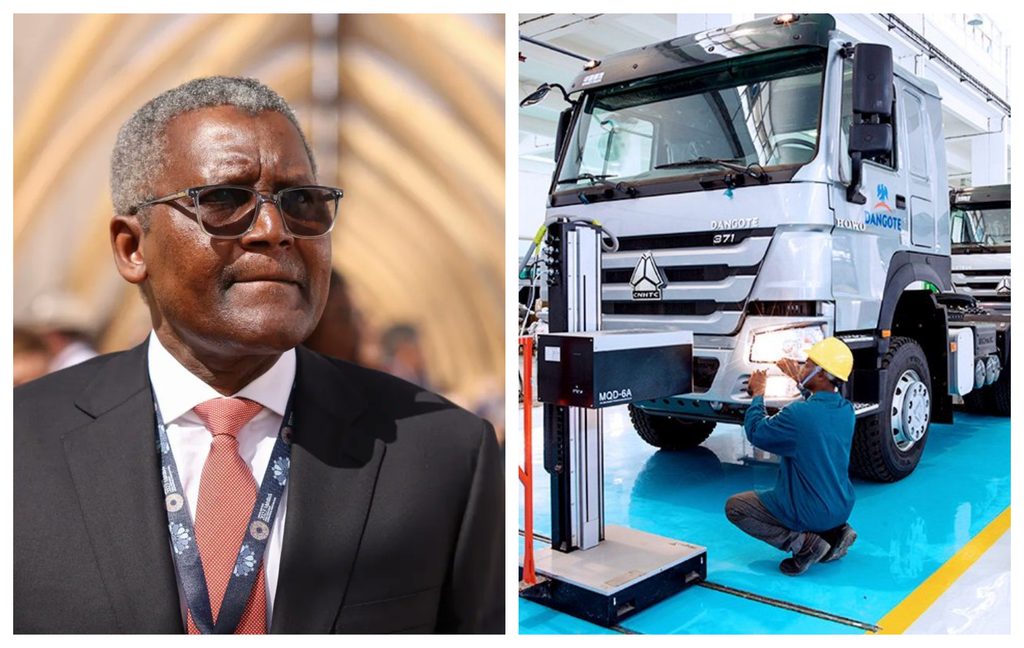
Dangote Sinotruk West Africa Limited has unveiled what it calls Nigeria’s first locally assembled electric heavy-duty trucks at its assembly facility in Ikeja, Lagos.
Senior representatives of the Dangote Group, Sinotruk Group and the Lagos State Government attended the unveiling, alongside customers, business partners and other stakeholders.
Sinotruk Group President, Liu Wei, described the vehicle as the first new-energy truck to be assembled on the African continent, a claim that has not been independently verified. The company said it signals a new era of green mobility, local manufacturing and sustainable transportation across Nigeria and West Africa.

Group Vice-President of Dangote Industries Limited, Devakumar Edwin, said the company is already preparing the infrastructure and technical support needed to deploy electric commercial vehicles in Nigeria. “So, we went into CNG technology and now we are going into electric technology,” he said.
Price, battery size, driving range and planned production volume were not disclosed.
The rollout expands the joint venture from conventional commercial vehicle assembly into new-energy mobility. The venture between the Dangote Group and China National Heavy Duty Truck Group Co. was formally set up in 2014, and its first heavy truck came off the assembly line in 2017. Liu said it has assembled more than 8,000 vehicles in Nigeria.
Nigeria’s National Automotive Industry Development Plan, 2023–2033, targets a 30 percent local EV production share and 40 percent local content. Under the Nigeria Tax Act 2025, VAT on electric vehicles and on semi-knocked-down assembly parts is zero-rated, and EV import duty was reportedly cut from 5 percent to zero under the 2026 fiscal policy measures. A bill covering EV assembly, charging infrastructure and local content passed second reading in the Senate in November 2025 and had not become law as of August.
Public charging remains limited. Reports put the number of public charging stations at fewer than 50, mostly in Lagos and Abuja. An industry analysis cited available grid capacity of 4,384 megawatts in February, about a third of installed capacity. Dealers estimate electric vehicles make up less than 1 percent of Nigeria’s vehicle fleet.
A representative of the Lagos State Commissioner for Transportation said locally assembled electric heavy-duty trucks show that Nigeria can take an active part in the global shift to cleaner transport instead of depending on imported automotive technology.
Dangote Sinotruk said it aims to make Nigeria a strategic automotive manufacturing hub for West Africa, with locally assembled vehicles serving the region’s logistics, construction, infrastructure and transport needs.
