

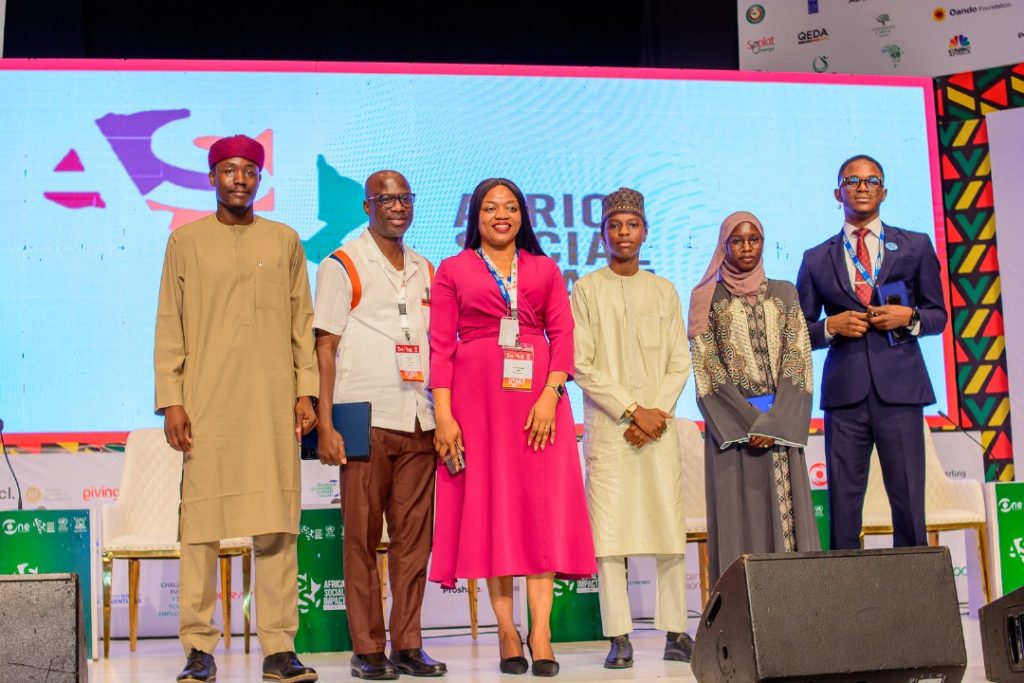
Experts across different sectors have called on corporate brands not to view Corporate Social Responsibility (CSR) as box-ticking activities, but as a vehicle for sustainable long-term solutions for communities across the country.
This call was made during a panel session titled “Centring Local Voices and Community-Led Solutions for Children and Marginalised Groups” at the just concluded Africa Social Impact Summit 2025, held at Eko Hotel and Suites.
Moderated by Jonathan Abakpa, Advocacy and Youth Programme Officer at Plan International, the panel discussion focused on the significance of involving local communities in decision-making processes to ensure that solutions are tailored to their specific needs.
The two-day event, themed “Scaling Action”, brought together a series of thought-provoking presentations around data being the foundation of AI advancement in any sector in Africa. This event was also a gathering of distinguished ambassadors from different continents, UN representatives, honourable Ministers and their representatives, distinguished development partners, captains of industries, innovators and visionaries.
The panel session, which had a majority of young people, include the following panelists Mohammed Bukar Umara, Chief Executive, Co-Development Hub; Fatima Muhammad Mafi, Girl Child Activist; Hon. Ibrahim Zanna Sunoma, Deputy Speaker at National Children’s parliament; Oladeji Olayemi, National Project Officer (Education for Health and Wellbeing UNESCO, Nigeria) and Tobi Ransomed, Education Specialist, Plan International.
While speaking on the topic, Umara emphasised the need for the private sector to stop doing CSR for communities, but with communities, so as not to just tick the box but provide sustainable solutions.
His words, “I would like to use this platform again to call on the private sector, especially as this is an event that is led by the private sector impressively, to look at something like the private sector CSR coordination platform, which is something similar to the humanitarian clusters in Waterview. To ensure that CSR are not just for ticking the box, which is basically what a lot of, I’m sorry to say, private sector companies are doing, but it’s beyond that. It’s people, it’s problems, it’s solutions, long-term solutions, that are sustainable and doable, not just solutions for the sake of ticking the box.

“You see a lot of CSR initiatives happening across Nigeria, particularly in the Northeast where I come from, but there’s still no coordinated effort to ensure that these CSR initiatives achieve the highest impact that they should. This is why we call for a private sector CSR coordination platform, just like we have in the humanitarian development sector, with clusters and sub-sectors that make sure that resources allocated for humanitarian efforts are well-coordinated, and their results are achieved at the maximum level.
“This is something that needs to happen within the private sector industry, because the private sector is one large industry that can probably solve most of the issues we have in this country, with or without aid. But to what effort, to what extent are these resources coordinated in such a way that they reach the right audience? Now, the sector must stop doing CSR for communities, but with communities, because in the end, it’s not how much is spent, but where it was spent, and with whom it was spent, and for whom.”
Ibrahim Zanna Sunoma stressed the importance of prioritising young people and amplifying the voices of local communities, particularly children and young people.
His words, “Meaningful change and participation are beyond speaking, but creating platforms to listen to the community and design long-lasting solutions to be implemented for the community. Corporate organisations should allow inclusivity to co-create a lasting solution because the youth are not useless, but are used less. What that means is, engage us, we can be useful to the conversations and create a positive impact.”
He also challenged both government and private organisations to see education, feeding & nutrition and health of a Nigerian child as a right and not a charity case.
In support of the conversation, Tobi Ransomed, Education Specialist, Plan International, who emphasised the critical role of education in promoting social impact and empowering marginalised communities, appreciated her fellow panellists for speaking vulnerably, honestly and truthfully to the room.
She said, “For us to make any headway on any issue. There is a need to be open, to share our experiences from the standpoint of finding solutions, and that is what I have been experiencing generally.
“And that is what I have been experiencing, generally in this summit. So, when we say engagement across different partners, I think the number one thing we need to start from is agreement. Agreement on what the issues are, and then agreement on what the solutions are.
“So, for example, when we look at education, we all agree that there is a rising number of out-of-school children. We agree that this is an issue, but we may contend over the numbers. Like you rightly said, if you speak to one group of people, it is a million, million.
“But we cannot stay on the contentions. Rather, agree on what needs to be done. Are there faces behind these numbers? Absolutely.”