

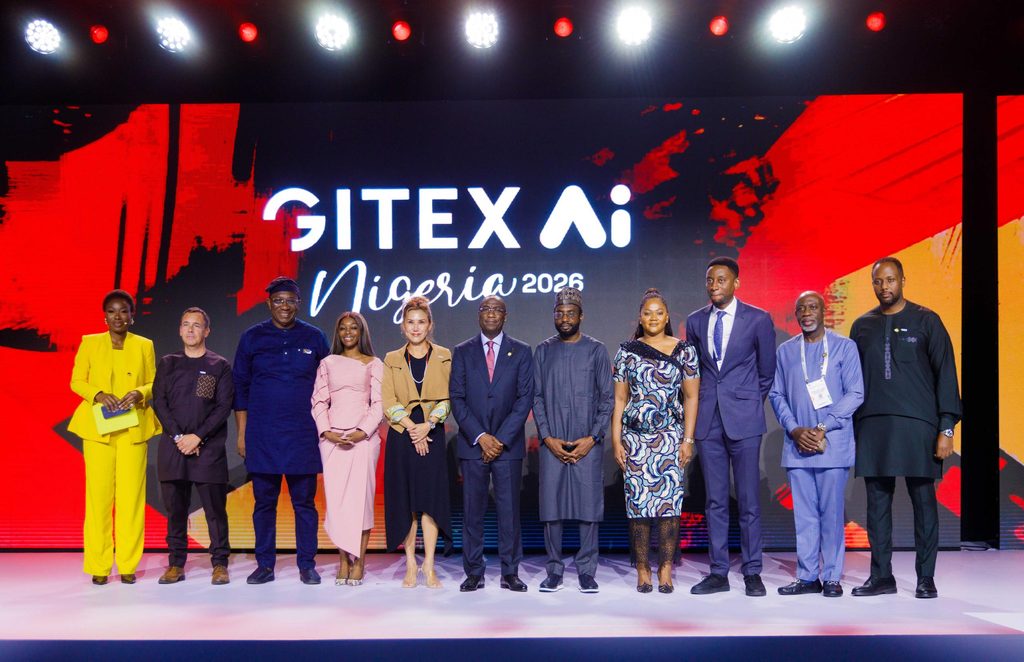
Lagos State strengthened its push to position itself as Africa’s leading innovation hub as the Lagos State Ministry of Innovation, Science and Technology (MIST), led by its Honourable commissioner, Olatunbosun Alake, took a big role at GITEX Nigeria 2026, using the two-day technology gathering to showcase the state’s growing startup ecosystem, connect innovators with investors and deepen conversations around digital transformation across Nigeria.
Held at the Landmark Centre, Victoria Island, the Lagos leg of GITEX Nigeria brought together government officials, technology companies, startups, investors and international ecosystem players as the Tech Expo, Future Economy Conference and Startup Festival provided a broad platform for conversations around the continent’s digital future. The programme followed a Welcome Dinner attended by representatives of several state governments, founders, investors and diplomatic guests.

Representing Lagos State Governor Babajide Sanwo-Olu at the opening, Deputy Governor, Dr. Kadri Obafemi Hamzat described Lagos as a “consequential city”, stressing that the decision to bring GITEX to the state reflected its growing importance within Africa’s technology landscape. He reiterated the administration’s ambition to move Lagos beyond its traditional identity as Nigeria’s commercial capital towards becoming Africa’s innovation capital, pointing to the state’s nearly 1,000 active startups as evidence of the depth of its technology ecosystem.
More than two dozen startups and technology companies, spanning artificial intelligence, fintech, cybersecurity, edtech, agritech and logistics, were visible on the exhibition floor. Among them were Sidebrief, DawnAI, RollaPay, Hyperspace Technologies, Sowota and Climatrix AI, which used the platform to engage investors, government representatives and potential international partners.

A major highlight of Lagos’ participation came on the second day with the Lagos State Employment Trust Fund (LSETF) Pitch Programme, organised in partnership with TechQuest STEM Academy and MIST. The initiative provided selected founders with an opportunity to present their businesses, solutions and growth plans directly to investors and other ecosystem stakeholders.
Beyond serving as a conventional startup showcase, the pitch programme offered a direct link between Lagos’ innovation pipeline and the capital required to scale it, allowing founders to demonstrate the problems they are solving, their products and the markets they are targeting.
MIST’s Special Adviser to the Governor on Innovation, Technology and Broadband Development, Engr. Ganiyu Oseni who is also the Chairman, Local Organising Committee (LOC), also used the gathering to make a broader case for Lagos and Nigeria to move from being consumers of imported technologies to becoming producers of solutions capable of competing across Africa and the global market.
According to Oseni, connectivity, power, digital identity and talent remain critical foundations for a functioning digital economy, while infrastructure and policy must be developed together rather than treated as separate issues. He also challenged investors to look beyond Lagos as simply a large market, urging companies to establish operational presence in the state and build, operate and grow from within the ecosystem.
The conversations extended into financial technology through FDX Nigeria by GITEX, which examined digital payments, banking, financial inclusion, digital assets and cross-border finance. The launch of MINT Africa by GITEX, a platform focused on the future of finance on the continent, further aligned with Lagos’ interest in fintech, digital assets, tokenisation and cross-border financial innovation.
Beyond GITEX itself, MIST’s convening role was also evident in the Commissioners’ Roundtable on Digital Transformation and Innovation, which Lagos hosted for the second consecutive time. The closed-door meeting brought together commissioners, directors-general and technology chiefs from Katsina, Ogun, Jigawa, Ondo, Kwara, Delta and Borno states, alongside representatives of the Nigeria Governors’ Forum and senior Lagos officials.
The Roundtable focused on the institutional, infrastructural, human-capital and policy conditions required to move digital government beyond isolated pilot projects towards sustainable, citizen-centred systems. Participants identified political will, digital literacy, standardised data, cybersecurity, strategic infrastructure, innovation-to-government pipelines, measurable digital-economy outcomes and stronger inter-state collaboration as key requirements.
For Lagos, Alake highlighted the state’s implementation policy framework, enterprise architecture and IT education, alongside efforts to standardise data, audit systems holding state information, operate an Oracle-based Applicant Resourcing Platform and maintain a fully digital payroll system.
Other states also presented their own digital initiatives and challenges, including Katsina’s Resident ID and iKatsina platform, Delta’s ICT youth training programme and digital agency, and technology delivery challenges in Kwara, while representatives from Jigawa, Ondo, Borno and Ogun outlined their respective infrastructure and digital-government gaps.