


Across Nigeria, from bustling cities to quiet rural towns, communities are striving to rise above economic hardship and rebuild the foundations of a better tomorrow. Rising inflation, dwindling opportunities, and social inequality have made daily life a battle for millions. Yet, amid these challenges, one company has emerged not merely as a business entity but as a catalyst for shared growth.
Through deliberate, people-focused initiatives, Nestlé Nigeria is redefining what corporate responsibility means, moving beyond donations to tangible empowerment, community partnerships, and sustainability programs that rebuild lives and strengthen local economies. From rural women in Ogun to dairy farmers in Paikon Kore, waste workers in Lagos, and food vendors in Bauchi, the company is helping communities not only survive but thrive.

Nestlé Nigeria’s community development strategy proves one simple truth: when people are equipped with knowledge, tools, and dignity, communities grow stronger from within.
Empowering Waste Workers, Strengthening Communities

Across Lagos and Abuja, plastic waste workers rise before sunrise to confront one of Nigeria’s most pressing environmental challenges—plastic pollution. Their work, often overlooked and underpaid, forms the backbone of Nigeria’s informal recycling system. Through its Safety, Health, and Environment (SHE) Training Program, Nestlé Nigeria is bringing transformation to this vital community of workers, ensuring that environmental progress also means human progress.
The program, supported by the National Environmental Standards and Regulations Enforcement Agency (NESREA), the Recyclers Association of Nigeria (RAN), and the Food Beverage Recycling Alliance (FBRA), has trained 100 waste workers in safe waste handling, fire prevention, emergency response, and the use of personal protective equipment.
Victoria Uwadoka, Nestlé Nigeria’s Corporate Communications, Public Affairs, and Sustainability Lead, emphasized that community development begins with respect and safety.
“At Nestlé, we are committed to building a waste-free future and recognize the crucial role plastic waste workers play in reducing pollution and facilitating a circular economy. This training enhances their quality of life while improving productivity within a sustainable waste management framework,” she said.
Professor Innocent Barikor, Director General of NESREA, commended the initiative, saying, “I commend Nestlé Nigeria Plc. for its commitment towards environmental sustainability and for prioritizing the health and safety of those at the frontline of waste management.”
For Engr. Mayowa Elefin, MD of Maladase Ecopreneur Management Company Limited, the impact is personal and communal. “This training aligns with our goal of promoting a safe, healthy, and sustainable work environment across our plastic recycling value chain. It has provided valuable knowledge that will improve productivity and workplace safety,” he said.
Through this initiative, Nestlé is not only safeguarding workers but fortifying communities that depend on waste management as a source of livelihood.
Rural Women Empowerment: Strengthening the Heart of Local Economies
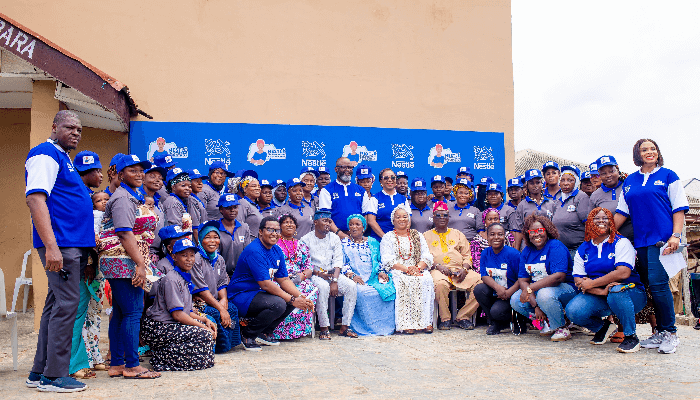
In Agbara, Ogun State, 49 women gathered in a hall buzzing with possibility—each determined to rewrite her story. They are the latest beneficiaries of “Nestlé Empowering Rural Women in Nigeria,” a community development initiative that has transformed the economic landscape of rural communities over the past five years, reaching 431 women so far.
These women, many of whom run small-scale retail shops, receive structured business training, mentorship, and support that enable them to expand their enterprises and increase income by up to 300 percent.
According to Victoria Uwadoka, “Nestlé Empowering Rural Women in Nigeria is about creating genuine opportunities for women. Supporting rural women to scale their retail operations is not only beneficial for business but essential for fostering inclusive growth, stronger families, and resilient communities.”
For Nestlé, Agbara holds deep significance—it is both a community and a home base. “We’ve witnessed the transformative impact of training and mentorship on the women who have already benefited,” Uwadoka added. “By investing in them, we’re also investing in the ripple effects that benefit entire communities.”
The program has proven that when rural women thrive, local economies flourish. They reinvest in their families, support education, and become role models of self-reliance within their communities.
Dairy Farmers: Nurturing Livelihoods, Securing Food Systems

In Paikon Kore and other dairy communities across Nigeria, local milk farmers are reclaiming their future through the Nestlé Dairy Development Project. Before 2019, smallholder dairy farmers struggled with low yields, poor veterinary access, and unstable income. Nestlé’s intervention changed that trajectory.
By providing training on modern dairy techniques, veterinary services, reliable collection infrastructure, and better water access, the project has strengthened entire farming communities.
The results are tangible: milk rejection rates have dropped from 12% to 5%, while farmers’ monthly income has risen from about ₦70,000 in 2019 to ₦250,000 in 2024. Over one million litres of milk have been aggregated through Nestlé’s supply network, and 2,000 farmers have gained new technical knowledge.
This success led to a partnership with the Federal Government, with Nestlé’s Dairy Demonstration Farm in Paikon Kore serving as a model for a national dairy training centre under the Ministry of Livestock Development.
Nestlé’s vision goes beyond milk—it’s about creating self-sufficient communities where agriculture becomes a source of dignity and generational wealth.
The company has also extended its community impact through MAGGI’s Regenerative Agriculture (RegenAg) pilot program for local soybean sourcing. The project, executed with TechnoServe and IDH, introduced sustainable techniques like minimal tillage, crop rotation, and hedgerows to improve soil health and yields.
Funmi Osineye, Category Manager for Culinary at Nestlé Nigeria, noted, “Supporting local farmers to grow soybean sustainably is central to our mission. By equipping farmers, especially women and youth, with regenerative agriculture skills, we’re improving productivity today while protecting the land for future generations.”
Through such initiatives, Nestlé is empowering farmers as agents of environmental and economic transformation within their communities
Fueling Culinary Dreams, Preserving Culture
Across Nigeria, food vendors form the pulse of local communities. They serve not just meals, but culture, connection, and livelihood. Recognizing their importance, Nestlé Professional created the “Business of Food” workshop, an initiative that has empowered over 2,600 food entrepreneurs across 11 states.
In Bauchi, 250 local vendors recently received hands-on training on menu planning, hygiene, and business management. Through this, Nestlé is helping micro-entrepreneurs grow from small street vendors into structured, sustainable food businesses.
“Our goal is to see food vendors in Nigeria not just survive but thrive,” said Ibraheem Awelenje, Business Manager at Nestlé Professional Nigeria. “By connecting them with skills, innovation, and networks, we’re helping build businesses that feed families, create jobs, and preserve our culinary heritage.”
Participants like Justina Stephen, Managing Director of Justfine Restaurants, shared how the training reshaped her business mindset, teaching her better pricing, customer engagement, and long-term planning.
Each workshop becomes a mini-laboratory for community development, where local food vendors exchange ideas, share challenges, and collectively elevate the standards of the Nigerian food industry.


A Future Built by Empowered Communities
The impact of these initiatives is deeply human. The waste worker now returns home safely, proud of his role in building a cleaner city. The rural woman who once sold only essentials now dreams of expanding her shop into a chain. The dairy farmer who once felt forgotten now trains others. And the food vendor in Bauchi cooks with renewed confidence, knowing her small business feeds both families and futures.
The promise of a better Nigeria does not rest on policies alone. It takes companies that invest in people, communities that work together, and a vision that sees empowerment as the path to progress.
From Lagos to Paikon Kore, Agbara to Bauchi, Nestlé Nigeria’s story of community development shows what is possible when sustainability is rooted in people. The company’s initiatives are not just transforming lives; they are reshaping the social and economic fabric of entire communities.
Nestlé Nigeria is building more than a business; it is building the bridges that connect hope to opportunity, people to progress, and communities to a shared tomorrow, one empowered person, one thriving village, and one strengthened nation at a time.