

Stanbic IBTC Summit: Experts Call On African Businesses To Rethink Approach To Growth, Trade, Resilience

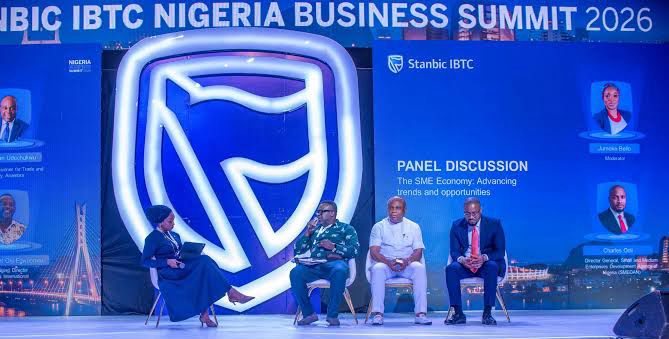
Business leaders, policymakers, and financiers across Africa have called on businesses in the continent to rethink their approach to growth, trade and resilience. emphasizing that these businesses must fundamentally rethink how they grow, trade, and stay standing when the ground shifts beneath them.

The leaders made this call in a high level panel session at the just concluded Nigeria Business Summit 2026 organised by Stanbic IBTC with the theme Nigeria Means Business: Powering Sectors, Growing Sustainable SMEs and Unlocking Global Trade.”
Muyiwa Oni, Regional Head of Equity Research for West Africa at Standard Bank, set the tone early by pushing back against one of the most stubborn habits in continental business thinking, which is the tendency to treat Africa as a single economic unit responding uniformly to the same conditions.
“Different countries go through economic cycles at different times,” he said. “For pan-African businesses, it is critical to understand the economic cycle each country is in, because that drives how you allocate resources and make investment decisions.”
His position was not simply an academic observation. For companies operating across multiple African markets, the practical implication is that a strategy built on one country’s recovery trajectory can quickly unravel in a neighbouring market still dealing with the fallout of a different crisis.
Oni urged investors and business leaders to stop treating Africa as a monolith, stressing that businesses must understand where each market sits in its cycle before committing resources. He went further to say that beyond the broad growth figures, any serious cross-border expansion plan must factor in sector-specific conditions, inflation pressures, foreign exchange dynamics, and the direction of government policy in each target market.
According to Oni, the foreign exchange point alone carries significant weight in the Nigerian context. The naira has had a turbulent few years, and the ripple effects on businesses trying to plan across borders have been real. Any business that built its projections on stable FX assumptions has had to relearn that lesson the hard way.
Among the most pointed discussions was the panel session that examined what it would genuinely take for African enterprises to convert the promise of the African Continental Free Trade Area (AfCFTA) into practical, ground-level outcomes, even as global uncertainty makes long-term planning difficult.
Folasade Aluko, Principal Manager for Business Development at NEXIM Bank, moved the conversation toward trade, and she chose her measure of Africa’s progress carefully.
“The pace of intra-African trade under AfCFTA tells us whether Africa is truly integrating its markets or still exporting raw materials to the rest of the world,” she said.
It is a clear indicator, and the numbers give context to why she chose it. Intra-African trade is forecast to grow ten percent in 2026 to around $230 billion, up from $210 billion in 2025, driven largely by accelerating AfCFTA implementation, according to a report by the African Export-Import Bank.
According to Aluko, a meaningful rise in that number would signal far more than commercial activity. It would reflect a real shift in how African economies relate to each other, the emergence of stronger regional value chains, genuine movement toward processing raw materials at home rather than shipping them abroad, and a reduced exposure to the external shocks that have repeatedly caught African markets off guard.
“This figure is really a test of Africa’s competitiveness and industrialisation,” she noted.
A persistent trade finance gap estimated at around $100 billion continues to limit the participation of small and medium-sized enterprises in regional trade, which means the challenge is not just about policy frameworks but about who actually gets to participate in the opportunities those frameworks create.
Nigeria’s Finance Minister Wale Edun, who delivered the keynote address at the summit, made the case that the country must reposition itself as an export-driven economy. “Our true potential lies in becoming a leading export economy,” he said. “Increased participation in regional and global trade will be critical to diversifying foreign exchange earnings and driving inclusive growth.”
Together, the panel made one thing clear. Resilience is not a soft concept or a buzzword for investor presentations. For African businesses navigating today’s conditions, it is a practical requirement, and building it means understanding markets more precisely, trading more within the continent, and adding more value before goods ever leave its borders.
