

Every brand has a story. The difference lies in how it is told, who tells it, and whether anyone believes it long enough to act. That is the power of storytelling: not entertainment alone, but influence, memory, and behaviour change wrapped in a human voice. A good story makes a factory in Agbara feel like a neighbour, a farmer in Kaduna feel like family, and a schoolgirl in Sagamu feel like our own child.
Neuroscience, psychology, and anthropology now confirm what our grandmothers always knew: when we hear a story, we do not merely process words; we live inside them. We feel the struggle, celebrate the breakthrough, and carry the lesson long after the figures fade. In public relations, storytelling is therefore not decoration but strategy. It humanises a brand, turning a logo into a living presence and building an emotional bond no advert can buy. People who hear how a programme changed a real life remember it, trust it and defend it.
Authenticity is the test. A genuine story, even one that admits a challenge or a slow start, resonates far more than a polished claim. It also makes a complex idea simple: show people one child, one mother, one farmer, and the change becomes clear.

Building Communities With the ‘Nestlé for Good’ Campaign
It is with this understanding that Nestlé Nigeria Plc has moved from merely doing community development to telling its story, deliberately, consistently, and through the voices of the people themselves.
The clearest expression is the ‘Nestlé for Good’ campaign, unveiled in March 2026 and set to run for nine months. It rests not on celebrity endorsements or corporate slogans but on short films about real people, from farmers and students to women entrepreneurs and families. Eniola Fausat, a retailer in Agbara, declared: “I am now more confident that I can improve my shop and better support my family. I thank Nestlé… for believing in us.” In Kaduna State, Zenab Abubakar spoke of renewed hope for business expansion, saying Nestlé’s support was vital to her household’s daily livelihood and financial stability.
These are people whose lives have been touched by Nestlé’s youth and women empowerment schemes, climate protection work, and dairy development programmes across Nigeria. The camera does not start at the head office. It starts at the farm, the market stall, the classroom, and the borehole. The story is told backwards, from impact to investment.
This is Nestlé’s Creating Shared Value model in narrative form. The principle, which has guided the company for 64 years in Nigeria, is simple: for a business to thrive, the communities around it must thrive too. Community development is therefore no afterthought or charity appendage but a business strategy, and storytelling is how that strategy is made visible, believable, and shareable.
Nestlé’s Concrete Community Impact
Victoria Uwadoka, Corporate Communications, Public Affairs and Sustainability Lead, puts it plainly: “At Nestlé, we believe our responsibility goes beyond producing quality products. We must contribute to thriving, resilient communities. That is what Creating Shared Value means to us.” In Agbara, Sagamu, and Abaji, where Nestlé’s three factories stand, that is lived experience, and the resulting stories fall into clear pillars, each a different chapter of the same book.
Educational Impact in Communities
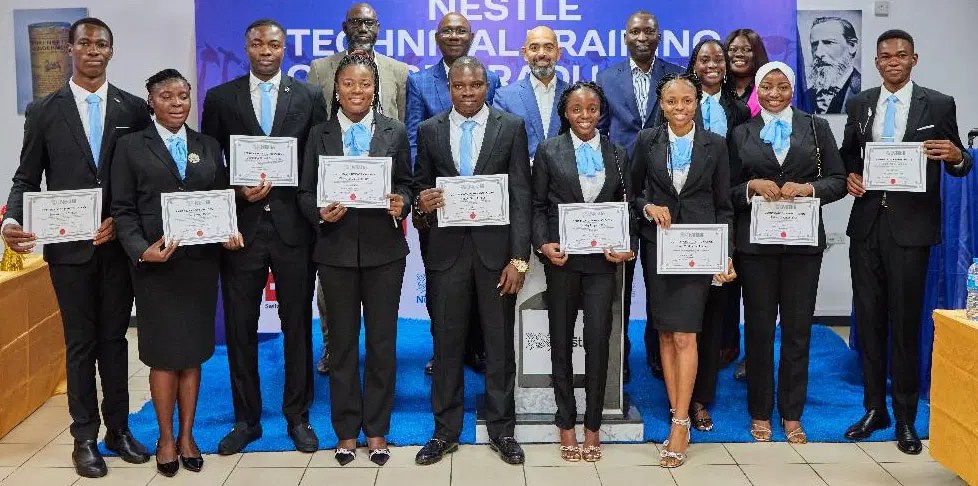
The first chapter is education, the one about the future. Nestlé’s biggest community asset is not a building or a brand but its Technical Training Centres in Agbara, Abaji and Flowergate, Sagamu. For 15 years, they have trained young Nigerians free of charge in engineering, manufacturing, and food technology, with City & Guilds of London certification. Over 309 youths have passed through, and 98 per cent were employed by Nestlé itself. Told as a statistic, it impresses; told as a story, it transforms. It is Akindele from Agbara, with no godfather but plenty of skill, walking into a job because he was trained for it. It is Toluwani, who once thought engineering was not for girls and now maintains machines in a factory that feeds a nation. The company has invested over N6 billion, but the return is measured in dignity, not naira.
The Community Scholarship Scheme, launched in 2020, carries the thread forward. More than 250 students from Agbara, Sagamu, and Abaji have won scholarships to study Science and Technology, and the 2026/2027 edition is now open. Over 70 per cent of beneficiaries graduate with First Class. Again, the story is the girl who would have dropped out, now topping her class, and the boy whose parents are traders, now studying engineering. In 2025 and 2026, Nestlé also renovated LUFASI Park Primary School in Agbara and upgraded water and sanitation facilities in public schools across its host communities. A renovated classroom may not trend, but for the child who learns in it, it is a story of being seen and valued.
Stories Around Water & Environment
Another chapter is water and the environment, where storytelling turns an invisible need into a visible change. In Agbara and Abaji, Nestlé has provided boreholes and water treatment plants for communities facing scarcity, and its Cares Clean-up and Eco-Project equips Community Development Associations for annual clean-ups. In 2024, Nestlé became the first company in Nigeria to achieve full plastic neutrality, diverting over 61,000 tonnes of plastic waste from landfills. Yet the story that stays is not the tonnage. It is the Lagos waste collector, given safety training and protective gear for the first time, who can tell his children his work matters, and Iya-Akindele in Oke-Arin, whose trading space is now cleaner and safer. Sustainability becomes local pride.
Story of Health & Nutrition
Another chapter is health and nutrition, where the story is told on the body itself. Nestlé’s yearly medical outreach in Sagamu, Agbara, and Abaji offers free consultations, drugs, eye tests, and nutritional counselling to over 5,000 community members. Through Nestlé for Healthier Kids, now in over 80 public schools, children learn healthy feeding habits and hygiene, and carry the lesson home. In 2025, Nestlé disclosed that 95 per cent of its products sold in Nigeria are now fortified to meet at least 15 per cent of the Recommended Daily Allowance. Told through a mother in Agbara who feeds her children Golden Morn every morning, fortification becomes breakfast with a purpose.
Stories of Agriculture and Livelihood in Communities
The next chapter begins in the soil. Through its Livelihoods Project, Nestlé works with over 2,000 smallholder farmers in Kaduna, Kebbi and Plateau States, training them in regenerative agriculture and linking them to markets. Improved seedlings and soil-health training have cut post-harvest losses by over 30 per cent. The work has scaled up through StreFaS, the Strengthening Farmers’ and SMEs’ Resilience through Climate Smart Grain Production initiative, launched in May 2025 with AGRA and TechnoServe to reach 25,000 farmers in Kaduna and Nasarawa over three years. Add the Dairy Demonstration Farm in Paikon-Kore, Abuja, unveiled in 2025, and an investment of over N1.8 billion in dairy development, and the story becomes a pastoral farmer learning modern dairy practice, watching his cows give more milk and his income steady.
Women Empowerment in Communities
Another emotional chapter is women empowerment. The Empowering Rural Women in Nigeria programme, now five years old, has empowered 482 women retailers across nine communities. Each receives business training, product grants worth 300 per cent of her stock, and three months of mentorship; over 80 per cent have sustained growth, many scaling by up to 300 per cent. Imagine Mma Affiong, who started with a table-top display and now owns a shop, keeps records, mentors another woman, and pays fees. She is no longer waiting for empowerment; she is practising it. Women account for about 60 per cent of Nestlé’s retail network, so empowering the retailer empowers the community economy. The Business of Food workshops have equipped over 2,000 food businesses, and the MAGGI August Meeting reaches over 8,000 women yearly in 18 South-East communities.
Youth Development in Communities
Youth development is another chapter. Through Nestlé Needs YOUth, the YEEP Entrepreneurship Summit and the MILO Basketball Championship, involving 13,000 schools, Nestlé tells young Nigerians that skill, discipline and teamwork can open doors. A basketball court becomes a classroom for life skills; a summit becomes a launchpad for an idea.
Building Partnerships for Community Development
Crucially, Nestlé does not tell these stories alone. The Nestlé Media Awards reward Nigerian journalists for reporting on business, youth empowerment, community development, and nutrition, and the independent accounts they produce carry a weight few corporate films can match. The Nestlé for Good Summit and the CSV Platform go further, giving beneficiaries the microphone to explain, in their own words, how an intervention changed their resilience. The brand steps back; the community steps forward. The Women, Words, and Wealth collaboration with the Malaika Arts Foundation helps female writers move from private expression to public authorship. That is why Nestlé’s storytelling works: it simplifies complexity through a single life, shows work in progress rather than perfection, and makes customers feel part of something larger than a purchase.
In a world of noise, where every brand is shouting, Nestlé Nigeria is doing something quieter and more enduring: letting its communities tell its story. In Agbara, where a youth gets a job without knowing anyone, a woman moves from table-top to shop owner, and a child learns in a better classroom, that story is not just public relations. It is prosperity, told from community to community, one life at a time.

