

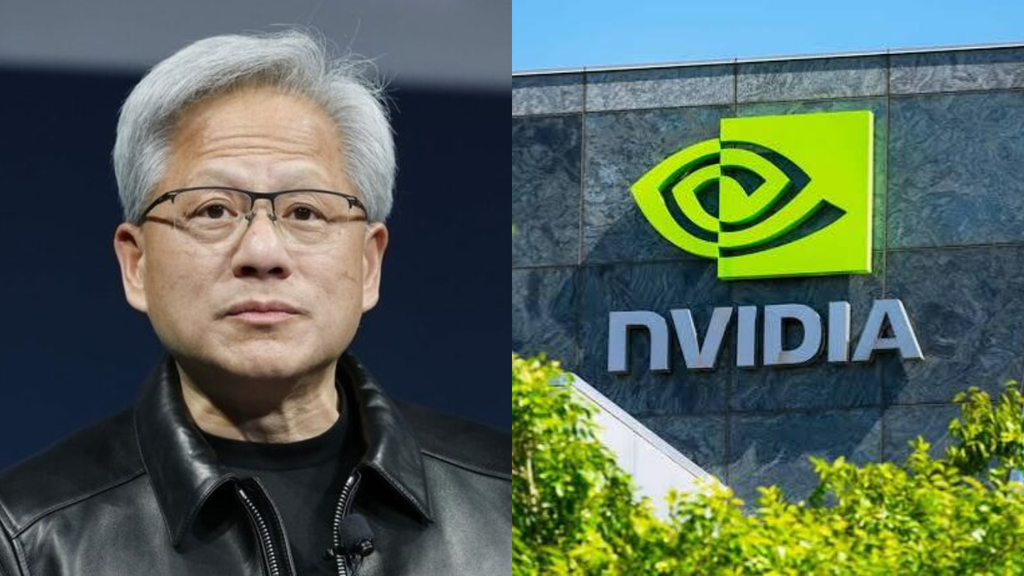
Thirty-three years after co-founding the chipmaker that powers the AI age, Jensen Huang has resigned in a week of confession, congressional pressure and spy allegations. He leaves behind an interim chief, an unfinished investigation, a family still entwined with the company, and one question no one can yet answer: Was he the target of a foreign design, or the author of his own ruin?
Empires seldom end with a thunderclap, more often, they end with a quiet meeting in a boardroom at night. So on Wednesday evening, the directors of NVIDIA gathered to decide the fate of the man who had led the company since it began in 1993. By Thursday morning, a startling news was made public. Jensen Huang had resigned as president, chief executive, and board member, effective immediately.
The announcement closed one of the most shocking weeks in modern corporate history, as only four days earlier, the board had declared its confidence in Huang. NVIDIA’s shares plunged as much as 16 percent after the news, then recovered to close 4.3 percent lower, a one-day loss of roughly $182 billion in market value. A statement was released by the company, but it contained no word from Huang himself. Chief financial officer Colette Kress was named interim chief executive, and the board opened the search for a permanent successor, internal or external.

The Week The Crown Slipped
The unpalatable unravelling began in early November, when the United States media reported that American intelligence officials allegedly suspected a woman named Alice Huang of working for Chinese intelligence. She was not biologically related to Jensen Huang, however, she was a former executive at Megaspeed, a Singapore-based data centre company that happened to be a customer of NVIDIA. Reports said she had formed a close relationship with NVIDIA’s chief executive. A wire service report stated that she had used that relationship to gain access to export-restricted chips and helped ship them to China.
On Sunday, November 8, NVIDIA’s board announced an independent investigation “in light of recent reporting” that Huang had been the target of a foreign intelligence effort. The board said it had no reason to believe national security or company secrets were compromised, and that it had confidence in Huang and his leadership team. The company hired the law firm Wachtell, Lipton, Rosen & Katz to carry out the inquiry.
No one knows what precipitated this, but the same day, Huang wrote to staff admitting he had been unfaithful to his wife, said he would cooperate, and wrote: “I am fully committed to NVIDIA and will work to earn back your confidence.”
Then the ground shifted again. On Wednesday, a major US newspaper reported a second Huang affair with an NVIDIA executive who reported to him. These reports revealed Kimberly Powell, the company’s vice-president of healthcare as Huang’s partner. These, until date, remain allegations as Huang has not publicly addressed them. Hours later, a wire service reported, citing two sources, a third relationship with another NVIDIA employee. This time, NVIDIA declined to comment on the matter, instead the board met that night. According to an insider, the company’s directors worked on their communications strategy till late that night, while the public awaited the final, official decision the next morning.
Target Or Accomplice? The Question Of Foreign Design
Strip away the human drama, and the story rests on one phrase from the board’s own statement: the target of a foreign intelligence effort. It is a carefully chosen statement that casts Huang, at least in the board’s first telling, as someone pursued rather than someone who pursued.
The suggestion is chilling. The most consequential figure in the global AI chip trade, who sits at the centre of a contest between Washington and Beijing over advanced semiconductors, was allegedly cultivated by a woman US officials concluded was likely working for Chinese intelligence. If this turns out to be true, the episode was not a mere scandal. It was a successful operation against a company whose products sit at the heart of American technological power.
That reading is the strongest case for an outside hand at work, and it carries a plain caution. No public evidence yet establishes how the relationship began, who directed it, or what, if anything, was passed on. President Donald Trump said Thursday that it is not yet clear whether Alice Huang was a spy, and that he believed her status should have been a key factor in Huang’s decision to resign. The board’s inquiries have not reported findings. Nothing in the public record points to sabotage from inside the company. The only sabotage alleged, if the word applies at all, is external and unproven.
The opposite reading is just as grave. If investigators conclude that a chief executive knowingly became entangled with someone linked to chip diversion, then he was not the target of the scheme but a participant in it, however unwittingly. Congress will press that distinction, and Huang has agreed to answer.
The Family At The Centre
Behind the boardroom drama sits a household woven into NVIDIA for years. Huang has been married to Lori Huang since 1985. They met as students, and she left the workforce to raise their two children. In 2007, the couple founded the Jen-Hsun and Lori Huang Foundation, which focuses on STEM education. Lori Huang has kept a low public profile through the week, and no public statement from her has been reported.
In his November 8 message, Huang addressed his family directly. “My actions hurt her and our children,” he wrote, and added: “I hope our family will heal and that, over time, I can earn back your trust.”
Both of the couple’s children work at NVIDIA. Madison Huang is senior director of product and technical marketing for physical AI platforms. Spencer Huang manages robotics software products. Both joined as interns, Madison in 2020 and Spencer in 2022, after careers outside the chip industry. Madison worked in luxury goods and Spencer ran a bar in Taipei. Madison’s partner, Nico Caprez, also works at the company as a vice-president. The company’s proxy filing says neither child is an executive officer, lives with their father or reports directly to him. Their combined compensation last financial year was about $2.55 million. None of this suggests they did anything wrong, and neither has been publicly named as a successor.
What The Resignation Means For Huang And NVIDIA
His connection to the company: The break is formal and nearly total. Huang no longer holds any title or board seat. NVIDIA’s release gave no reason for his departure and disclosed no terms, such as severance or equity. Reports say the company has not given him an advisory or honorary role, and the release only praised his 33 years of contributions.
What remains is ownership. He holds about 3.6 percent of NVIDIA, reportedly around 871 million shares, most of them jointly with his wife. That keeps him among the company’s largest investors. Because NVIDIA has a single class of shares, with no special founder voting rights, he has the same rights per share as any other holder. He can vote his stake, but he cannot steer the board, and the board has already shown it does not need his consent. Any future sale by a holder of that size will also be watched closely, though no such sale has been reported.
His legal ties to the company also continue. The Wachtell inquiry is still running, a shareholder suit over the affair has been filed, and Huang has agreed to testify to Congress. Leaving the company did not close any of those doors.
For his family: The reach is wider, and quieter. Their finances remain tied to the share price. A foundation tax return for 2024 reportedly showed the family’s foundation holding about 69 million NVIDIA shares with net assets of $9.1 billion. The family’s fortune now rises and falls on a company whose direction the new board will set, without the founder in the room.
Their employment is an open question. NVIDIA has announced no change to the roles of Madison, Spencer or Mr. Caprez, and their jobs were not formally linked to their father’s office. But the arrangement was long disclosed in company filings as a related-person matter, and with Huang gone, the family may face the kind of scrutiny that follows a founder’s exit.
Their lives have also moved into public view. Mr. Trump said he spoke with Huang before the resignation and described him as “going through hell,” particularly over the effect of the affairs on his wife and children. Huang’s coming testimony is expected to be recorded and transcribed, so the next chapter will unfold on the record.
Voices From The Aftermath
Senator Elizabeth Warren, who is poised to lead the Senate Banking Committee, said Huang’s resignation “does not absolve him, other executives, or the company as a whole of responsibility for putting our national security at risk.” She has urged the administration to preserve all records on the export of NVIDIA’s advanced AI chips to China.
Representative Brian Mast, who chairs the House Foreign Affairs Committee, said Huang has agreed to testify before Thanksgiving. “Jensen and I have been very at odds, as some of you already know, on export controls, but NVIDIA is a very important company to the United States of America,” he told reporters. “I don’t want to see anything hurt in NVIDIA, but he has some very serious questions to answer.” Representative John Moolenaar, who chairs the House China Select Committee, said lawmakers must hear from Huang directly and soon. Both have said they will use subpoenas if talks break down. House Speaker Mike Johnson called the resignation a “big and shocking development.” Mr. Trump called the saga a “horrible thing” and “so sad to see.”
On the corporate side, University of Colorado law professor Ann Lipton said the board must now “move swiftly” to present a succession plan, no easy task given Huang’s former central position in the company. Jeremiah Buckley of Janus Henderson called the exit a “clearing event” that could help the shares. Analysts at Bernstein were bleaker, summing up Huang’s fall as “first with a bang, then a whimper,” and downgrading the stock.
A Kingdom Without A Crown Prince
NVIDIA has long revolved around one man, and the facts bear that out. Before his exit, Huang was one of 11 directors and the board had no chair. A business publication reported that the company had no chief operating officer and that Huang had about 60 direct reports. Analysts note he was vague about succession in an interview as recently as mid-October.
The board has now filled two seats at once. Harvey Jones, 73, a director since 1993 and former chief executive of Synopsys, becomes the first-ever chairman. Kress, 59, chief financial officer since 2013 after nearly 25 years at Cisco and Microsoft, becomes interim chief while keeping her finance role. Jones said the board expects operations, customer commitments and the product roadmap to continue “without interruption.” Kress promised to build on “the extraordinary foundation Jensen created.”
Who might take the permanent chair is, for now, uncertain. Names floated by analysts include Ian Buck, who runs the data centre business, and Bryan Catanzaro, vice-president of applied deep learning. Chief technology officer Michael Kagan and chief scientist Bill Dally have also been mentioned, as well as co-founder Chris Malachowsky. A leading financial daily has floated Arm chief executive Rene Haas, a former NVIDIA executive, as another possible option.
President Trump has also entered the guessing game. In a Truth Social post on Thursday, hours after the resignation was announced, he said Huang “has done a fantastic job” and that “there is only one man to take his place,” naming Tim Cook, Apple’s former chief executive and now its executive chairman. Trump did not say whether Cook has shown any interest in the role, and reports differ on whether the remark was meant seriously. A financial news service reported on Wednesday that the board had been working with an outside firm to identify replacements. None of these names have been confirmed by NVIDIA. Kress’s dual role is the immediate worry. She now runs the company and its finances just days before NVIDIA reports quarterly earnings. For the first time, she alone will be left to present the numbers and also answer analysts’ questions about Huang’s exit, the investigation, and the search for his successor.
The Market’s Verdict
A wire service calculated that, if each day’s losses held, NVIDIA would altogether have shed about $600 billion since the board announced its investigation. Other tallies run higher, depending on where the clock count starts. While some analysts voiced relief that the uncertainty had ended, others warned that NVIDIA’s reliance on one man has now exposed this business method as a market risk.
The measure of the loss is not only financial. NVIDIA is the second-largest listed company in the world, and Jensen Huang was its brand, its salesman, its strategist and its public face. Replacing someone who played all four roles will not be a mere hiring exercise, it will involve a complete re-invention.
What Comes Next
Three clocks are now running. The first is legal. The Wachtell inquiry has no announced end date, and its findings could settle whether any secrets or national security interests were put at risk, and whether any company policy was breached. The second is political. Huang’s testimony will be watched for what he says about Alice Huang, export controls and what his colleagues knew. The third is commercial. The board must name a permanent leader while earnings, export rules and a congressional inquiry press in from three sides.
The Lesson
There is an old lesson in this new silicon story: a company can be built by a single brilliant will, but it cannot safely be left to one individual. At NVIDIA, the structure still holds because Huang owned only a single-digit share of the company and had no special voting power, so the board, not he as the founder, decided his fate.
Yet the board’s own words carry a warning for every founder-led company. A founder’s private conduct can become a shareholder matter, a diplomatic matter and, if the spy allegations prove true, a national security matter, all within a week. For now, little is settled. Huang admitted to an affair and resigned. The board is investigating. Congress waits. Everything else rests on reports, anonymous sources, and an inquiry that is yet to conclude or report.
That is the other side of a bargain NVIDIA long enjoyed. Every founder builds two things: a company and a story about himself. For thirty-three years, the two were nearly indistinguishable, and that was the company’s greatest strength. But when a company’s story is one man’s story, his unravelling becomes everyone’s problem, from the board that must steady the ship to the family still working inside it. The ball will keep rolling. The harder task now is how NVIDIA’s nifty balancing powers will guide it through this storm to safety.
