
From Global Pledge To Local Practice: How Nestlé Nigeria Is Turning Sustainability Goals Into Measurable Results

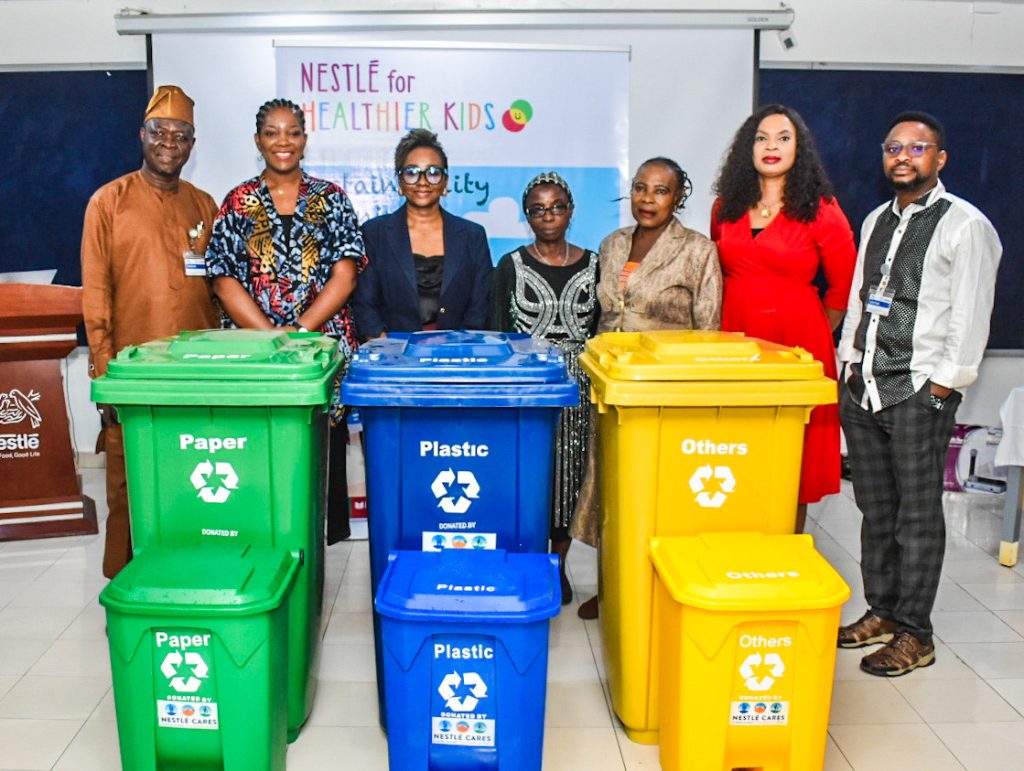
Nestlé Nigeria is translating the group’s global sustainability agenda into a local programme that combines plastic recovery, recycled packaging, water stewardship, community action and worker safety. Over the last 15 months, its most visible progress has been in packaging circularity: a reported 110% collection rate for the plastic it placed on the market in 2025, a nationwide multi-stakeholder coalition in 2026, and more than one million MILO wrappers recovered through schools.
The Global Mandate
Nestlé’s worldwide sustainability strategy rests on reducing greenhouse-gas emissions, making packaging more circular, sourcing agricultural raw materials responsibly, and protecting water resources. The company’s climate roadmap targets a 20% absolute emissions reduction by 2025 and 50% by 2030, on the path to net zero by 2050.

Globally, Nestlé reported a 24.5% net reduction in greenhouse-gas emissions against its 2018 baseline, exceeding its initial 20% target. It also reported a 28% reduction in virgin plastic use against the same baseline, while setting a new target to reduce virgin plastics by 12–17% by 2030. These commitments matter for Nigeria because packaging, water use, factory operations and waste management are the areas where a multinational’s global policy becomes visible in local communities.
Packaging As The Frontline
Packaging is Nestlé Nigeria’s most immediate environmental challenge. Its products reach consumers through bottles, sachets, wrappers and other lightweight formats that can easily escape formal waste systems, block drains, or end up in open dumps and waterways. The company’s response has therefore moved beyond one-off clean-ups towards collection systems, recycling partnerships and packaging redesign.
A central result is Nestlé Nigeria’s claim that it collected the equivalent of 110% of the plastic it placed on the market in 2025. In practical terms, the company says it supported the recovery of more plastic than it introduced into the market during that year, through partnerships with recyclers and other value-chain actors. This is an important measure of extended producer responsibility, although the full environmental value depends on whether the collected material is actually sorted, processed and recycled rather than merely gathered.
The company’s recycling partnerships have recovered more than 60,000 metric tonnes of plastic since 2019 through organisations including Chanja Datti, Wecyclers and Maladase Ecopreneurs Management Company (MECOM). That cumulative figure shows that Nestlé Nigeria has built a continuing recovery ecosystem, not simply relied on annual publicity campaigns. Its Employee Plastics Collection Scheme, introduced in 2022, has recovered more than 12,000 kilogrammes of plastic, demonstrating an internal culture of collection alongside external partnerships.
Nestlé Nigeria has also incorporated recycled polyethylene terephthalate, or rPET, into Nestlé Pure Life bottles. It reported maintaining 50% recycled PET in those bottles, a measure that reduces demand for virgin plastic in a high-volume product category. The use of rPET does not eliminate plastic, but it can shorten the material loop when collection, processing and food-grade quality standards align.
From Clean-Ups To Systems
In June 2026, Nestlé Nigeria marked seven years of environmental action by launching a multi-stakeholder coalition across 12 locations. The coalition brought together the Federal Ministry of Environment, the National Environmental Standards and Regulations Enforcement Agency (NESREA), the Lagos State Ministry of Environment, the Lagos State Waste Management Authority, recyclers, industry platforms and development partners.
The coalition’s stated purpose is to connect policy, infrastructure, community action and market-based recovery systems. That language is significant because Nigeria’s waste problem cannot be solved by corporate clean-ups alone. A manufacturer can fund recovery and redesign packaging, but municipal collection, informal waste pickers, recycling businesses and consumer behaviour all determine whether material is actually diverted from landfills and drains.
The 2026 campaign mobilised 424 volunteers across Lagos, Abuja, Agbara, Jos, Kano, Enugu, Awka, Ota, Abaji, Sagamu, Port Harcourt and Ibadan. It recovered 4,556 kilogrammes of waste: 4,507.8 kilogrammes of solid waste and 48.2 kilogrammes of recyclable waste. The company said the recovered material was channelled through appropriate recycling and disposal pathways.
Schools As Collection Points
Nestlé Nigeria has also used its MILO brand to make recycling tangible for young people. In June 2026, the MILO Elevate Recycling Initiative involved more than 60,000 pupils in 100 primary schools across Lagos State. The children collected more than one million used MILO wrappers as part of World Environment Day activities.
The programme combined environmental education with a school-based recycling competition. Pupils received instruction on responsible waste management and practical exposure to recycling and material recovery. This matters because small sachets and wrappers are among the most difficult packaging formats to recover once they are discarded individually. Schools provide an organised point where large volumes can be aggregated before entering a recovery chain.
The initiative produced a measurable output: 1,036,650 wrappers were collected and later transformed into 1,013 school items, including school bags, lunch bags and pencil cases, through a partnership with Rotaract. The upcycling component gives the programme a visible circular-economy outcome and helps children see discarded packaging as a resource rather than worthless litter.
Distribution As Recovery Infrastructure
One of Nestlé Nigeria’s more practical innovations is the use of its distribution network as a collection channel. Through its My Own Business programme, the company trains young operators and attendants who sell products including MILO, NESCAFÉ and Golden Morn from mobile businesses.
At the MYOWBU Engagement and Environmental Awareness Initiative 2.0 workshop in August 2026, environmental awareness and responsible waste disposal were incorporated into vendor training. Under the “Sell, Keep & Return” approach, pushcart operators selling sachet products are encouraged to collect used wrappers along their routes, place them in collection bags attached to the carts, take them to aggregation points and hand them to recycling companies.
This is a potentially scalable model because vendors already move through communities and interact daily with consumers. Instead of asking consumers to take packaging to a distant recycling point, the company embeds recovery into an existing commercial route.
The limitation is transparency. Public reporting has not yet provided a separate tonnage for wrappers recovered through the MYOWBU scheme, nor a measure of participation rates or repeat collection volumes. Until those figures are published, the initiative should be viewed as a promising collection channel whose impact is still being established.
Water, Factories And Emissions
Nestlé Nigeria’s sustainability programme also extends into its manufacturing operations. At Agbara in Ogun State, the company operates a wastewater treatment facility intended to control the physical, chemical and biological characteristics of wastewater before discharge, in line with Nigerian regulatory requirements.
The company has also built a distribution centre within the Agbara factory. According to Nestlé, this reduces transport-related pollution associated with moving raw materials and finished products between the factory and a former distribution centre in Ota. In a country where logistics congestion, fuel use and road emissions are material concerns, locating distribution closer to production can reduce unnecessary movement.
At Abaji in the Federal Capital Territory, Nestlé Nigeria has identified operational water efficiency and waste reduction as areas of progress. It describes the facility as one of the most water-efficient operations in its region and has committed to the Alliance for Water Stewardship standard, which promotes responsible water management and engagement with surrounding watersheds.
These actions align with Nestlé’s global emphasis on water as a priority area. However, the available Nigerian disclosures do not yet provide a complete numerical account of water consumed per unit of production, wastewater treated, water reused, or compliance performance over time. Without those indicators, it is difficult to quantify how much the measures have improved environmental outcomes.
Protecting Waste Workers
Nestlé Nigeria’s approach also recognises that recycling depends on people who collect, sort and handle waste. In July 2025, the company announced a safety, health and environmental training programme for 100 plastic waste workers in Lagos and Abuja, supported by NESREA, the Recyclers Association of Nigeria and the Food and Beverage Recycling Alliance.
The training covered occupational health and safety, responsible handling of recyclable materials, fire prevention and the use of personal protective equipment. Nestlé said participants would receive protective equipment to support safer working conditions.
This is an often-overlooked part of sustainability. Waste workers help move materials from streets, dumpsites and collection points into recycling systems, but they can face cuts, exposure to hazardous materials and unsafe conditions. Training and protective equipment do not solve every structural problem in the informal waste economy, but they acknowledge that environmental progress must not come at the expense of the people doing the recovery work.
Route To Improvement
The last 15 months show a clear shift in Nestlé Nigeria’s environmental approach. The company is no longer presenting sustainability only as factory compliance or annual clean-up campaigns. It is building recovery channels through schools, employees, vendors, recyclers, regulators and community organisations.
A Promising Local Model
Nestlé Nigeria is following the direction of its global sustainability agenda, but it is doing so through a distinctly Nigerian implementation model: partnerships with recyclers, schools, regulators, waste workers and informal vendors. Its work on packaging recovery is the clearest evidence of progress, while its water, wastewater and emissions disclosures remain less quantified.
The company’s central challenge is to convert visible activity into durable environmental performance. If collection volumes continue to rise, recycled content expands beyond Nestlé Pure Life, vendor-based recovery is measured, and factory emissions and water use are disclosed with comparable annual data, Nestlé Nigeria could become a stronger example of how a multinational can localise global sustainability goals. For now, its last 15 months show meaningful momentum: less reliance on one-off campaigns, more emphasis on shared responsibility, and a growing attempt to keep packaging in use rather than allowing it to become pollution.
