
WPRF 2026: Trust, Transparency, High Cost Of Misinformation Dominate High-Level Business Communication Panel

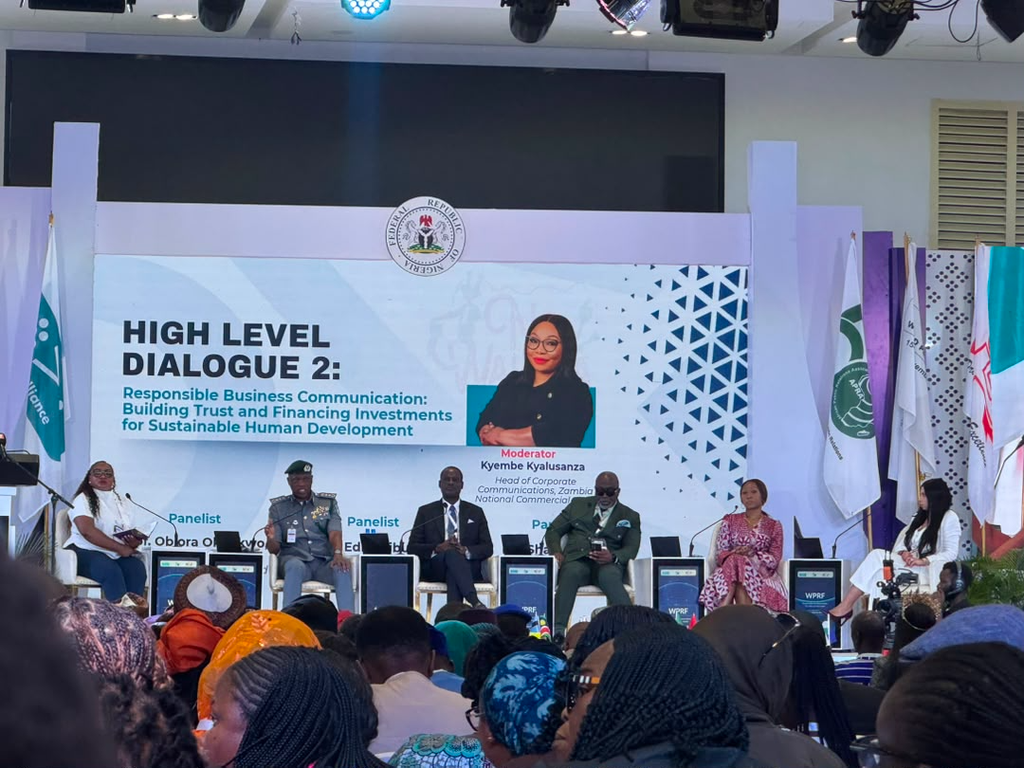
The High-Level Dialogue on “Responsible Business Communication: Building Trust and Financing Investments for Sustainable Human Development” at the 2026 World Public Relations Forum (WPRF) delivered one of the most important conversations of the week, as a panel boasting of a finance minister, development finance leader, aviation top brass, and a head of customs dissected the relationship between transparency, trust, and the flow of capital into Africa.
The session, which followed a keynote address by Mr. Taiwo Oyedele, Nigeria’s Minister of Finance and Coordinating Minister of the Economy, was moderated by Patience Chisanga-Mayer, a corporate communication expert based in Germany. The panel featured Ms. Sharon Ezzeldin, Founder of Honor Public Relations, United Kingdom; Prof. Obiora Okonkwo, OFR, Chairman and CEO of United Nigeria Airlines; Ms. Edith Jibunoh, Director of External Affairs at the World Bank Group; and Dr. Bashir Adewale Adeniyi, MFR, Comptroller-General of the Nigeria Customs Service and Chair of the World Customs Organisation.
Transparency in Development Finance
Sharon Ezzeldin opened the panel by drawing on her experience supporting government institutions across the Middle East and Africa, particularly in Egypt. She highlighted the NWFE project which is a landmark initiative focused on food, energy, and water as a case study in how responsible communication can unlock development finance.

“We worked with various development finance organizations, working through the Ministry of Planning, Economic Development, and International Cooperation. We had 36 projects across $9 billion,” Ezzeldin explained. The project involved bringing international finance organizations together with various Egyptian ministries like Irrigation, Energy, and others to match finance to key projects. Once that was achieved, the team was able to work with farmers in the Nile Valley, map their needs against available financing, and support the transparency of results.
Truth As The Best PR Strategy
Prof. Obiora Okonkwo of United Airlines brought a refreshingly candid perspective from the private sector, particularly the aviation industry, where he noted that responsible communication must be accompanied by service delivery. “Unlike the CG Customs has said earlier, and even the Honourable Minister of Finance, it doesn’t just take communication to get it right. It must have to come with service delivery,” Okonkwo said.
He shared that a passenger had written to him vowing never to fly United Nigeria Airlines again. When Okonkwo asked why, the passenger replied: “Because they left on time.” The airline had advertised a departure time of 11:30 am but departed at 11:20 am. “As the head of the communication and as the chairman, I was actually worried on how to respond. I wanted to get angry, I wanted to shout back at him, but again, my experience being a member of this forum and institution came to play, and I simply sent him a message: ‘I apologize for United Nigeria leaving on time.’ He never got back to me again.”
He also recounted an incident in which a dispatcher mistakenly wrote the code for Asaba (ABB) instead of Abuja (ABV) on a flight plan. The aircraft took off from Lagos and landed in Asaba, where the cabin crew announced, “Welcome to Abuja.” The pilot explained the mistake, but the airline’s communication team, in an attempt to protect the company’s reputation, issued a statement claiming the aircraft diverted to Asaba because of bad weather in Abuja. “That’s just a lie. It was not there. And actually, that took all over the whole airways because the weather was as good as just anything you can imagine,” Okonkwo said. The incident went viral globally, becoming the subject of satire and ridicule.
“I really think that if a little bit of verification was done, and if the truth was told, it probably would have put us in a better position and saved us some problem,” Okonkwo concluded. “I am a big believer of saying the truth, no matter how hard that is.”
The Test Is Not Just Listening, But Making Transparent What You Heard
Edith Jibunoh of the World Bank Group took the conversation further by outlining the institution’s Country Partnership Frameworks (CPF), which she described as a contract between the World Bank and the client country that sets out investment priorities over a period of time. The CPF process, she explained, begins in collaboration with governments to define sectors of investment, and then involves consultations with communities and stakeholders.
But Jibunoh argued that listening is only the beginning. “The test is not just listening. The test is making transparent what you heard, and then the further test is actually showing people what you’ve done with what you heard,” she said. “That’s the cycle, that’s the contract, in my view, between institutions like ours and the people, between the governments that we work with and the people.”
She acknowledged the bravery required to be transparent when things go wrong, noting that the World Bank frequently faces situations where subcontractors fail to comply with regulations and policies. “We have a reputation to uphold, but we also have a commitment to uphold to the people that we contracted with, to share information when things go wrong and to make sure that it’s clear what we’re going to do about it,” Jibunoh said. “Usually, civil society wants to completely kill us when these things happen, right? When things go wrong and you reveal the information, but I think there’s a bravery in being able to say, ‘We shared this information as committed to. We are now going to tell you what exactly we’re going to do about it, and we seek your help.'”
The $500 Billion Cost of Narrative Misinformation
Mr. Taiwo Oyedele, Nigeria’s Minister of Finance and Coordinating Minister of the Economy framed transparency as the foundation of investment attraction and economic development. He began with an analogy drawn from Okonkwo’s aviation anecdote: “Sometimes building trust requires that you be on time, not earlier and not later. And if you go earlier than you communicated previously, you must explain.”
He noted that some departments under the Ministry of Finance sometimes plan to generate revenue of 10 billion naira but end up generating 12 billion, with no explanation. “That’s not good enough, because I need to know whether your 10 was too conservative, maybe it should have been 15. I also need to know whether this extra two is sustainable, or whether it’s a one-off. So, we must always explain in a transparent manner.”
Oyedele then made a profound observation about the weight of responsibility borne by communicators. “Those of us in public service, we hold the resources of the people in trust and therefore we must be accountable. Guess what? Communicators hold people’s emotions, their careers, their livelihoods, sometimes their lives in trust with very little or no accountability.”
He illustrated this with a report had been circulating about Nigerians undertaking dangerous journeys through Libya to Europe, many of whom do not survive because they were told “anywhere but Nigeria is paradise.” He then referenced the misinformation that surrounded Nigeria’s recent tax reforms, when rumours spread that small businesses’ bank accounts would be debited automatically from the effective date of the new tax laws. “Some people were running to the bank to close their accounts. They were actually scared. Fast forward 10 months after, no account has been debited. When we ask those small businesses, every single one of them heard about their account to be debited. Many of them did not hear that they have been exempted. Those people who carry this misinformation, they still have it on their timelines, zero accountability,” he said.
“As we speak today, Nigeria, and Africa, and the rest of the developing world pay a prejudice premium, a narrative cost, a stereotyped tax, combined, on-target estimated that it’s about $500 billion a year, including billions of dollars we pay in Nigeria for this narrative cost.”
He added: “We must hold public servants to account. We must hold ourselves to the same level of accountability, because it matters. The same level of transparency that we expect from the public sector is what we must provide in the private sector and in the general population. That is the way we can attract investment, keep those investments, and ensure that the cost of capital is affordable.”
Trust as the Currency of Trade Facilitation
Dr. Bashir Adewale Adeniyi, Comptroller-General of the Nigeria Customs Service and Chair of the World Customs Organisation, brought the conversation full circle by emphasizing that trust is the essential element in modern customs administration. He explained that since the events of 2011, which threatened the international trading community, the global customs community has developed tools like the SAFE Framework of Standards to make international trade safe while maintaining speed and control.
“The most popular amongst them is what we call the SAFE Framework of Standards. It allows us to eat our cake and have it,” Adeniyi said. He highlighted the Authorized Economic Operator programme, which is based on trust, identifying businesses that respect the rules and ensuring they do not receive the same treatment as those who break them. “So the essential elements are still the same: it is a matter of trust. We’re building trust with the people and putting in place a reward system that rewards compliance.”
Adeniyi noted that customs communication is designed to amplify both sanctions for non-compliance and rewards for compliance, in the form of faster clearance times. His message was clear: trust is not just a soft virtue but a hard economic asset that facilitates trade, reduces friction, and rewards those who play by the rules.
A Unified Call for Truthful, Accountable Communication
As the session drew to a close, each panelist was asked to offer final reflections. Sharon Ezzeldin argued that businesses must communicate their failures as well as their successes, noting that it has taken Egypt nearly a decade to build credibility and trust among the international community. Edith Jibunoh called for separating perceived risk from real risk, arguing that the gap between the two is usually information, and that credible data is essential to responsible communication. Prof. Okonkwo reiterated his belief that the truth, told responsibly, is always the best strategy.
But it was Oyedele who delivered the most memorable closing statement, one that will likely echo through the corridors of the WPRF for days to come. “It is not enough for you to say the truth and say it well,” he told the communicators in the room. “When you see misinformation, you also have an obligation to call it out. When you are silent, evil will prevail because good people keep quiet.”