

Airtel Nigeria has revealed that it is tightening its grip on Northern Nigeria and using that advantage to power a broader national strategy focused on speed, scale and service quality.
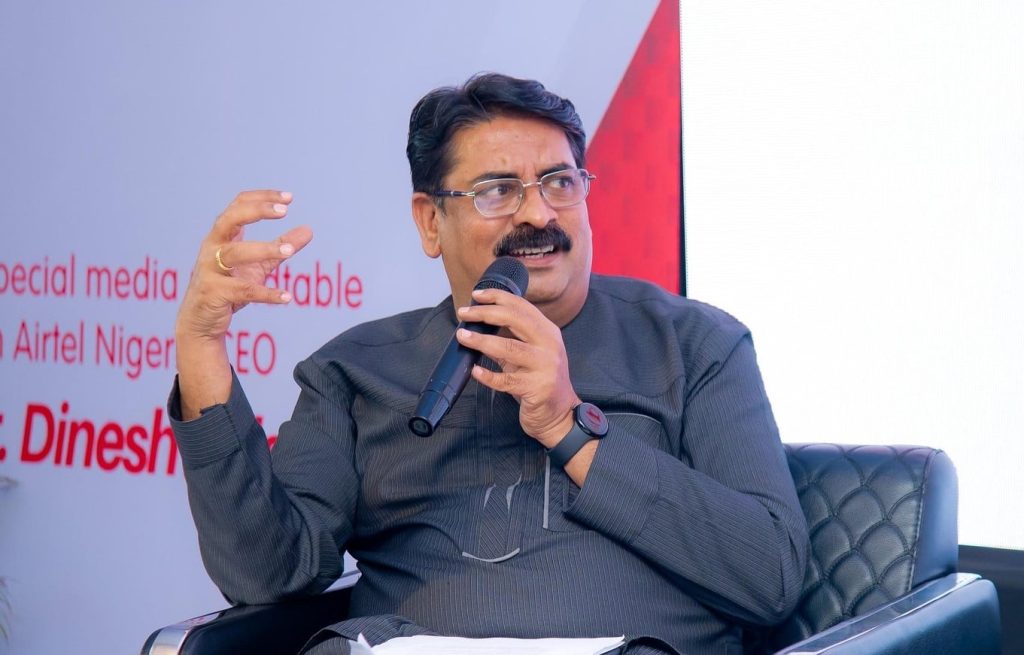
The telecoms operator revealed this at a media roundtable with senior editors and industry correspondents in Ikeja, Lagos, recently. The company outlined an ambitious next phase of expansion: more sites, greater capacity, enhanced redundancy and a deliberate shift toward cleaner energy.
Responding to questions about regional spread, Chief Executive Officer Dinesh Balsingh confirmed what the numbers already suggest: Airtel’s dominance is most pronounced in Northern Nigeria, particularly in remote and underserved communities.
“In most regions, competition is relatively balanced,” the company said. “But in the North, especially in hard-to-reach areas, we are significantly ahead.”
That advantage is not accidental. Network deployment in remote Northern locations presents logistical, security and infrastructure challenges. Yet Airtel has leaned into those complexities, building coverage in places where connectivity has historically lagged.
The result? Wider reach, more contiguous coverage and stronger service consistency across large swathes of the region.
Airtel’s executives emphasised a critical distinction: expanding coverage is important, but optimising capacity is what truly shapes customer experience.
To that end, Airtel has built approximately 17,000 network sites nationwide, with 650 additional sites currently under construction. Once completed, the operator will be approaching the 18,000-site mark, a milestone that reflects both reach and density.
Improving network performance often means strengthening existing infrastructure rather than simply adding new towers. That includes deploying additional radios, increasing spectrum utilisation, expanding fibre capacity and upgrading network equipment to handle surging data traffic.
“If customers experience poor service in a location, the answer is not always a new site,” executives explained. “Often, it’s about increasing capacity, adding radios, strengthening fibre and optimising spectrum.”
As data consumption continues to climb across Nigeria, this more intelligent, capacity-led approach is becoming a competitive differentiator.
Currently, much of the country’s international internet traffic routes through Lagos. Airtel plans to introduce a second internet breakout point from Southern Nigeria, leveraging the 2Africa submarine cable landing in Kwa Ibo, Akwa Ibom State.

Executives described the move using a simple analogy: creating “another door” for internet traffic.
With two breakout routes, traffic no longer depends on a single entry and exit point. That reduces congestion, improves redundancy and strengthens overall resilience, benefiting customers in both the North and the South.
“Once you have another breakout, traffic does not depend on a single route,” the company said. “That improves capacity and resilience for the entire ecosystem.”
In a country where digital infrastructure is increasingly mission-critical, that redundancy could prove transformative.
Connectivity expansion is only part of Airtel’s long-term plan. Sustainability is now firmly embedded in its operating model.
The company is aggressively reducing reliance on diesel generators, which have historically powered many telecom sites across Nigeria but contribute significantly to carbon emissions.
“Our priority is to convert sites to grid power wherever possible,” Airtel said. “Once grid power becomes available, diesel consumption drops significantly and so does our carbon footprint.”
To support that transition, Airtel has deployed high-capacity lithium-ion batteries capable of delivering up to 20 hours of backup power. Solar energy is being introduced as a third layer, charging batteries and further cutting diesel dependence.
The strategy is pragmatic rather than symbolic, combining grid, battery and solar solutions to create a more reliable and environmentally responsible power mix.
“The end goal is clear,” the company stated. “Reduce diesel usage, cut emissions and adopt cleaner, sustainable energy sources across the network.”
For Balsingh, the expansion is not about short-term optics. It is about positioning Airtel for Nigeria’s accelerating digital future.
“Over the last two years, we have invested with discipline and clarity to strengthen our network nationwide,” he said. “Those investments are now translating into measurable improvements in performance, customer experience and reach, including in underserved communities.”
As mobile data demand rises and digital services expand into every sector of the economy, leadership in telecoms will increasingly depend on proactive infrastructure spending and intelligent network design.
Airtel’s northern dominance may have started as a geographic advantage. But its broader strategy, deeper capacity, smarter routing, cleaner energy and sustained capital investment signal something more ambitious.
This is no longer just about coverage maps. It is about building a network strong enough, resilient enough and sustainable enough to power Nigeria’s next digital decade.