
When A PR Pro Writes On PR: A Review Of Efe Obiomah’s Landmark Guide To Building A PR Career In Nigeria

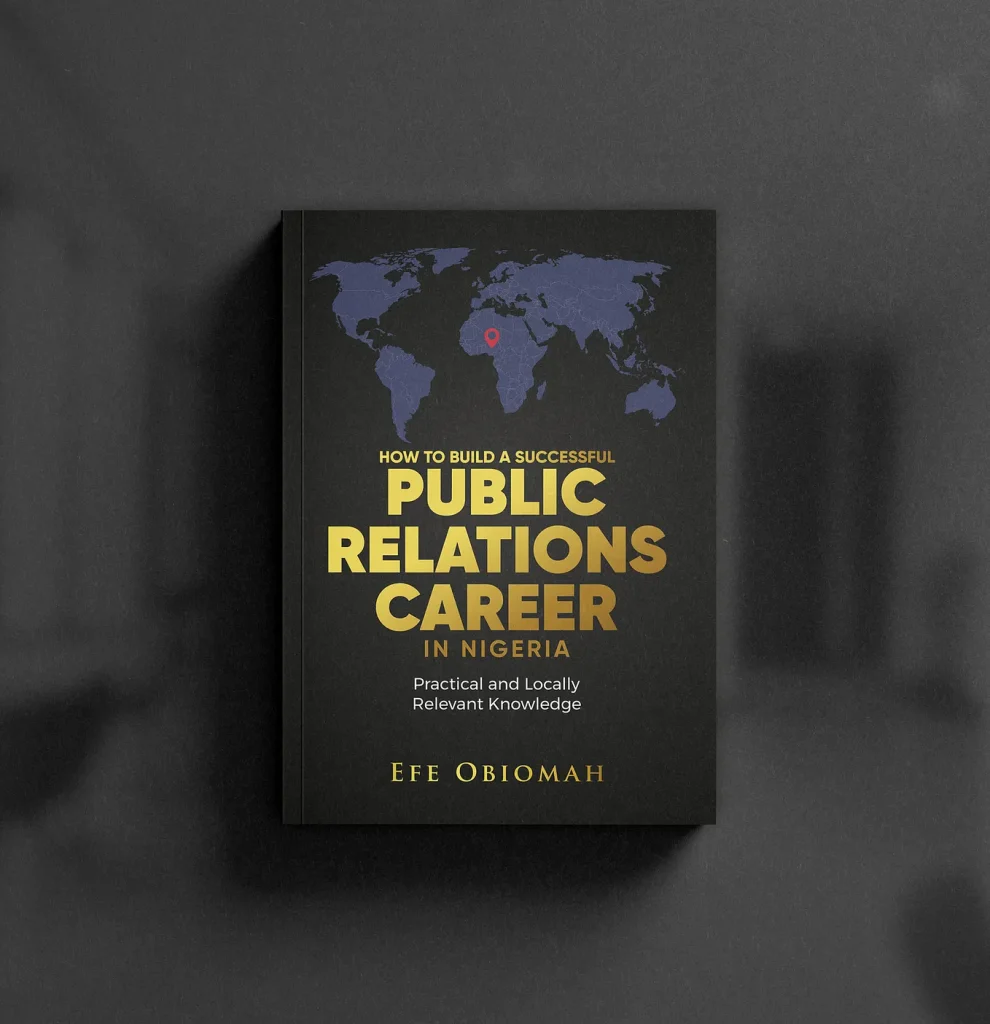
Efe Obiomah’s How to Build a Successful Public Relations Career in Nigeria a career guide that is also a declaration of professional independence. It is a locally anchored, technically rigorous corrective to decades of borrowed, ill-fitting frameworks.
I first met Efe Obiomah in a professional capacity when she was helping Kwese TV circumnavigate the complex PR terrain of the Nigerian market. That should be when the Kenyan Pay TV giant brought NBA Legend, Jerome Williams to Lagos with the late Sound Sultan and other celebrities in attendance. Even in that setting which is high-pressure, high-stakes, with the particular demands of a pan-African media brand finding its footing in a fiercely competitive landscape, she carried herself with the quiet authority of someone who had not merely studied public relations, but had metabolised it. So when news arrived that she had written a book on PR, my reaction was not surprise. It was relief. Here, finally, was someone who had both the knowledge and the credibility to say what Nigerian PR practitioners have needed to hear and read for a very long time.
How to Build a Successful Public Relations Career in Nigeria, published in February 2026, is Obiomah’s second book and her first dedicated entirely to the PR profession. Comprised of 9 carefully put together chapters, it arrives on the heels of her twentieth anniversary in the marketing and communications industry, and it carries the weight of that experience on every page. But before reviewing what the book contains, it is worth pausing on what its very existence means because the importance of this work goes beyond its content.
The Long Walk to a Local Text
For someone like me who studied Mass Communication in Nigeria roughly fifteen years ago, PR was introduced as a module within a broader curriculum. We are talking a few weeks carved out of a degree that was itself trying to cover journalism, advertising, broadcasting, communication development, development communication and media theory all at once. It was an introduction in the loosest sense of the word. You left university knowing that public relations existed, that it had something to do with managing reputation and relationships, and very little else that was directly usable in a professional context. But then, the real education happened on the job through trial, error, mentorship if you were fortunate enough to find it, and the slow accumulation of experience that nobody had thought to document.
Available books were not much help. PR practitioners of that generation reached for whatever was on the shelf, and what was on the shelf was almost entirely Western, written for the British or American market, rooted in case studies from organisations operating in regulatory, and media environments that bore minimal resemblance to Lagos, Abuja, or Port Harcourt. The most commonly circulated was Public Relations by Frank Jefkins, revised by Daniel Yadin in 1998. It was the standard text. It was also, by Obiomah’s own assessment in this book, deeply problematic, carrying, she argues, characteristics more typical of pre-colonial thinking, with generalisations and assertions that were in some cases downright misleading for an African practitioner trying to apply its lessons in an African context.
The parallel that comes to mind is literary, but it is precise. When Chinua Achebe published Things Fall Apart in 1958, he was responding directly to the distorted, colonialist depictions of Africa in Joseph Conrad’s Heart of Darkness (1899) and Joyce Cary’s Mister Johnson (1939). Beyond disagreeing with the books, Achebe wrote a counter-narrative, a story told from the inside, with the authority of someone who actually inhabited the world being described. Obiomah’s book occupies a structurally similar position in the PR literature. Not writing a response in the academic sense, she is writing the book that should have existed all along, authored by an African PR expert who lives the profession, practises it daily, and understands it not from a theoretical standpoint alone but from twenty years of earned, documented, Nigerian experience.
Chapter One: Laying the Foundation with Unusual Rigour
The book opens with what is, in effect, a definitional reckoning. Chapter One, Understanding Public Relations is the longest and most philosophically ambitious section of the work, and rightly so. Before Obiomah can build anything, she has to clear the ground. And the ground, it turns out, is considerably cluttered.
The chapter works through a series of contested questions that practitioners encounter constantly but rarely see resolved with this level of precision. Is PR about reputation or relationship management? Is it a subset of marketing? Should it be considered a mass communication specialisation or a discipline in its own right? Is it a subset of corporate communications? Each question is examined with the seriousness it deserves, drawing on a range of definitions across eras and schools of thought, before Obiomah arrives at her own considered position.
The most striking and, I would argue, most intellectually important contribution of this chapter is its flat rejection of the concept of Digital Public Relations as a distinct discipline. This is a claim that has gained traction in recent years, particularly as social media has reshaped how organisations communicate with their publics. Obiomah is unequivocal in her opinion that Digital PR does not exist as a separate field. Digital, she argues, is simply a channel in the same category as television, radio, print, and out-of-home. Just as no serious practitioner speaks of Television PR or Radio PR as independent disciplines, the prefix Digital adds nothing meaningful to the understanding of what PR is or how it works. What changes across channels is the execution. The discipline remains the same.
The proliferation of Digital PR as a job title, a service category, and a curriculum track has, in many organisations, served primarily to fragment what should be an integrated communications function, creating silos where there should be strategy. Obiomah names this problem clearly and provides the conceptual grounding to push back against it. Chapter One alone justifies the book’s existence.
Mapping the Hazards and Getting Started
Chapters Two through Four build methodically on the foundation laid in Chapter One. Chapter Two maps the functional areas and specialisations within PR, a useful taxonomy for practitioners trying to understand where their work sits within the broader discipline and where they might develop. Chapter Three takes on something that most PR texts studiously avoid: the hazards of PR practice in Nigeria specifically. Operational hazards and media-related hazards are addressed with the directness of someone who has experienced both and survived them.

Chapter Four “Getting Started in Public Relations” covers educational and professional pathways, requisite skills and attributes, and the foundational choice between in-house and consultancy practice. The inclusion of a Decision Table on Practice Attributes and Trade-offs is a particularly practical touch, the kind of structured thinking tool that Mass Communication graduates of fifteen years ago would have benefited enormously from having before they stepped into their first PR role. Most of us had to construct that framework ourselves, over years, through experience. Obiomah has saved the next generation that particular cost.
The Influence and Progression Model: A Framework Worth Studying
The centrepiece of the book’s second half, introduced in Chapter Five, is what Obiomah calls the Influence and Progression Model. Introduced under the chapter titled “Now That You Are on the Job”, alongside practical guidance on internalising organisational culture, immersing oneself in the business, and building internal relationships, the model addresses one of the most persistent frustrations of Nigerian PR professionals. That is the ever present proverbial elephant in the room, the difficulty of being taken seriously at the strategic level.
PR departments in many organisations are treated as support functions that are only useful in a crisis, decorative in the absence of one, and rarely consulted when strategy is being formed. The Influence and Progression Model provides a structured methodology for changing that dynamic from the inside. It maps the informal hierarchies, coalition-building patterns, and decision-making rhythms of corporate life, and equips practitioners with the tools to circumnavigate them deliberately. The goal is not to play politics for its own sake, but to ensure that the communications function earns and holds the strategic influence that the organisation’s reputation depends upon.

What distinguishes this framework from similar models in international PR literature is its grounding in the specific texture of Nigerian organisational culture where personal relationships, seniority, and informal authority structures often operate alongside, and sometimes in tension with, the formal hierarchy on the org chart. This is knowledge that takes years to acquire through experience. Obiomah has codified it.
Media Relations, Future Positioning, and What Comes Next
Chapter Six which is Media Relations in Nigeria is one of the most immediately practical sections of the book. The Reality About Pitching to Nigerian Journalists alone is worth the attention of every communications professional in the country. The chapter covers print, online, TV, radio, and, in a sign of Obiomah’s awareness of how the media landscape is evolving, podcast appearances. This is a notable inclusion.
Chapter Seven “Positioning Yourself for Future Opportunities” shifts from the organisational to the personal. Building a personal brand, optimising a LinkedIn profile, developing writing skills, building connections, celebrating wins, being worthy of recommendation, and thinking critically when applying for jobs are the building blocks of a sustainable PR career. The chapter is written with the directness of a mentor rather than the detachment of an academic, and it is all the more useful for it.
Chapters Eight and Nine round out the book with a forward-looking analysis of the future of PR in Nigeria where it examines the industry, the practitioner, and the media in turn, followed by a chapter on PR Myths and Nigerian Lingo, which addresses the gap between how PR is practised globally and how it is spoken about locally. This last chapter is a quietly subversive act that takes the informal knowledge that circulates among experienced practitioners… the shorthand, the assumptions, the myths, and subjects it to scrutiny. Some of it holds up. Some of it does not. Obiomah is not afraid to say which is which.
Read It, Recommend It, Debate It
Obiomah has done something that required not only knowledge and discipline but a particular kind of professional courage and willingness to commit one’s own frameworks and conclusions to paper in a field where the absence of any prior local benchmark makes the act of codification inherently exposed.
The Influence and Progression Model is a genuine contribution to Nigerian PR thinking. The debunking of Digital PR as a discipline is an argument the industry needs to have. The media relations chapter is the most practically Nigerian treatment of that subject I have encountered in print. And the book’s refusal to uncritically accept the inherited assumptions of Western PR literature places it firmly in a tradition of African intellectual self-determination that is long overdue in the communications profession.
For the aspiring practitioner entering the industry today, this book provides what my generation never had…a starting point that is grounded in the reality of PR practice. For the experienced professional, it offers a mirror, a chance to see hard-won knowledge reflected back in structured form and to test it against a framework built from comparable experience. For the educator, it is the curriculum text that should have existed a decade ago. And for the business executive who has never quite understood why his PR team is not contributing more to strategy, it is both an explanation and a provocation.
Read it. Assign it. Debate it. That process of engagement, argument, and refinement is precisely how a profession builds a body of knowledge. Efe Obiomah has given Nigeria’s PR ecosystem its opening canonical text. What we do with it is now our responsibility.
“How to Build a Successful Public Relations Career in Nigeria (Practical and Relevant Knowledge)” by Efe Obiomah. Published February 2026. Obiomah is the founder of Brand Spark and a two-time author. Her first book, The Unfettered Woman, was published in 2025.