

From Arsenal to Aston Villa, Rwanda, the small East African nation has built a $650 million tourism industry on the back of sports sponsorships — and the critics haven’t stopped it.

A Shirt, A Statement, A Strategy
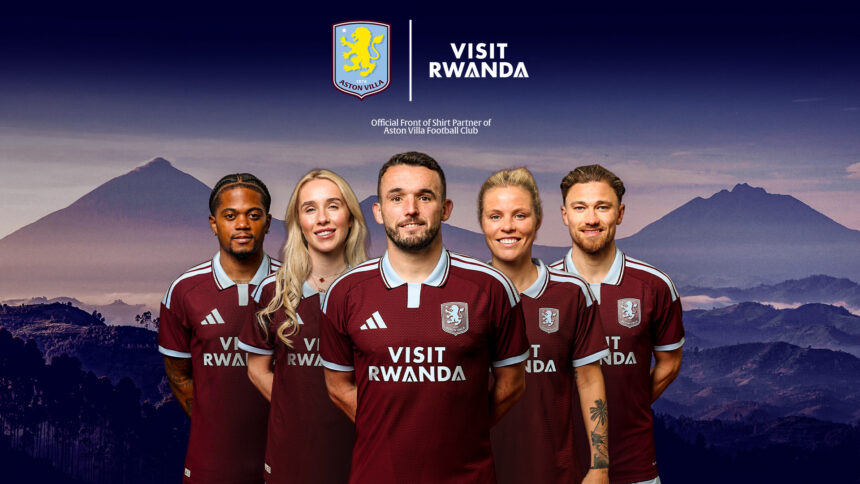
When Aston Villa takes to the pitch for the 2026/2027 Premier League season, millions of fans across the United Kingdom, Europe, and beyond will see something unusual on the club’s famous claret and blue shirts. Nestled where a betting company’s logo once sat will be two simple words: “Visit Rwanda”.

The reported $26 million-a-year deal is the most significant sponsorship in Aston Villa’s commercial history. It makes Rwanda the club’s principal partner, official tourism partner, and, in a detail that speaks volumes about the country’s ambitions, official coffee provider.
But the branding isn’t just going on the men’s team. It will appear on the shirts of the women’s and academy teams too, because for Rwanda, this isn’t just about one club. It’s about reaching everyone.
From Gunner to Villan: The Arsenal Origins
To understand why a country roughly the size of Wales or Oyo State in Nigeria is spending tens of millions of pounds on football shirts, you have to go back to 2018. That was when Rwanda first burst onto the global sports stage, becoming Arsenal’s official sleeve partner, the first African nation to ever secure such a deal.
At the time, many scoffed. How could a country still recovering from the 1994 Genocide against the Tutsi spend that much on such a deal? Wasn’t this just vanity? Eight seasons later, the numbers told a different story.
When Arsenal and the Rwanda Development Board mutually agreed to end their partnership at the close of the 2025/2026 season, the club confirmed that visitor arrivals had reached 1.3 million in 2024, with tourism revenues rising to $650 million, a 47% increase since the partnership began.
The Visit Rwanda brand appeared weekly across the Premier League, Champions League, and international broadcasts, generating billions of impressions each year. The partnership spotlighted Rwanda’s conservation successes, from mountain gorilla protection to national park regeneration, and gave hundreds of young Rwandan players access to football development clinics. The deal worked so well that Rwanda didn’t stop at Arsenal. It went global.
A Sports Sponsorship Empire
Today, Visit Rwanda’s portfolio reads like a who’s who of global sports:
– Paris Saint-Germain — Renewed through 2028, with branding appearing on the club’s jerseys during the 2025 FIFA Club World Cup
– Atlético Madrid — A three-year deal running until 2028, with branding on training kits, match jerseys, and across the Metropolitano Stadium
– Bayern Munich — An academy partnership that has helped develop young talent
– LA Clippers — Making Rwanda the first African tourism brand to sponsor an NBA team, with the Visit Rwanda logo appearing on the Clippers’ exclusive jersey patch
– LA Rams — The first African tourism brand to sponsor an NFL team
– Basketball Africa League — The league has played games at Rwanda’s BK Arena since its launch in 2021
The strategy is clear: place Rwanda inside the world’s most-watched sporting ecosystems. As one observer put it, “Some saw a logo on football shirts. Rwanda saw global distribution”.
The Results Speak for Themselves
Here’s what that global distribution has delivered :
– $685 million in tourism revenue in 2025
– 1.3 million visitors as at 2024
– Close to 386,000 jobs supported by the tourism sector
– Travel and tourism now near 10% of GDP
Rwanda’s broader economic numbers are equally impressive. In 2024, the country secured $3.2 billion in investment commitments, a 32.4% increase from the previous year. China emerged as the leading source of foreign investment, contributing $460 million.
The country was ranked first in Africa and among the top 10 globally in the World Bank’s inaugural Business Ready report.
Rwanda Development Board CEO Jean-Guy Afrika put it simply: “This partnership gives us a powerful way to bring Rwanda closer to millions of people around the world, inviting them to visit, invest, do business, and discover the energy and opportunity shaping our country.”
More Than Just Marketing
But this isn’t just about putting a logo on a shirt and hoping for the best. The sponsorships come with real investments in infrastructure and community development.
The Clippers deal includes contributions to refurbish a basketball court in Rwanda, training sessions for Rwandan youth coaches in San Diego, and coaching clinics in Rwanda. Through the PSG Academy Rwanda, more than 400 young Rwandans have received world-class football training, education, and mentorship.
Rwanda has also invested heavily in the infrastructure that tourism requires: airports, hotels, conference facilities, event venues, and airline connectivity. The country’s visa-on-arrival and e-visa policies have made it “one of Africa’s most accessible destinations,” according to the International Air Transport Association.
The Critics and the Response
The announcement of the Aston Villa deal has attracted its share of criticism, much of it tied to political tensions between Rwanda and its neighbour, the Democratic Republic of Congo.
In early 2025, the DRC government formally requested that European clubs, including Arsenal, Bayern Munich, and PSG, terminate their agreements with Visit Rwanda, citing the conflict in eastern DRC that they claim is sponsored by Rwanda.
But Rwanda’s leadership has been clear: these partnerships are about economic transformation, not politics.
The country’s message is straightforward: come and see. Come and experience the landscapes, the conservation, the hospitality, the business opportunities, and the ambition.
Africa’s Branding Lesson
The broader lesson from Rwanda’s strategy is one that many African countries have yet to learn: the world is shaped by those who tell their stories effectively.
For decades, Africa has complained about negative stereotypes, images of poverty, conflict, and helplessness dominating global perceptions. Yet when countries invest in changing that narrative, they are sometimes criticised for promoting themselves.
Rwanda’s response has been to ignore the noise and keep building.
With a target of $1 billion in tourism revenue by 2029 and a 9.4% economic growth rate in 2025, the country is betting that global attention, when backed by real investment and infrastructure, can translate into lasting economic transformation.
As Ibrahim Sagna, a strategist tracking Rwanda’s approach put it: “The logo was visible. The system behind it did the work.”
For Africa, that might be the most important lesson of all.
Can Nigeria Learn & Turn The WPRF 2026 Into a Branding Victory?
Nigeria stands at its own moment of opportunity, and it is far bigger than a football shirt.
In November 2026, Abuja will host the World Public Relations Forum (WPRF), a global gathering expected to draw delegates from 126 countries, including presidents, ministers, and top advisers to governments worldwide. The Nigerian Institute of Public Relations (NIPR), which won the hosting right for the nation, describes it as “the greatest reputation project” for the country.
Dr. Ike Neliaku, NIPR President, has been blunt about the stakes: “Having 126 countries converge in our nation to discuss peculiar issues comes with reputational value, which is biggest of it all, then professional and financial values.” The delegates, he noted, are “important individuals who advise presidents, advise governors, ministers and large corporations,” influencers whose impressions of Nigeria will ripple across global boardrooms and government houses long after the forum ends.
What should Nigeria borrow from Rwanda’s playbook to make WPRF work?
First, treat every delegate as a potential ambassador. Rwanda didn’t just put a logo on Arsenal’s shirts; it invited journalists, influencers, and football executives to visit, experience the country firsthand, and tell the story themselves. Nigeria should offer WPRF delegates curated cultural experiences. Make them feel the vibrancy of Nollywood, Afrobeats, and Nigerian hospitality.
Second, infrastructure must match the ambition. Rwanda built the BK Arena, expanded hotels, and upgraded airports ahead of major events. Nigeria is already moving in this direction, with plans for a National Infrastructural Tourism Development Initiative (NITDI) running from 2026 to 2030. The proposed development of Aso Rock as an iconic tourism hub, Jabi Lake as a waterfront destination, and luxury tourism zones in Maitama and Asokoro are exactly the kind of place-making that Rwanda has used to reposition Kigali.
Third, Nigeria has a diaspora advantage that Rwanda cannot match. With millions of Nigerians abroad, the NiDCOM-NTDA partnership is already working to harness diaspora investment and storytelling power. Abike Dabiri-Erewa, Chairman and Chief Executive Officer of the Nigerians In Diaspora Commission (NiDCOM) has stressed that Nigerians must become “the principal narrators of the Nigerian story.” The World Public Relations Forum offers the perfect launchpad. But Nigeria needs sustained, long-term sponsorships, not one-off events.
Finally, Nigeria must embrace the “come and see” philosophy. Hannatu Musawa, Minister of Art, Culture, Tourism and the Creative Economy, put it bluntly: “Nigeria is known for its music, fashion and food, yet we do not have the infrastructure to host the world.” The government has adopted “Destination 2030: Nigeria Everywhere” as the national soft power and tourism brand. WPRF 2026 is the first major global test of that brand.
Rwanda proved that a country once defined by tragedy can redefine itself through strategic global visibility. Nigeria, with its population, cultural influence, and economic weight, has even more to gain. The question is whether it will seize the moment or let it pass.
