

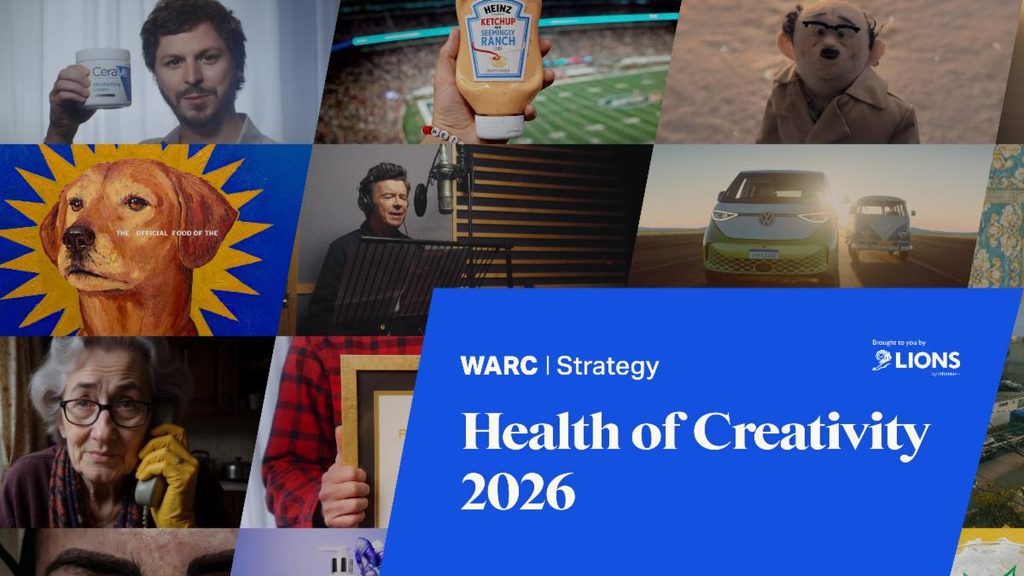
Award-winning creative advertising campaigns are more than twice as likely to deliver measurable effectiveness, according to new findings released by global marketing intelligence platform, WARC.

The latest edition of WARC’s The Health of Creativity 2026 report found that while 21 per cent of all creatively awarded ideas subsequently received recognition for effectiveness, the figure rose to 45 per cent among ideas that ranked among the most creatively awarded campaigns.
The report, released on September 17, 2026, is based on an analysis of 6,360 ideas and 11 years of WARC Rankings data covering award results from 2015 to 2025.
The findings examine the relationship between creativity and effectiveness, the characteristics shared by the most successful campaigns, and the extent to which creatively recognised work translates into measurable business results across sectors, brands and agency networks.
According to WARC, the research provides further evidence of a relationship between creative excellence and campaign performance, with the conversion from creativity to effectiveness increasing substantially among campaigns that achieve the highest levels of creative recognition.
Amy Rodgers, Head of Content, WARC Creative, said the research was designed to examine whether campaigns recognised for creative excellence were maintaining or strengthening their performance advantage.
“Mounting evidence demonstrates how creativity plays a crucial role in driving campaign success,” Rodgers said.
“Drawing on findings from 11 years’ worth of WARC Rankings data, we examined whether campaigns recognised for creative excellence have sustained or strengthened their performance edge compared to last year’s findings and what are the current shared characteristics that define the most creative and effective ideas.”
Creative recognition linked to effectiveness
The report showed that more than one in five, or 21 per cent, of ideas that received creative awards in shows tracked by the WARC Rankings were subsequently recognised for effectiveness.
The figure remains unchanged from last year.
However, the likelihood of conversion increases significantly among ideas that receive a high level of creative recognition.
WARC found that 45 per cent of highly awarded creative ideas went on to receive effectiveness recognition, compared with 21 per cent across all creatively awarded ideas.
The 45 per cent figure represents an increase from 44 per cent recorded last year.
Rodgers noted that the 21 per cent overall conversion rate should be viewed within the broader context of the advertising industry, where securing both creative and effectiveness recognition for the same campaign remains difficult.
She attributed the challenge to a number of factors, including the industry’s shift from long-term brand building towards performance marketing, differences in brand size and the resources required to measure effectiveness and develop strong award submissions.
Television losing ground as lead channel
One of the major findings of the report is the declining role of television as the primary channel for highly successful creative campaigns.
According to WARC, only 25 per cent of the best-in-class ideas led with television in 2025, compared with 44 per cent in 2018.
Despite the decline, the report noted that television remains a powerful medium for reaching large numbers of engaged consumers. It also retains particular strengths in emotional storytelling and the creation of memorable brand messages.
WARC said there was no indication that a single alternative channel had replaced television as the dominant lead medium.
Instead, the report found that leading campaigns are increasingly distributing their communication efforts across a wider combination of channels.
The development reflects the growing complexity of the media environment, with brands increasingly combining different platforms and touchpoints to reach consumers and build campaigns.
Brand building remains a major objective
The research also found that brand building remains central to successful advertising.
About 85 per cent of campaigns in the wider dataset had brand building as an objective, while the proportion increased slightly to 88 per cent among ideas that were both highly creative and highly effective.
WARC said strong brands are capable of supporting business growth and commanding premium prices through sustained investment in brand equity.
The report stressed that successful brand building requires consistency in the delivery of a brand promise across areas including product performance, advertising and pricing, while maintaining investment in awareness and brand equity over time.
Social justice, partnerships and emotion emerge as key strategies
The study also identified social justice issues, customer experience, strategic partnerships and emotional storytelling as prominent characteristics of highly creative and highly effective campaigns.
Nearly half, or 49 per cent, of the best-performing ideas significantly over-indexed in the use of social justice issues, including corporate social responsibility, advocacy and brand activism.
Customer experience featured in 42 per cent of the top ideas, while strategic partnerships were used by 40 per cent.
According to WARC, the findings indicate that the strongest campaigns increasingly move beyond conventional customer-focused approaches to engage with wider social issues and audiences.
The report also highlighted emotion as an important ingredient in campaigns seeking to establish stronger connections with consumers and create messages that remain memorable over time.
Top campaigns deliver measurable sales impact
The findings further showed that highly creative and effective campaigns are not limited to generating awareness or brand recognition.
Almost two-thirds, or 61 per cent, of the best ideas recorded measurable impact on sales, while nearly half had an impact on market penetration.
Return on investment and revenue also appeared significantly more frequently as measures of success among award-winning campaigns.
WARC noted that behavioural change was another distinctive metric among the top-performing campaigns, suggesting that the strongest ideas seek to achieve more than short-term communication objectives.
According to the report, such campaigns combine long-term brand building with efforts to influence consumer behaviour and generate broader commercial impact.
PR value and fame increasingly important
Another notable finding was the growing importance of public relations and other so-called “soft” measures in assessing campaign effectiveness.
WARC found that PR value was measured by 70 per cent of highly creative and highly effective ideas, compared with only 27 per cent across all cases analysed.
The report said the gap highlighted the importance of fame and wider public attention in successful campaigns.
Other soft measures, including social media buzz, brand health and search, also appeared more frequently among the best-performing ideas.
The findings suggest that successful campaigns are increasingly assessed not only by direct sales or immediate consumer response, but also by their ability to generate public conversation and strengthen broader perceptions of a brand.
Longer campaigns deliver sustained impact
The study also found that highly creative and effective campaigns tend to run for longer periods.
About 37 per cent of award-winning campaigns lasted for at least one year, compared with just 15 per cent of typical cases.
WARC linked the finding to previous research indicating that highly creative campaigns can build stronger emotional resonance and generate more lasting impact, while less creative campaigns are more likely to focus on short-term results.
The report therefore points to campaign longevity and sustained investment as important characteristics of some of the most successful creative work.
Retail leads creative effectiveness
The retail sector emerged as the largest contributor to the 167 ideas identified as both highly creative and highly effective.
WARC found that 20 per cent of the best-of-the-best ideas came from the retail sector, even though retail accounted for only 13 per cent of all cases analysed.
The food sector followed with 10 per cent, while technology and electronics, toiletries and cosmetics, and financial services each accounted for eight per cent.
The figures suggest that some sectors are producing a disproportionately high share of campaigns that combine strong creative recognition with measurable effectiveness.
Creative commitment linked to effectiveness
The report also examined what WARC describes as “creative commitment”, a composite measure based on media budget, campaign duration and the number of media channels used by a campaign or initiative.
According to the research, creative commitment correlates strongly with effectiveness.
As creative commitment increases, WARC said, so does campaign performance across measures including sales, brand building, market share and profit.
Comparing case studies from the full WARC Rankings dataset with ideas appearing in the WARC Creative 100 and Effective 100, the report found that highly successful ideas recorded an average creative commitment score of 7.0, compared with 6.0 for the wider group.
WARC stressed that the difference in scores was not simply a reflection of brand size.
Agency networks
The report also provided an analysis of how creatively awarded ideas converted into effectiveness across agency networks.
Ogilvy recorded the highest total tally of creatively awarded ideas, with 575, including 84 added during the latest period analysed.
BBDO recorded the highest number of creatively awarded ideas that subsequently converted into effectiveness recognition, with 137.
VML recorded the strongest growth in the number of converted ideas, adding 27.
When measured by conversion percentage, Saatchi & Saatchi recorded a 32 per cent conversion rate among its creatively awarded ideas that were also recognised for effectiveness.
Among highly creative ideas, the agency network’s conversion rate increased to 44 per cent.
WARC noted that the agency network data reflects how agencies were credited at the time the awards were given, including networks and agencies that have since been acquired, merged or rebranded.
167 best-of-the-best ideas analysed
The latest report examined 167 ideas that ranked in both the WARC Creative 100 and WARC Effective 100 between 2016 and 2026, describing them as the “best of the best” in terms of the combination of creativity and effectiveness.
The analysis forms part of the fifth edition of The Health of Creativity, WARC’s annual examination of the relationship between creative excellence and business effectiveness.
The report also contains detailed information on creative conversion by category, brand and agency network, alongside the full list of the 167 best-performing ideas.
The findings reinforce the view that creativity and effectiveness should not necessarily be treated as separate measures of campaign performance.
While only 21 per cent of all creatively awarded ideas converted into effectiveness recognition, the rate more than doubled among ideas that achieved the highest levels of creative recognition.
The research also points to several recurring characteristics among campaigns that combine creative and commercial success: sustained brand building, emotional storytelling, strategic partnerships, engagement with social issues, measurable sales impact, longer campaign durations and significant investment across media.
WARC said the next edition of its rankings, the Creative 100, Media 100 and Effective 100 will be published in March 2027, following analysis of work awarded during 2026.