
WPRF 2026: Global PR Leaders Confront Misinformation Crisis, Call for Ethical, Inclusive Communication

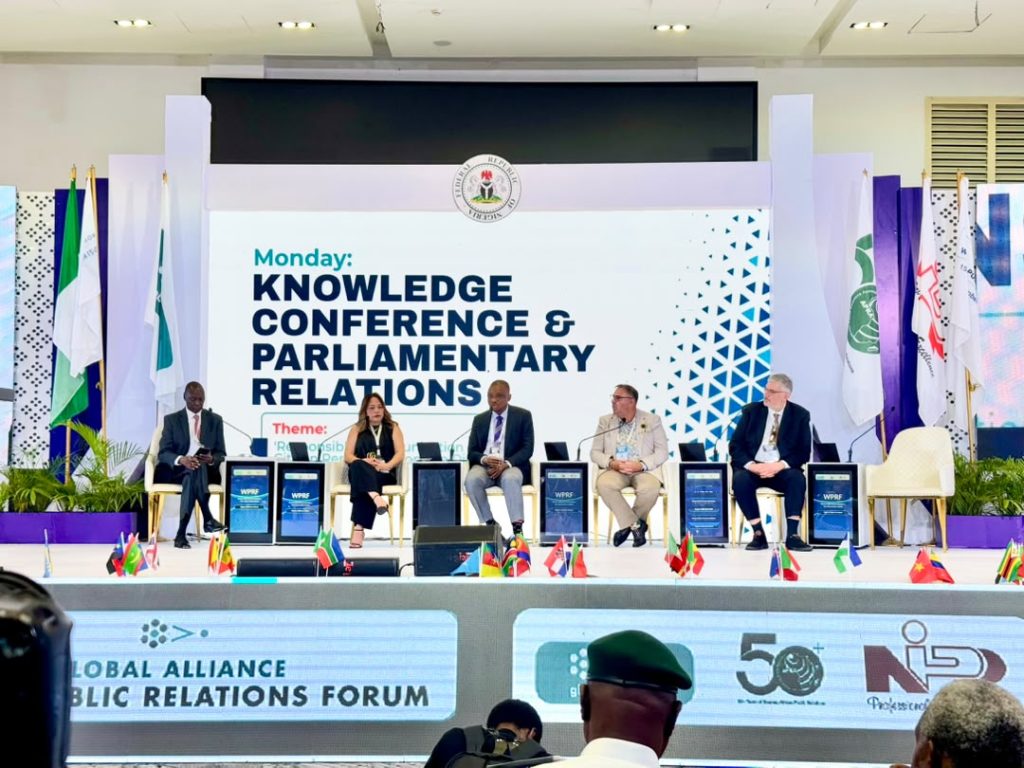
The first panel session of the 2026 World Public Relations Forum (WPRF) Knowledge Conference, which began today at the Transcorp Hilton Event Centre in Abuja has revealed that the fight against misinformation and disinformation is a moral imperative that demands ethical courage, emotional intelligence, and radical inclusivity.
The session, themed “Misinformation and Social Cohesion: Rebuilding Trust Through Responsible Public Relations,” was moderated by Peter Mutie, CEO of Peterson Communications Limited, Kenya. It featured a distinguished panel of global communication leaders that include Ana Pista, CEO of Ardent Communications and President of the Public Relations Society of the Philippines; David Anyaele of the Abia State Disability Commission, Nigeria; Adrian Cropley, Co-Founder of the Centre for Strategic Communication Excellence, Australia; and Alastair McCapra, CEO of the Chartered Institute of Public Relations (CIPR), United Kingdom, who delivered the opening address on the topic before joining the panel discussion.
The session opened with McCapra’s fifteen-minute keynote, in which he set the tone for the deliberations by highlighting the growing gulf between organizations and the younger generation, particularly Gen Z where he noted the paradoxical relationship young people have with artificial intelligence where they are embracing it as primary users while simultaneously resenting it as a threat to their careers and future. “We can communicate openly and transparently, and still not be heard, and still not be believed,” McCapra observed, stressing the importance of listening before speaking.
Defining the Challenge
Peter Mutie framed the central question: How can public relations help build trust in a world where people are increasingly struggling to distinguish truth from false?
Responding, Ana Pista described disinformation as “one of the greatest threats to public trust and social cohesion today.” She warned that when false or misleading information spreads, it creates confusion, fuels division, weakens institutions, and erodes confidence in leadership. “As artificial intelligence starts farms in the street, our responsibility becomes even greater,” she said. Pista argued that PR professionals have a critical responsibility not only to correct misinformation but to actively promote truthful communication, ethical practices, transparency, and accountability.
She made the case for the professionalization of public relations, framing it not as an industry aspiration but as a societal responsibility. “We must recognize that our influence comes with accountability. We have the power to shape narratives, influence opinions, and build reputations, but with that power comes the responsibility to protect the truth,” Pista declared. She called for advancing the profession through professional standards, ethics, education, and responsible digital governance, emphasizing that “responsible public relations is not about controlling what people think but about giving people truthful information so they can think, decide, and act responsibly.”
The Inclusivity Imperative Is To Leave No One Behind
David Anyaele brought a critical perspective to the discussion, arguing that the conversation about misinformation and trust must begin with a fundamental question of who is being reached. He asserted that when communication is inaccessible, people are missing, and when people are missing, marginalized populations are excluded. Drawing on the Nigerian context, he noted that more than 35 million Nigerians live with some form of disability, yet much communication remains inaccessible to them.
“If someone is deaf, and there is no sign language interpreter, there is no audio, no matter how truthful the communication is, such an individual is missing,” Anyaele explained. He argued that “responsible communication” must be for all, invoking the disability rights mantra: “There is nothing about us without us. No one should be left behind in any communication.”
Anyaele called for a review of ethical frameworks to ensure inclusivity, warning that exclusion constitutes abuse, and abuse constitutes injustice. He praised institutions like Nigeria’s Independent National Electoral Commission (INEC) for setting an example by including sign language interpreters in their communication mechanisms, while urging other government institutions at the state and federal levels to follow suit.
Credibility, Context, and the Limits of “Misinformation”
Adrian Cropley offered a nuanced perspective on the challenge, drawing on Australia’s history as a nation founded by prisoners sent from the United Kingdom, a context he noted bred healthy cynicism toward authority and institutions. He cautioned against conflating the erosion of trust with the labeling of all dissenting views as misinformation. “What we have to start doing is distinguish between erosion of trust and calling things misinformation when it’s actually opinion, or it’s something that people are sharing,” Cropley said.
He observed that in the current media landscape, “anybody can say anything to anyone, and then they write it off as ‘this is just an opinion.'” The role of communication professionals, he argued, is to establish the credibility of the message by providing facts, understanding, background, and context. Cropley challenged the perception of PR professionals as mere wordsmiths, insisting that the profession is fundamentally about relationships. “We move into this new era of the post-truth world. It really is about how do we establish those connections, those relationships,” he said, praising the forum’s opening for emphasizing emotional intelligence and the power of relationships in bringing the world together.
Ethics, Morality, and Moral Intelligence
When asked about the key PR challenges for today and tomorrow, Cropley returned to the theme of ethics, arguing that the term is often used loosely without tangible meaning. He called for contextualized conversations about ethics that account for the organizations, countries, and cultures in which professionals operate. “We need to bring that into our work as PR professionals,” he said, adding that education around not just ethics but morality is essential. He observed that the conversation around taking a moral stance is growing astronomically. “It’s not just about what we’ve written down as ethics, the rights or wrongs. It’s really about how we connect and feel,” Cropley stated.
Pista built on this, identifying the greatest ethical challenge as the growing disconnect between what technology allows and what conscience dictates. She proposed a dual framework of “emotional intelligence” and “moral intelligence” as essential tools for combating disinformation. “A good combination of emotional intelligence and moral intelligence would help us fight disinformation,” she said.
Advice for the Global PR Community
In the final segment, panelists offered their best piece of ethics advice to the global audience. McCapra emphasized the importance of understanding Gen Z, their values, expectations, and relationship with technology. “We need to bring that understanding into the organizations we work for and help those organizations to transform,” he said, identifying this as the profession’s biggest challenge.
Cropley called for courage, urging PR professionals to “call out” unethical behavior even when it is uncomfortable. “We are very compliant to our organizations and their requests, and not one of us wants to lose our job for kind of dissing the boss for doing or saying the wrong thing. But I think we have to get a lot braver,” he said. As AI takes over certain routine roles, Cropley argued that the role professionals must embrace is advising and leading in their organizations. This, he notes, is a task that requires “guts and conviction.”
Anyaele returned to his central theme: inclusivity. “No one should be left behind,” he said, calling on institutions to ensure that communication is accessible to all Nigerians, including those with disabilities. He reiterated INEC’s positive example and urged other government institutions to follow suit.
Pista closed with an appeal to invest in young people. She noted a that there is a disconnect between seasoned professionals and young practitioners, arguing that young people must be heard and involved in shaping policies and ethical frameworks. “They needed to be heard, they needed to contribute,” she said, citing the Global Alliance’s #NextInLine initiative, which celebrates students and young practitioners, as a model for engagement.