

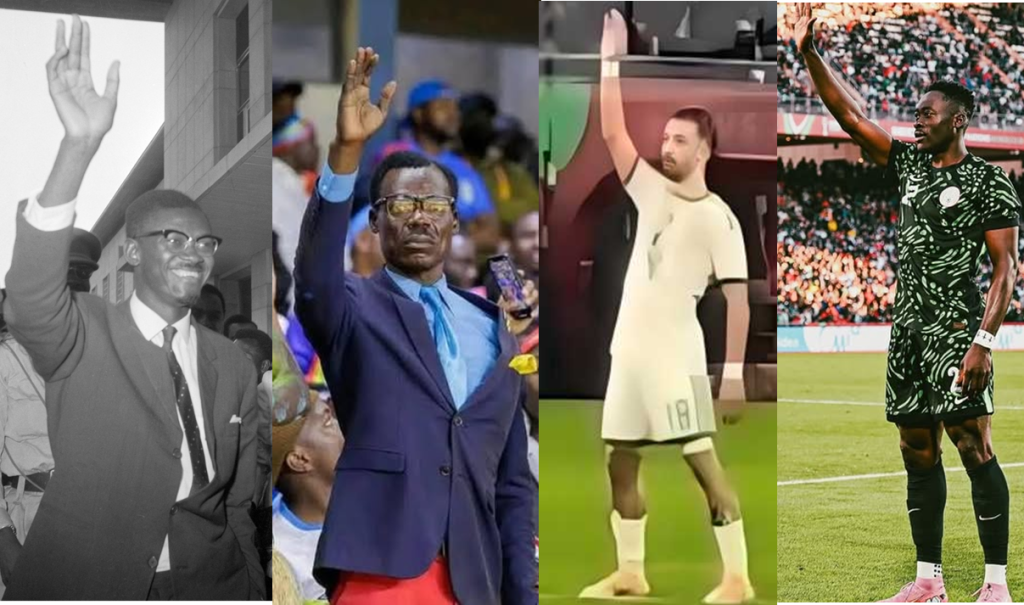
It was back in my undergraduate days as a student of journalism in the prestigious University of Nigeria, Nsukka (UNN) that I first heard from my photojournalism lecturer that a picture is worth a thousand words. Now, looking at the image above, how much are these four pictures joined as one worth? Beyond the thousands of meanings multiplied over, the image captures four men (one from a different era), three nationalities, one pose, one gesture and four different meanings.

Indeed, the four entirely different meanings are determined by context, intent, and cultural understanding. For the marketing and communications industry, this is a masterclass in everything we need to know about brand perception, cultural intelligence, and the dangerous assumption that our messages mean what we think they mean.
From left to right, you have Patrice Lumumba, the martyred first Prime Minister of the Democratic Republic of Congo, frozen in history with his right arm raised skyward (a revolutionary’s defiant gesture of hope and resistance). His recently erected statue in Kinshasa immortalizes him in exactly this posture.
Next to him is Michel Nkuka Mboladinga, a 49-year-old Congolese superfan who made himself a living monument of Lumumba throughout DR Congo’s matches at the ongoing 2025 Africa Cup of Nations in Morocco. For 90 minutes, sometimes longer, Mboladinga stood motionless on a small platform, replicating Lumumba’s statue pose in colourful formal attire. His mission was patriotic tribute, his body a silent prayer for his national team. When Algeria scored a devastating 119th-minute goal to eliminate Congo, cameras captured his first movement in nearly two hours, where he was wiping away tears.
The third figure is Mohamed Amoura, the Algerian forward whose celebration after that very goal sparked continental outrage. Running toward Congolese fans, Amoura mimicked the raised-arm stance before falling to the ground, as if toppling the statue itself. What he intended as victory banter was received as mockery of Mboladinga, nd by extension, of Lumumba’s legacy and Congolese dignity. His later apology claimed ignorance, that he was “simply joking around” and didn’t understand the gesture’s meaning.
Finally, Akor Adams, our own striker who closed this narrative arc with precision and grace. After scoring Nigeria’s second goal in the quarter-final elimination of Algeria, Adams froze in the now-famous pose, this time, as a tribute to both Lumumba and Mboladinga, and by extension, the Congolese people.
The Audience Owns Your Meaning
From this, here’s what every brand must internalize: the meaning of your message is not determined by your intent but by your audience’s interpretation within their specific cultural context. This is a business reality with measurable consequences.
In 2024, research revealed that 81% of consumers need to trust a brand before considering a purchase. But trust is not built on what you say about yourself on whether your audience believes you understand them. Consider how the raised-arm pose shifted meaning based solely on who performed it and their understanding of its meaning. The physical gesture is constant, but its interpretation achieves a different meaning completely with each of our four individuals in the imge. This is precisely how brands operate in global markets. Your logo, slogan, and visual identity remain constant, but their meaning can change entirely based on cultural context, historical knowledge, and local interpretation.
Indeed, the marketing industry’s graveyard is littered with campaigns that failed because brands assumed universal understanding. The financial costs are staggering, but the reputational damage often proves more devastating. A good example of this is the Dolce & Gabbana’s 2018 campaign in China. It featured an Asian model struggling to eat Italian food with chopsticks. The brand thought they were being playful. The Chinese market saw mockery of their culture and specifically insulting portrayals of Chinese women. Major retailers pulled D&G products, the Shanghai fashion show was canceled, and the brand’s Asia-Pacific market share dropped from 25% to 22%, amounting to hundreds of millions in lost revenue. Six years later, they still haven’t fully recovered their standing in the world’s largest luxury market.
In the same market, Pepsi’s “Come Alive with the Pepsi Generation” translated into Mandarin as “Pepsi brings your ancestors back from the grave” which is both nonsensical and offensive in a society that reveres ancestor worship. KFC’s “Finger Lickin’ Good” became “Eat Your Fingers Off” in Chinese translations. Mercedes-Benz entered China with a brand name phonetically sounding like “rush to die.” HSBC’s “Assume Nothing” became “Do Nothing” in some markets, suggesting paralysis rather than prudence.
Indeed, research shows that companies maintaining coherent messaging across markets see up to 23% revenue increases. But consistency doesn’t mean uniformity. It means ensuring your intended meaning remains intact even as execution adapts to cultural context.
Nike faced fierce backlash in 2013 for women’s leggings designed to look like traditional Samoan male tattoos. The pe’a is sacred, earned through excruciating rites of passage, and reserved exclusively for men. Nike’s fashion interpretation appropriated a meaningful cultural symbol and stripped it of dignity. Though the product was pulled, the damage to brand perception among Pacific Island communities had been done.
When H&M featured a Black child wearing a hoodie with “Coolest Monkey in the Jungle” printed on it, the global backlash was immediate and severe. Stores were vandalized, executives apologized, but the damage to brand perception, particularly among Black consumers globally, was profound and lasting.
For Nigeria’s 220 Million-person Market, Context Is King
Beyond global examples, and beyond localization rhetoric of global campaigns for Nigeria, it is important to understand our market’s complexity, our consumers’ sophistication, and the high cost of assuming that what works in Victoria Island will work in Warri, or that a message resonating in Lagos will land the same way in Kano.
In Nigeria’s 220 million-person market, the meaning of your message is not determined by your creative brief or your boardroom applause. It’s determined by your audience’s interpretation within their specific cultural, linguistic, and regional context. This truth lives in every successful Nigerian campaign and haunts every spectacular failure. It is no secret that Nigerian consumers respond to marketing that speaks their language literally, with phrases like “Sharp sharp delivery” or “No wahala” feeling more authentic than overly corporate messaging.
For Nigerian brands and international companies operating in, or just entering this market, cultural intelligence requires specific commitments. You cannot spot Nigerian cultural blind spots from a homogeneous team in Ikoyi or an international office in London. Positioning strategies never occur in a cultural vacuum, meaning branding is culturally intertwined and must be contextualized from market to market.

Second is investing in genuine local insights, not just surface-level market research. Experiential marketing thrives in Nigeria because the country is movement, music, people, community, conversation, and culture, with traditional ads alone not being enough. Nigerians remember events where streets turned into fashion runways, where brands became part of cultural moments. They forget banner ads by next week.
This means brands must be where Nigerians are…at Detty December events, at Owambe parties, at campus activations, in WhatsApp groups, on Twitter (X) conversations. With over 220 million people, many young, urban, and mobile-first, if your brand isn’t showing up in Nigerians’ scroll, it might not exist in their world. Discovery has gone digital, with platforms like Jumia, Instagram, and WhatsApp becoming the new storefronts.
Third is understanding that trust is currency in Nigerian markets. Sixty-five percent of Nigerian consumers rely on friends and family when making purchase decisions, while 58% check online reviews. Word-of-mouth remains king. This means every customer interaction, every promise kept or broken, ripples through communities. Nigerian consumers will forgive price increases if you’re honest. They won’t forgive feeling disrespected or deceived.
Fourth is respecting regional and religious sensitivities. A campaign featuring alcohol consumption won’t work uniformly across Nigeria’s Muslim-majority North and Christian-majority South. Beauty standards differ. Humor varies. Even something as simple as meal times shifts regionally. Brands succeeding in Nigeria don’t create one campaign and blast it nationwide—they create contextual variations that respect local realities while maintaining brand coherence.
Building Cultural Intelligence Into Brand DNA
For brands serious about achieving authentic cultural connection rather than expensive missteps, cultural intelligence must be embedded at every level. This starts with diverse decision-making tables where team members from target markets have actual authority to stop campaigns, not just provide feedback that gets ignored. When IKEA entered Thailand, they discovered several product names sounded like crude sexual terms in Thai. Rather than proceed and deal with fallout, IKEA hired local consultants to review every product name and made phonetic adjustments. This proactive vetting prevented spectacular failure in a key growth market.
Context-first creative development means starting with cultural research, not creative concepts. What are the historical sensitivities? What symbols carry loaded meanings? What recent events might color interpretation? This research phase shouldn’t be box-checking—it should inform every creative decision. Before launch, brands must ask: “How could this be misunderstood? What are the worst-case interpretations?” If you can’t articulate how your campaign might offend, you haven’t done enough research.
Despite best efforts, mistakes happen. The difference between temporary stumbles and lasting damage is response speed and authenticity. Rapid response protocols should include immediate acknowledgment without defensive justification, clear explanation of the mistake, concrete corrective actions, and sustained follow-through. The days of waiting for outrage to “blow over” are gone; in the social media age, silence is interpreted as indifference or arrogance.
For brands operating in 2026 and beyond, the question isn’t whether to invest in cultural intelligence but whether you can afford not to. With global branding investments in artificial intelligence projected to increase by 150% by 2025, and with 70% of global brands relying on customer data platforms to personalize experiences, the technical infrastructure for global marketing has never been more sophisticated. But all the data and AI in the world cannot replace human cultural knowledge and sensitivity.
Marketing strategist Seth Godin defined a brand as “expectations, memories, stories and relationships.” The same four elements determine how your brand is perceived in every market. You can control your messaging, but you cannot control how it’s received without first understanding the expectations, memories, stories, and relationships that already exist in your audience’s mind.