

Africa contributes less than four per cent of global greenhouse gas emissions, according to the United Nations, yet remains one of the regions most vulnerable to climate change. From prolonged droughts in the Horn of Africa to recurring floods across West Africa, climate change continues to threaten livelihoods, food production and economic growth. Ironically, the continent also possesses vast agricultural potential and many of the critical minerals expected to power the global energy transition, including cobalt, lithium and manganese.
As governments, businesses and investors place greater emphasis on sustainability, conversations around Environmental, Social and Governance (ESG) have expanded beyond environmental advocacy to include investment, regulation and economic development. Investors now pay closer attention to how organisations manage environmental and governance risks, while regulators continue to strengthen sustainability disclosure requirements.

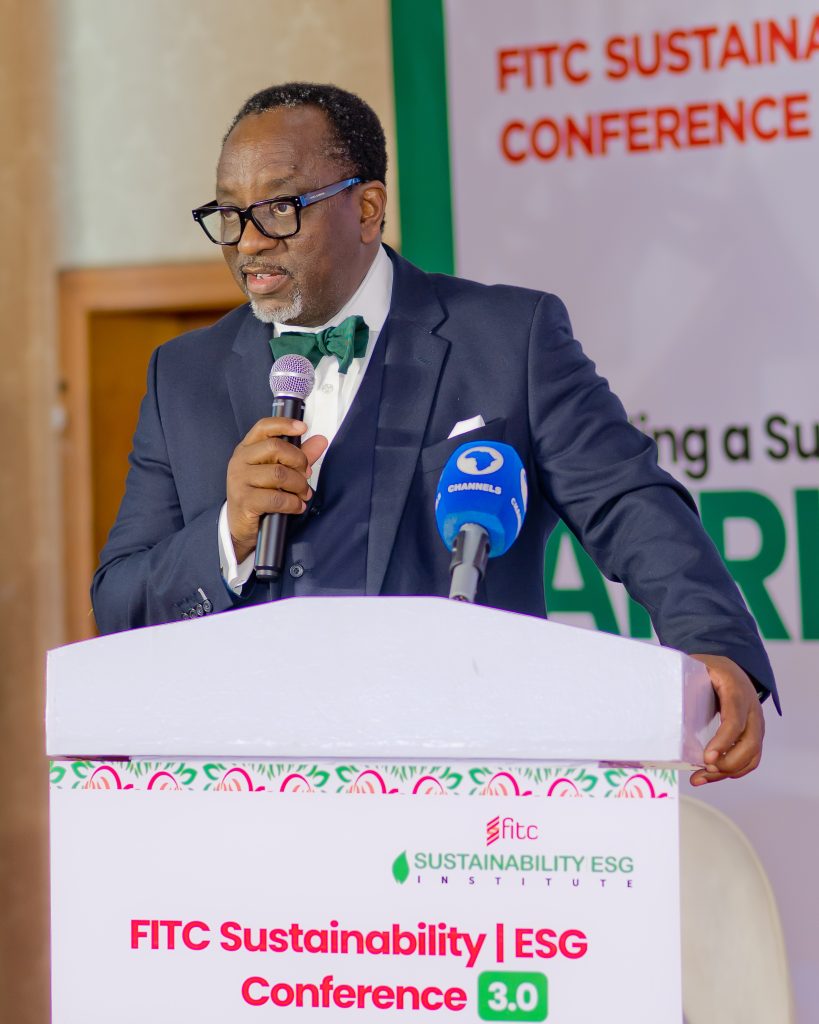
Those issues shaped discussions at the 2026 FITC Sustainability & ESG Conference held on July 8 at the Lagos Oriental Hotel, Victoria Island, Lagos. The conference, themed Building a Sustainable Africa: Integrating Environmental Stewardship, Social Impact and Strong Governance for a Prosperous Future, brought together policymakers, regulators, corporate leaders, sustainability professionals and financial institutions to examine how Africa can pursue economic growth while strengthening environmental responsibility, governance and social development.


Presenting one of the conference’s major papers, Professor Fabian Ajogwu, challenged one of the assumptions that has long shaped ESG conversations.
In a paper titled Environmental Stewardship or Environmental Compliance? Revisiting the Place of Governance in ESG, prepared with KENNA LP Associate Chiamaka Anakua and Research Associate Uyai-Abasi Etuk, Ajogwu argued that governance should not be viewed as the final pillar of ESG but as the foundation upon which environmental and social progress depends.
His position was direct.
“Governance is the foundational variable.”
Throughout the paper, Ajogwu argues that Africa’s biggest obstacle is not a shortage of sustainability policies or environmental commitments. Rather, it is the inability of institutions to consistently implement and enforce them.
He describes this as Africa’s sustainability paradox.
Although the continent contributes the least to global greenhouse gas emissions, it holds about 60 per cent of the world’s uncultivated arable land, according to the African Development Bank, alongside significant reserves of the critical minerals needed for renewable energy technologies and electric vehicles.
Yet much of that potential remains unrealised.
Africa continues to import large quantities of food despite its agricultural capacity, while exporting most of its mineral resources in raw form. Processing, manufacturing and value addition largely take place elsewhere.
For Ajogwu, the explanation lies not in the availability of natural resources but in the quality of governance surrounding them.
The paper extends that argument to Africa’s demographic realities. With the continent’s population projected to approach 2.5 billion by 2050, governments face increasing pressure to create jobs, strengthen education systems and build institutions capable of supporting inclusive economic growth.

Whether that population becomes Africa’s greatest economic advantage or one of its greatest development challenges, he argues, will depend largely on governance.
Climate finance forms another major strand of the paper.
Ajogwu estimates that Africa requires about US$277 billion annually through 2030 to finance climate adaptation and resilience. However, only a fraction of that funding currently reaches projects across the continent, with financing often passing through several administrative layers before reaching local communities.
He argues that stronger governance is necessary not only to attract investment but also to ensure available resources are deployed efficiently and transparently.
The paper also considers the growing influence of international sustainability regulations on African economies.
Using the European Union’s Carbon Border Adjustment Mechanism (CBAM) as an example, Ajogwu explains how policies developed in advanced economies increasingly shape trade and investment decisions globally.
Rather than merely responding to those standards, he believes Africa should play a more active role in shaping them.
“The imperative is to move from rule-taker to rule-maker,” he writes.
According to the paper, achieving that shift will require stronger regional cooperation through the African Continental Free Trade Area (AfCFTA), closer policy coordination among African governments and deliberate investment in sectors where the continent already enjoys comparative advantage, including green hydrogen and critical mineral value chains.
Ajogwu also draws a distinction between environmental compliance and environmental stewardship.
While compliance focuses on meeting minimum legal or regulatory requirements, stewardship considers whether natural resources are being managed in ways that protect future generations and the communities whose livelihoods depend on them.
“Compliance asks only whether a permitted threshold has been observed,” he writes.

That distinction becomes particularly important in Africa, where communities located around extractive industries often bear the environmental costs while receiving limited economic benefits.
The paper also supports a phased role for natural gas within Africa’s energy transition, arguing that it can support industrialisation and economic growth provided governments avoid locking themselves into long-term carbon-intensive development pathways.
Governance, however, remains the central theme.
Drawing on Section 305 of Nigeria’s Companies and Allied Matters Act 2020, Ajogwu argues that company directors already have legal obligations to consider the environmental impact of business decisions.
The challenge, he suggests, is not legislation but enforcement.
To illustrate the point, he revisits the landmark Gbemre v Shell judgment on gas flaring. Although the Federal High Court ruled against the practice nearly two decades ago, implementation has remained inconsistent.
For Ajogwu, that case reinforces one important lesson.
“No stewardship programme survives a captured regulator.”
The paper also highlights companies such as Access Holdings and Safaricom as examples of organisations that have embedded ESG principles into their overall business strategy rather than treating sustainability reporting as a regulatory obligation.
Ajogwu concludes by recommending a shift from ESG disclosure to ESG integration, stronger enforcement of existing legislation, expansion of sustainable finance mechanisms, greater regulatory harmonisation through the AfCFTA and sustained investment in institutional capacity.


His closing observation captures the broader message of the paper.
“The binding constraint across the continent is no longer the absence of rules but the capacity and the will to enforce them.”
As sustainability continues to shape investment decisions and economic policy around the world, Ajogwu’s paper offers a reminder that Africa’s ESG conversation cannot simply replicate global trends. Environmental commitments, social investment and sustainability reporting remain important, but without strong institutions capable of enforcing laws and building public trust, they are unlikely to deliver lasting change.
