

Cost, Awareness, and Relevance: New CIPR Research Reveals Structural Barriers Holding Back Africa’s Next Generation of Communications Professionals

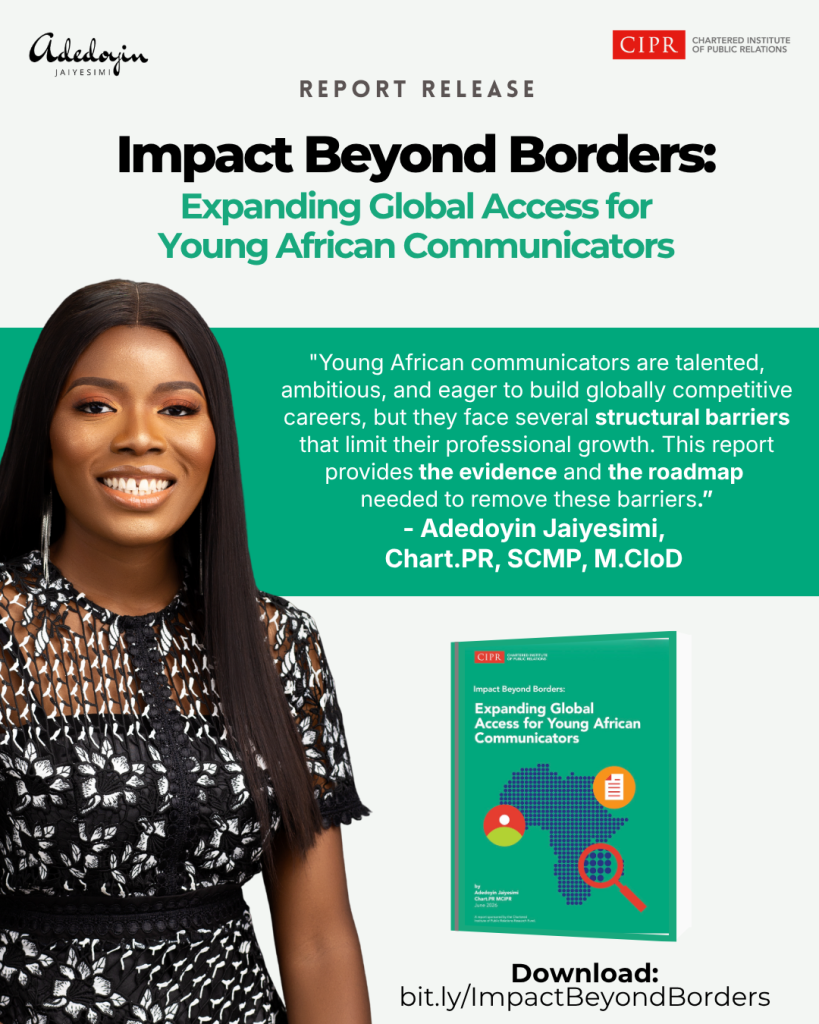
Landmark research sponsored by the CIPR Research Fund reveals 86% of uncertified young African PR professionals want global credentials, but 62% are priced out by high costs and currency restrictions.

A new eye-opening report, Impact Beyond Borders: Expanding Global Access for Young African Communicators, which offers an evidence‑based blueprint for transforming access, equity, and representation for young professionals across Africa’s communications and public relations industry has been released.
Sub-Saharan Africa is home to the world’s youngest population, with 70% of its people under the age of 30. Yet, the continent’s early-career public relations and communications professionals face systematic structural barriers that hinder their ability to access global training, certification, and career advancement.

The landmark research report sponsored by the Chartered Institute of Public Relations (CIPR) Research Fund and authored by Adedoyin Jaiyesimi, Strategic Communications Advisor and Co-Founder of The Comms, highlights a sharp divide between ambition and accessibility within the global communications industry.
“Young African professionals are talented, ambitious, and eager to build globally competitive careers, but they find themselves navigating structural roadblocks,” says Jaiyesimi. “More than eight in ten young professionals without a certification want to earn one. That ambition deserves a pathway that is within reach because leaving behind the world’s youngest workforce risks undermining the long-term relevance and diversity of the entire global communications profession.”
Impact Beyond Borders draws on quantitative survey data from over 200 young professionals across 11 African countries, in-depth focus groups in Nigeria, Kenya, and Zimbabwe, and interviews with presidents of leading national PR associations representing over 30,000 practitioners across the continent.
The report identifies three main barriers that limit the access young African professionals have to global training and certification:
- Financial constraints and affordability.
- Limited awareness and visibility of what professional associations offer.
- A mismatch between global training content and African market realities.

To address these barriers and structural challenges, the report proposes the ARC Model, a practical framework designed for global and regional PR associations which is built on three pillars: Accessibility, Relevance and Collaboration. The report also includes perspectives from leaders of national associations in Nigeria, Kenya, Ghana, and Zambia, all of whom emphasize the urgent need for stronger mentorship pipelines, practical, industry‑aligned training and Africa‑specific youth programmes from global associations.
“This is a valuable piece of research that asks an important question about the future of our profession. As the African continent grows in cultural and economic relevance, it focuses on a group whose experiences have too often been overlooked and sets out clearly the barriers standing in their way. My thanks go to Adedoyin for such a thoughtful and well-evidenced contribution. I would encourage practitioners and associations across the profession to read it and consider what it means for how we support the next generation of communicators”, CIPR President Farzana Baduel Chart.PR, Hon FCIPR.
The full research report which contains actionable recommendations for change is now available for download via the CIPR’s website – bit.ly/ImpactBeyondBorders
Adedoyin Jaiyesimi, Chart.PR, MCIoD, SCMP, is a Strategic Communications Advisor who counsels senior leaders and boards across Africa and emerging markets. She is the Co-Founder of The Comms Avenue, a pan‑African platform that is focused on strengthening Africa’s communications talent pipeline. Adedoyin remains committed to supporting the professional development of young professionals in the African communications and PR industry and closing skill gaps within the industry through her platforms – www.adedoyinjaiyesimi.com
Founded in 1948, the Chartered Institute of Public Relations (CIPR) is the world’s only Royal Chartered professional body for public relations practitioners with over 11,000 members.
The CIPR advances professionalism in public relations by making its members accountable to their employers and the public through a code of conduct and searchable public register, setting standards through training, qualifications, awards and the production of best practice and skills guidance, facilitating Continuing Professional Development (CPD), and awarding Chartered Public Relations Practitioner status (Chart.PR).
