

When Slogans Meet Sewage: Should The Branding Of Destination Lagos Start From Refuse Heaps?

Very often, a state government reaches for a big idea to sell itself to the world. Lagos has tried several: “Centre of Excellence.” “Eko Oni Baje”(meaning Lagos that never spoils). “State of Aquatic Splendour.” These are not just catchy lines; there are branding strategies behind each to project Nigeria’s commercial capital as a global city worth visiting and living in.

On paper, the pitch is easy to make. Lagos is Nigeria’s smallest state by landmass, yet it carries the country’s largest economy and functions as the commercial and financial engine of West Africa. It is home to more than 23 million people, a number expected to keep climbing in the coming decades. The state has leaned on events like Detty December, the Lagos City Marathon, alongside a thriving fintech scene and steady infrastructure spending, to project itself as a city on the rise, one confident enough to call itself a remarkable destination brand.
But a brand is not built on slogans and events alone. right now, one of the basic tests in destination branding is what happens to the rubbish a city produces every single day. This challenge is exposing the gap between the image Lagos wants and the reality many residents live in.
The Mountain That Won’t Go Away
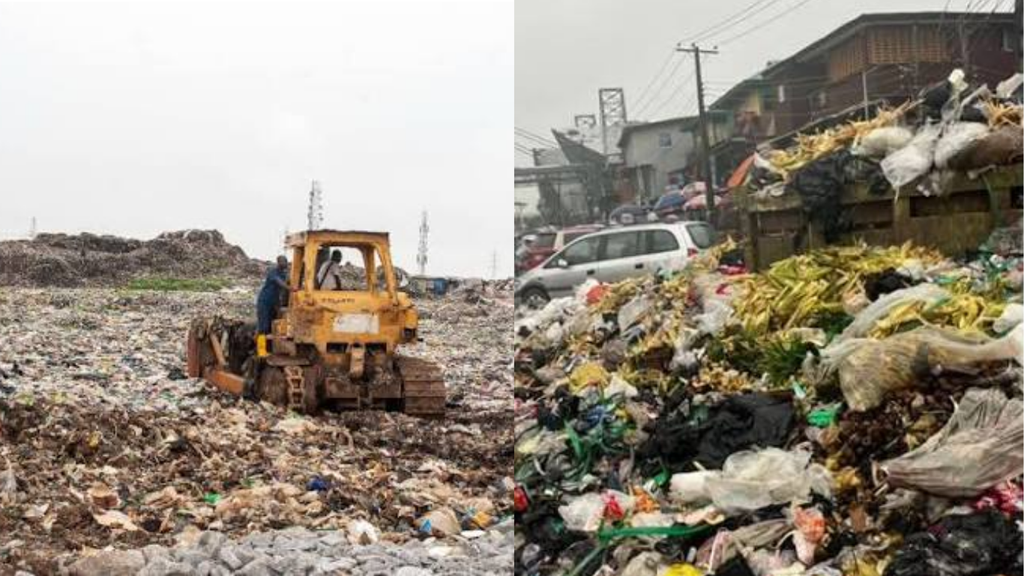
Lagos generates an estimated 13,000 tonnes of waste daily, a figure that has stretched the Lagos Waste Management Authority (LAWMA) and its partners to their limits. Across the state, the picture repeats itself: bins overflowing onto the road, refuse heaps spilling into walkways, and residents waiting far longer than they should for a collection truck that never quite seems to have enough capacity.
The trouble does not start on the street, though it starts at the dumpsite. Private Sector Participants (PSPs), the operators who form the backbone of Lagos’s waste collection chain, have reportedly faced severe delays at approved landfill sites such as Olusosun, with trucks that once turned around within days now queuing for five to fourteen days before they can offload. A collection system is only as fast as its slowest bottleneck, and for Lagos, that bottleneck appears to be the disposal capacity itself.
This is not a new problem dressed in new clothes. Olusosun, the state’s best-known landfill, has been receiving waste from a fast-growing metropolis since the early 1990s, when Lagos’s population was a fraction of what it is today. A dump site designed for a much smaller city has had to absorb the waste of one of the fastest-growing urban areas in the world, and the strain shows. Talk of shutting it down and converting the land to other uses has circulated for years. Now, the more urgent question is “Where does the 13,000 tonnes of daily waste go instead?”. This is yet to be answered.
A Gap That Is Hard To Hide
A persistent waste situation is a strikingly unglamorous problem for a state that markets itself on ambition and excellence. Waste management does not photograph well at an investment summit. It is not the kind of thing a state government puts on a billboard. But it is precisely the kind of thing that shapes how a city actually feels to live in and, increasingly, how it is perceived by outsiders deciding whether to visit, invest, or relocate.
Think about how a first-time visitor experiences a city. They do not read government press releases before they land. They see what is in front of them; the state of the roads from the airport, the drainage after a downpour, whether the streets they walk on look cared for. A slogan can shape expectations before arrival, but it is the physical environment that shapes the lasting impression. When the two do not match, the slogan starts to work against the state rather than for it, inviting exactly the kind of scrutiny and mockery that undermines years of marketing expenditure.
This is the trap Lagos risks falling into. The louder and more confident the branding, the more the state invites comparison between what it claims and what it delivers. A city that says nothing about being world-class can quietly under-deliver without much notice. A city that insists it is Nigeria’s number-one destination brand does not have that luxury as every overflowing bin becomes evidence in a case the public did not ask to hear, but will readily, happily discuss anyway.
Branding Beyond Slogan
There is a broader lesson here for how Nigerian states think about “destination branding.” A tagline can be commissioned, trademarked, and printed on government letterheads within weeks. Trust in a place, the sense that it works, that its basic services function, takes years to build and can be undone by something as unglamorous as an overflowing bin left too long on a residential street.
Lagos is not alone in this tension. Many Nigerian cities chase global recognition while struggling with fundamentals like power supply, drainage, and sanitation. But Lagos’s case is the most visible, precisely because its brand ambitions are the loudest, and because it carries the added weight of representing Nigeria to the rest of the world. Foreign investors, diaspora returnees, and international media often use Lagos as shorthand for how the entire country is doing. When the waste piles up in Lagos, it does not stay a Lagos problem, it becomes a Nigeria problem, at least in the eyes of anyone watching from outside.
What It Will Take
Fixing this is not simply about buying more trucks, though capacity clearly matters. It requires unclogging the disposal bottleneck at landfill sites, giving private waste operators room to actually complete their collection cycles without days-long queues eating into their turnaround time, and investing in newer, better-located disposal infrastructure that matches the scale of a 23-million-person city rather than the smaller Lagos of decades past.
It also means treating sanitation with the same seriousness the state gives to marathons and festivals, building it into the same conversations about branding and global competitiveness, rather than leaving it as a purely technical, back-office concern for one agency to manage alone. A city cannot out-market a waste crisis. No campaign, however well produced, survives repeated contact with an overflowing bin outside someone’s front gate.
A megacity’s brand, ultimately, is not just what it says about itself. It is what a resident encounters when they step out of their gate every morning, and what a visitor remembers days after the events end and the banners come down. Slogans fade from memory quickly; the smell of an uncollected refuse heap does not.
Until refuse collection in Lagos works as reliably as its marketing does, the gap between “Centre of Excellence” and the reality on the ground will keep giving critics an easy, and fair, rebuttal, and keep raising an uncomfortable question for a state that wants the world’s attention: what, exactly, is the brand promising, if it cannot promise something as basic as a clean street?
