

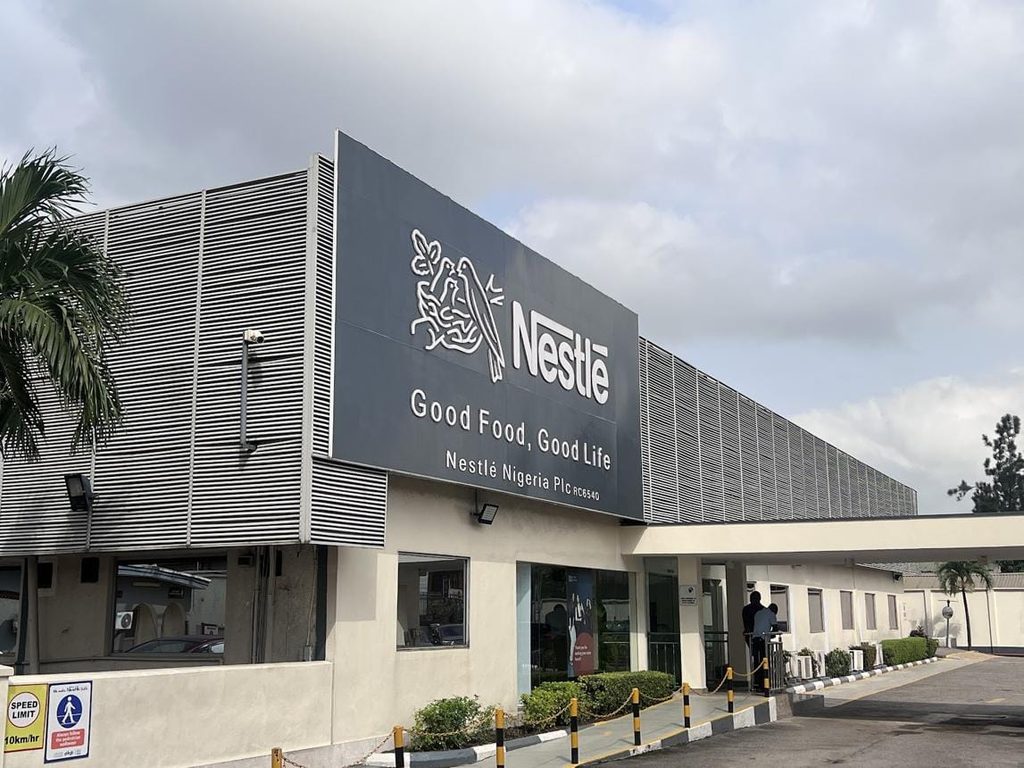
For a major food and beverage manufacturer operating in Nigeria, financial recovery is about more than returning to profit. It involves rebuilding margins, managing foreign-exchange exposure, maintaining production, navigating rising costs and convincing consumers that its products still offer value in a market where purchasing power remains under pressure.
Nestlé Nigeria Plc’s financial performance over the past two years provides a significant example of that challenge. After reporting a loss of ₦164.6 billion in 2024, the company returned to profitability in 2025, recording a profit after tax of approximately ₦105 billion. Its revenue also crossed the ₦1 trillion mark, reaching ₦1.208 trillion.
The figures represent a substantial reversal in the company’s financial position. However, understanding the recovery requires looking beyond the headline profit. Improved operating performance contributed to the turnaround, but foreign-exchange movements and a sharp reduction in net finance costs were also important parts of the story.

According to its audited financial statements for the year ended December 31, 2025, Nestlé Nigeria generated revenue of ₦1.208 trillion, a 26 per cent increase from ₦958.8 billion in 2024. Results from operating activities rose by approximately 34 per cent, from ₦167.9 billion to ₦225.4 billion.
More significantly, profit before tax moved from a loss of ₦221.6 billion in 2024 to a profit of ₦166.8 billion in 2025. Profit after tax also reversed from a loss of ₦164.6 billion to a positive ₦105 billion.
These results, contained in the company’s 2025 annual report, show a business that recovered from a difficult financial period. The annual report was published in February 2026 and contains the company’s audited financial statements.
Understanding The Numbers Behind The Recovery
The improvement in revenue and operating profit indicates that the company strengthened its performance from its core business activities. Its gross profit increased from approximately ₦306.4 billion in 2024 to ₦435.9 billion in 2025, reflecting a stronger gross-profit position.
Yet the most dramatic movement in the income statement came from financing.
Nestlé Nigeria’s net finance costs declined from approximately ₦389.5 billion in 2024 to ₦58.5 billion in 2025. This change was not simply the result of ordinary cost-cutting. The company’s accounts show that its 2024 finance costs included a net foreign-exchange loss of approximately ₦290.7 billion arising from the translation of foreign-currency-denominated balances.
In 2025, the company recorded a net foreign-exchange gain of approximately ₦40.1 billion under finance income. This reversal materially changed the financing position reflected in its accounts.
The distinction matters. While operating profit increased by 34 per cent, the much larger movement in profit before tax also reflected the improvement in financing results. It would therefore be inaccurate to attribute the entire return to profitability solely to increased sales, operational efficiency or stronger consumer demand.
The company also reported that it repaid US$40 million during 2025 on one of its foreign-currency loans from Nestlé S.A. The repayment is recorded in the annual report. It forms part of the company’s debt-management activity, although it should not be mistaken for the sole explanation for the reduction in finance costs.
The financial recovery, therefore, has two connected dimensions: stronger operating results and a considerably less damaging financing environment.
Management’s Explanation: Pricing, Procurement And Cost Control
In a September 10, 2025 interview with BusinessDay, Nestlé Nigeria’s Managing Director and Chief Executive Officer, Wassim Elhusseini, discussed the company’s return to profitability and the operational decisions behind it.
He identified revenue management, cost control, supplier-contract renegotiation, procurement improvements and stronger distribution as some of the measures adopted by the business.
Elhusseini also explained that the foreign-exchange environment had become relatively more stable, helping the company make more reliable business projections. He said Nestlé had increased local procurement efforts to reduce the need for foreign-currency transactions and had worked to settle foreign-exchange obligations promptly.
These comments provide management’s account of the recovery. They are important because they explain the company’s stated response to the pressures it faced, but they should be read alongside the audited financial results rather than treated as independent proof of the impact of every individual strategy.
The interview also addressed the challenge of balancing affordability with profitability. Elhusseini said the company offered smaller pack sizes for products including MAGGI, MILO and GOLDEN MORN to serve different consumer segments.
That approach is relevant in a market where households have had to make difficult decisions about food and everyday spending. Smaller pack sizes can reduce the immediate amount a consumer needs to spend, although they do not automatically establish that a product has become cheaper per unit or more affordable in relation to household income.
For Nestlé, the commercial challenge is to maintain the relevance of established brands while responding to consumers whose spending capacity has been affected by inflation and currency pressures.

Local Sourcing And The Nigerian Supply Chain
Local sourcing is another important part of Nestlé Nigeria’s stated business strategy. In the same BusinessDay interview, Elhusseini said more than 80 per cent of the company’s agricultural raw materials were sourced locally. This is a figure attributed to the CEO and should be understood in the context of the company’s definition of agricultural raw materials, rather than interpreted as meaning that 80 per cent of every input used in production is Nigerian.
Nestlé Nigeria’s 2025 annual report identifies local materials explored or used in its production processes, including salt, sugar, soya bean, maize, cocoa, palm olein, sorghum, cassava and corn starch, alongside packaging materials.
The report also makes clear that the company procures raw materials from both local and overseas suppliers. It identifies companies within the wider Nestlé Group among its overseas suppliers and records transactions involving related companies for raw materials, finished products and services.
This provides a more complete picture of the company’s sourcing structure. Local procurement is part of its supply-chain strategy, but it operates alongside international sourcing and group relationships.
The potential economic significance of local sourcing extends beyond the manufacturer. When agricultural inputs are purchased from domestic suppliers, the supply chain can create opportunities for farmers, processors, transporters and other businesses. The extent of those benefits, however, depends on the volume purchased locally, the number of suppliers involved, the consistency of demand and the commercial terms under which they operate.
Nestlé has also documented agricultural programmes in Nigeria, including initiatives focused on improving the quality and productivity of maize, sorghum and millet value chains. Such programmes demonstrate areas of engagement, but their existence alone should not be treated as proof of a specific increase in farmer income or national agricultural output.
A Stronger Performance In 2026
The company’s subsequent financial performance suggests that the recovery continued into 2026.
In its results for the nine months ended September 30, 2026, Nestlé Nigeria reported revenue of ₦976.5 billion, representing a 10.4 per cent increase from ₦884.5 billion in the corresponding period of 2025.
Operating profit increased by 15 per cent to ₦208.2 billion, compared with ₦181.3 billion in the previous year’s corresponding period. Profit before tax rose by 52 per cent to approximately ₦193.9 billion, while profit after tax increased by 43 per cent to ₦103.4 billion from ₦72.5 billion.
The company also reported that total equity increased from ₦12.9 billion at the end of December 2025 to ₦116.3 billion at the end of September 2026.
However, the nine-month results also require careful interpretation. Net finance costs declined from approximately ₦53.4 billion in the first nine months of 2025 to ₦14.3 billion in the corresponding period of 2026. Finance income rose to ₦37.1 billion from ₦1.8 billion, with the interim financial statements recording approximately ₦35.3 billion in net exchange gains from the translation of foreign-currency balances.
Independent financial reporting by Nairametrics similarly noted that the increase in profit before tax outpaced operating-profit growth, with lower net finance costs playing a significant role.
This distinction is important to investors and other readers assessing the quality and sustainability of the improvement. Revenue and operating profit show how the business is performing through its operations, while financing results can significantly affect the final profit figure.
In its October 29, 2026 results announcement, Elhusseini described the performance as continued progress in strengthening the company’s business fundamentals. He also said Nestlé Nigeria had recorded its eighth consecutive quarter of profitability since returning to profit in the fourth quarter of 2024.
The company identified innovation and product renovation, margin management, value-chain efficiency and targeted investment as priorities for the next phase of its business.
Beyond Revenue: EEmployment And Community Investment
Nestlé Nigeria’s contribution to the local economy can also be examined through its employment and disclosed community-related expenditure.
Its 2025 annual report recorded a workforce of 2,603 employees as of December 31, 2025, compared with 2,565 employees in the previous year. The figure represents the company’s direct workforce, not the total number of people whose livelihoods may be connected to its suppliers, distributors or wider value chain.
The same report disclosed gifts and donations amounting to approximately ₦678.5 million in 2025, compared with ₦287.2 million in 2024. The listed areas included community water projects, schools and scholarships, Nestlé for Healthier Kids, the Rural Women Empowerment Project, product donations and technical training centres.
Technical training centres accounted for approximately ₦364.1 million of the disclosed 2025 donations and gifts, while community water projects, school projects and scholarships accounted for approximately ₦158.1 million.
These are reported expenditure figures. They provide a record of the company’s disclosed contributions, but expenditure alone does not establish the number of beneficiaries, the long-term impact of the projects or whether the interventions have achieved their intended outcomes. Those questions require programme-level evidence and independent assessment.
The Next Test: Sustaining The Recovery
Nestlé Nigeria’s financial turnaround is substantial. The movement from a ₦164.6 billion loss in 2024 to a ₦105 billion profit in 2025, followed by further growth in revenue and profit during the first nine months of 2026, marks a significant change in the company’s reported financial position.
But the figures also reveal why the recovery should be assessed with care. Stronger revenue, gross profit and operating profit are encouraging indicators of business performance. At the same time, foreign-exchange gains and lower net finance costs have played a material role in the improvement in reported profit.
The next challenge is to demonstrate that the business can sustain its performance through its core operations, manage its financing exposure, maintain production and distribution, and remain relevant to consumers facing affordability pressures.
For a company whose brands occupy a visible place in Nigerian households, financial strength and consumer relevance are closely connected. A profitable business must still compete for household spending, respond to changing preferences and maintain confidence in the value of its products.
Nestlé Nigeria has moved from a period of heavy losses to a period of reported profitability. Whether that recovery becomes a durable foundation for long-term growth will depend not only on the next set of financial statements, but also on how effectively the company converts its improved financial position into stronger operations, competitive products and measurable value across the Nigerian economy.
