

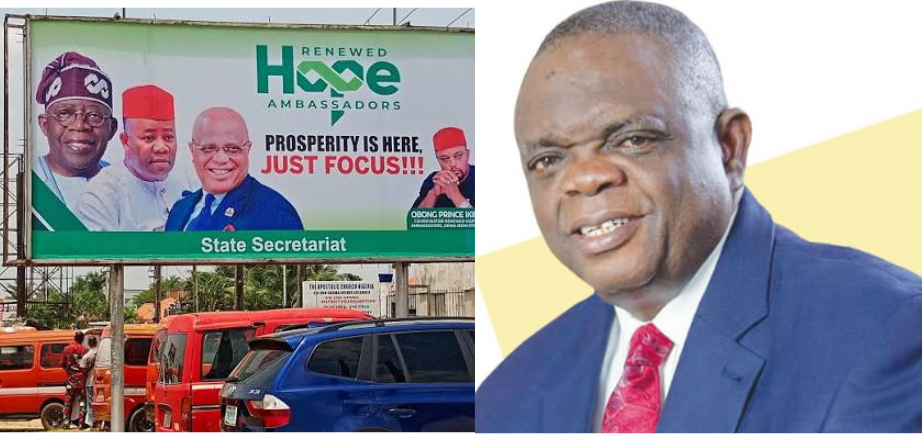
As campaigns gather momentum ahead of 2027, a dispute over billboard fees has exposed deeper structural challenges In Nigeria’s out-of-home advertising sector: multiple taxation, regulatory overlap, weak professional standards, and insecure investment.

The 2027 political season may still be gathering steam, but Nigeria’s out-of-home (OOH) advertising industry is already facing one of its defining tests. At the centre is a deceptively simple question: how much should it cost a political candidate to put a campaign message on a billboard?
In Abia State, the answer has raised eyebrows. The Abia State Structures for Signages and Advertising Agency (ABSSAA) has announced campaign advertising permit fees of N200 million for presidential candidates, N150 million for governorship candidates, N100 million for senatorial candidates, N50 million for House of Representatives candidates and N20 million for State House of Assembly candidates. The schedule was unveiled at a stakeholders’ forum in Aba themed “Order in Outdoors: Partnership for Safe Campaigns, Sustainable Revenue and a Cleaner Abia.”

The controversy goes well beyond the price of a billboard. It raises fundamental questions about regulation, access, investment, professionalism, and the sustainability of the OOH ecosystem.
The Advertising Regulatory Council of Nigeria (ARCON) has rejected what it regards as arbitrary political billboard charges. Its Director-General, Dr. Olalekan Fadolapo, argues that such fees are inconsistent with Nigeria’s advertising regulatory framework. “No, ARCON does not consider arbitrary charges consistent with Nigeria’s advertising regulatory frameworks,” he said, describing them as “not only inimical to Nigeria’s political atmosphere” but also “a fundamental menace to general out-of-home advertising and a threat to business and economic interests in Nigeria.”
While ARCON focuses on regulatory authority, the Outdoor Advertising Association of Nigeria (OAAN) views the controversy through a wider industry lens. For its President, Sola Akinsiku, PhD, FRPA, the fee debate is only the latest symptom of an industry already suffering multiple “traumas.”
A Sector Under Pressure
Akinsiku’s assessment is blunt. The industry, he says, is under the yoke of over-regulation, multiple taxation, excessive permit fees and levies, low entry requirements, unprofessional practices, and indebtedness.
The root problem, in his view, is that government departments and agencies at every level see OOH as a primary, and sometimes the only, source of internally generated revenue. “Unfortunately, however, there are hardly any corresponding contributions, in terms of provision of the relevant infrastructures to enhance productivity, or profitability in the sector,” he says.
That creates a paradox. The more visible and successful OOH becomes as a channel, the more attractive it is as a revenue source, yet the added financial demands make it harder for operators to expand and sustain the business. These challenges, Akinsiku says, “have made nonsense of every effort to make OOH businesses as productive as it should be.”
OAAN’s response is not resignation. “We are simply not giving up!” he says. The association intends to confront the structural roots of the problems through stakeholder engagement, in order to give the sector “a new lease of life,” with brands among the principal beneficiaries.
When Regulation Becomes a Business Risk
The fee controversy exposes the tension between regulation and commercial certainty. Fadolapo argues that state governments and their agencies may control outdoor structures within their jurisdictions, but that this is not an authority to vet and approve advertisements before exposure. “Neither State Governments nor their Signage agencies have legal authority to vet and approve advertisements, whether political or otherwise, before exposure,” he said, pointing to the ARCON Act No. 23 of 2022, which places that responsibility with the Advertising Standards Panel.
For operators working across several states, the result can be a different set of structures, permits, and charges in every location. For political advertisers, the stakes rise further in an election cycle. “The disparity will definitely create problems in the political stage in Nigeria,” Fadolapo warned.
OAAN’s concern is similar but rooted in market access. Akinsiku argues that states should keep to the tariffs already gazetted for billboards of different sizes and orientations rather than introduce special political charges. “Setting new fees payable for political campaigns is tantamount to shifting the position, or tampering with the size or height of the goal post after the game has commenced,” he says.
The consequence, he argues, is not just higher bills. It could distort competition. “It is not healthy for fair competition, and it simply means that it is only the very rich that can engage OOH platforms to connect with the electorate!”
There is a commercial irony as well. If campaigns become prohibitively expensive, fewer candidates will use OOH just when demand should peak. A policy meant to raise revenue could shrink the volume of legitimate advertising, and the income of billboard owners with it.
Protecting Investment in the Outdoor Landscape
Billboards are capital-intensive. Operators secure locations, build structures, maintain them and pay fees, so arbitrary removal is more than an inconvenience. It can undermine the business itself.
Akinsiku draws a careful distinction. Where an owner holds the relevant approvals and has met all financial obligations, the government should not remove the structure unless overriding public interest, such as road construction or expansion, demands it. Even then, he says, the owner should be compensated. The principle, then, is not immunity. It is predictability. Investors need to know the rules, comply with them, and trust that compliance buys real protection.
The Issue Of Professionalism
Perhaps the more uncomfortable issue is what happens inside the industry. Akinsiku does not blame the government alone. He admits OOH players have their share of unprofessional practices, including poor materials, inadequate production and foundation details, faulty installation, and “outright neglect of maintenance requirements.”
More troubling is an apparent conflict of interest, “officials of the regulatory departments also own locations, and directly compete with the regulated” He also points to individuals and organisations that ordinarily should not be in the business but have entered it, making the sector “an all-comers engagement” and producing what he calls “palpable charlatanism.”
OAAN says it is engaging stakeholders while insisting on ethics, orderliness and excellence.
Politics, Access, and Neutrality
With political advertising set to intensify, could operators be pressured to deny space to opposition candidates? Akinsiku says no such pressure is known to him, but if it happens, it would be “unfair and undemocratic,” and OAAN would oppose it.
Operators, he explains, are business owners rather than political actors. “They are in business to ‘sell’ and to make profit,” so every political organisation should have equal access to available platforms. That neutrality will matter more as prime outdoor locations become strategic campaign assets.
Towards a More Coherent Regulatory Ecosystem
The deeper question is where responsibility for OOH ultimately sits. Akinsiku notes that the constitution vests control of OOH media in local governments, while some states have partnered with councils and created signage agencies that effectively “warehouse that power.” His worry is that some agencies may act beyond the powers their enabling laws grant them, and OAAN’s answer is to insist on strict adherence to those laws.
ARCON, for its part, says it is engaging state governments to resolve concerns over additional approvals. “ARCON is reaching out to State Governments to amicably address the issues and find a permanent solution to it,” Fadolapo said, adding that ARCON recognises the constitutional role of local governments and wants the different tiers to complement one another rather than overlap. A healthy system should provide order without duplication, uncertainty or unnecessary barriers.
The Bigger Question
That may be the most important takeaway from the billboard-fee row. The debate should not end with whether a presidential candidate can afford a N200 million permit. The real question is what kind of OOH industry Nigeria wants to build.
An industry driven by permits, levies, and overlapping controls risks becoming ever more expensive and difficult to operate. One that combines clear regulation, professional standards, investment protection, fair access, and accountable operators can be a far stronger asset for brands, political communicators, cities, and the wider marketing communications economy.
The challenge for government, regulators, and the industry is to ensure that the pursuit of revenue does not undermine the sector that can generate lasting economic value. For brands and political advertisers alike, the payoff would be an outdoor ecosystem where visibility is not reserved for those who can pay the highest price, but is supported by a predictable, professional, and sustainable marketplace.