

An examination of Nestlé Nigeria’s agricultural partnerships, the farmers behind them and the challenges of building a dependable local supply chain
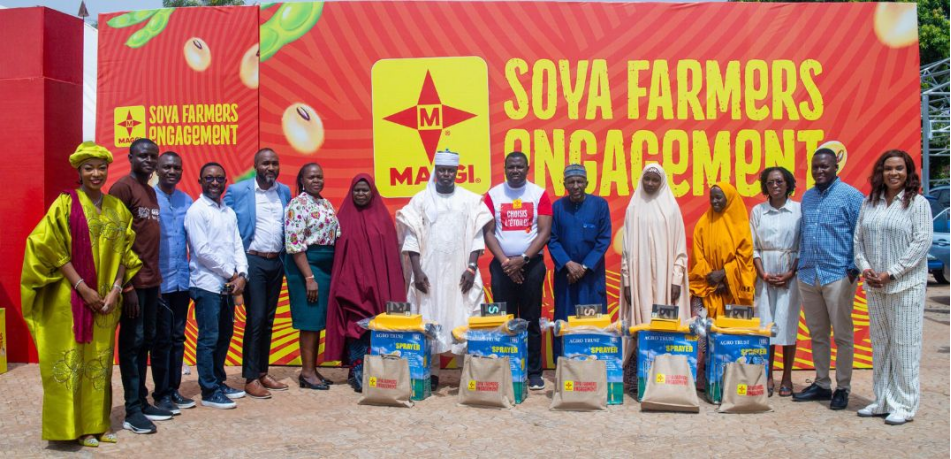
Farmers and project representatives at a MAGGI soybean-farmer engagement event, pictured in Nestlé’s October 2025 report on its regenerative-agriculture pilot.
Danjuma Yusuf, a farmer in Soba, Kaduna State, describes a problem that did not end with the harvest. Limited storage often meant selling his maize and soybeans early to local traders. He also described challenges with measurement practices and the prices offered for his produce.
Before participating in STreFaS, his farming practices included burning crop residues, clearing the soil extensively and relying heavily on rainfall. Through training provided by TechnoServe agronomists, he says he adopted minimal tillage and cover cropping, which helped retain soil moisture during dry spells.

Access to a more structured market also changed his experience. He described the use of digital weighing scales, the availability of a buyer and prompt payment as important differences from his previous trading arrangements.
“For the first time, I am not guessing my income. That steady paycheck is what allowed me to pay my children’s school fees in full this year, straight from the currency of my own dirt,” he said.
His experience highlights an important part of agricultural development that is sometimes overlooked: the conditions under which farmers sell their produce.
Improved cultivation practices can help farmers manage production risks, but the economic benefits may remain limited if they cannot access buyers offering transparent measurements, fair prices and dependable payment arrangements.
A farmer may have a good harvest, but that does not automatically mean the produce will reach an industrial buyer. There are questions of quality, storage, transportation, pricing and whether the buyer needs the quantity being offered. In dairy production, the challenge is even more immediate. Fresh milk must be collected and cooled quickly before its quality deteriorates.
In a 10 September 2025 interview with BusinessDay, Nestlé Nigeria’s Managing Director and Chief Executive Officer, Wassim Elhusseini, said more than 80 per cent of the company’s agricultural raw materials were sourced locally. That is management’s description of agricultural sourcing, not a claim that every ingredient, packaging material or factory input is Nigerian.
The figure points to the role Nigerian farmers and suppliers already play in the company’s operations. It also raises a bigger question: what does it take to build a local agricultural supply chain capable of meeting the demands of industrial production?
The grain production challenge
STreFaS is the Strengthening Farmers’ and SMEs’ Resilience through Climate Smart Grain Production and Accessing the Structured Markets project. Funded by AGRA and Nestlé and implemented by TechnoServe, it covers maize, soybean, rice and sorghum in Kaduna and Nasarawa. TechnoServe dates implementation from June 2024 to October 2027, with a public launch in Zaria on 6 May 2025. Its target is 25,000 smallholder farmers, including 20,000 in Kaduna and 5,000 in Nasarawa.
Its focus extends beyond increasing the quantity of crops farmers produce. It also seeks to improve agricultural practices and strengthen the connections between farmers, aggregators and structured markets.

Representatives of AGRA, TechnoServe and Nestlé at the STreFaS launch in Zaria, 6 May 2025.
TechnoServe’s project page reports 12,373 farmers engaged and 74,223.53 metric tonnes of produce aggregated from smallholders. These are the implementer’s reported figures. Engagement does not establish completion of training, and aggregation measures produce brought together for markets, not additional crops grown because of the project. The page does not give a clear reporting cutoff for these two totals or identify how much Nestlé bought.
An important part of that connection is the role of agricultural aggregators. These businesses collect produce from different farmers, consolidate volumes and help prepare agricultural commodities for larger buyers.
Their involvement matters because individual smallholders may not always have the capacity to supply industrial manufacturers directly. Aggregators can help bridge that gap, although they also need adequate storage, handling facilities, financing and transport capacity to operate effectively.
A connection to Nestlé and other formal buyers, as described by TechnoServe, also needs to be distinguished from a commitment to buy every farmer’s harvest. Dependable market access depends on the buyer’s quality requirements, the price and deductions, the quantity accepted and when payment arrives. Transparent weighing answers one of those questions, not all of them.
Storage is part of that commercial question. In a separate October 2025 report on training in Lafia, Nasarawa State, the International Institute of Tropical Agriculture emphasised timely harvesting, proper drying and clean, airtight storage to preserve grain quality. That work was not evidence of STreFaS results. It illustrates why finding an industrial buyer does not remove the need to handle grain properly after harvest.
Climate advice needs to be practical too. NiMet’s 2026 seasonal outlook projected variation in rainfall timing, including a longer rainy season in parts of Kaduna and Nasarawa. A forecast cannot establish what happened on Danjuma’s farm, but it shows why farmers need locally relevant planting and harvesting advice alongside cultivation training.
For Danjuma, the link between cultivation and selling is the point. Better farming practices may reduce production risks, but a farmer without storage or working capital may still need to sell quickly. Whether a structured buyer improves his return depends on what remains after the costs of growing, handling and moving the crop.
In dairy production, that need to reach a buyer is more urgent. Grain can be stored if it is handled properly. Fresh milk needs prompt collection and cooling.
The race to preserve fresh milk
Musa Dikko, a Fulani cattle herder around Paikon Kore in Gwagwalada, describes the search for water and pasture and the difficulty of getting milk to a buyer before it spoiled.
“We walked until our legs ached, and by the time we reached the local market, half the milk had spoiled in the calabash,” Dikko explains. “You either sold it at a massive loss or poured it into the dirt.”
Dikko describes changes in feeding and veterinary care after joining a cooperative linked to the Nestlé Livestock Development Project. He says these changes have improved his herd’s milk output. His experience shows why the practical requirements of dairy production extend beyond owning cattle.
“We know the heat is our enemy, so we have to rush straight from milking to the solar cooling centre before the sun ruins the batch,” he says.
Dikko’s experience illustrates why increasing milk production must go hand in hand with investment in collection and preservation facilities.
FAO identifies prompt cooling and access to refrigeration as central to preserving raw milk. Its guidance recommends cooling to around 4°C to maintain quality. Cooling needs to accompany hygienic milking and handling; a thermometer reading alone does not establish that milk is safe or suitable for processing.
Nestlé’s dairy engagement dates to 2019, while its February 2025 announcement describes the Livestock Development Project as inaugurated in 2021. The company’s 2024 annual report identifies Paikon Kore in the FCT and Laduga in Kaduna as project locations. The programme is delivered with CBI Innovations and 2SCALE, with support from the FCT Administration.
In February 2025, the company launched its Dairy Demonstration Farm in Paikon Kore. The facility is intended to demonstrate improved practices in cattle breeding, feeding, animal health and herd management.

Cattle feeding at Nestlé’s Paikon Kore Dairy Demonstration Farm, shown in the company’s 2025 launch post.
Nestlé says the farm is designed to demonstrate how breeding, feeding and herd management could raise output from about one litre per cow daily to potentially more than 10 litres. That is a stated productivity potential, not a measured result for Dikko’s herd or every participating farmer. Whether farmers can afford and sustain the required feed, water and animal-health services is part of the commercial test.
In its February 2025 announcement, Nestlé reported 83 dairy cooperatives and approximately 3,000 milk producers. It said daily collection at the Paikon Kore centre had risen from 200 litres in June 2021 to an average of 6,000 litres, with more than one million litres aggregated by the time of the announcement. These are historical programme figures, not independently measured current output. Collection from more producers can rise without a corresponding increase in yield per cow.
Nestlé’s 2024 annual report also records nine solar-powered milk collection points deployed across six communities. Deployment is an infrastructure milestone; dependable supply also requires the equipment to work, milk to reach it promptly and collected batches to meet the buyer’s standards. The report alone does not establish the current operation of every point.
The company said in February 2025 that its dairy-development investment since 2019 exceeded ₦1.8 billion around Paikon Kore and Kachia. This is a wider programme investment, not the construction cost of the demonstration farm alone or funding for STreFaS.
An April 2026 government announcement records a further agreement to establish a Dairy Technical Skills Development Centre. It followed the dairy-training collaboration announced in June 2025. A signed agreement establishes a plan; it does not establish that the centre is already open or delivering training.
But the development of a viable dairy sector requires more than individual facilities. It also depends on the availability of suitable cattle breeds, quality feed, animal health services, reliable transportation and a commercial market for the milk produced.
What local sourcing demands
The company’s own sourcing figure already indicates a substantial role for Nigerian agricultural suppliers. The harder question is how much more dependable that supply can become, and on what terms for the people producing it.
For smallholder farmers, access to structured markets is useful, but it does not remove every production challenge. They still need affordable inputs, access to finance, storage facilities and the ability to manage climate-related risks.
There is also the question of how local suppliers can sustain their operations beyond the period of formal development programmes. Agricultural businesses need sufficient working capital, technical capacity and dependable demand to continue supplying manufacturers.
The public programme figures show farmers reached, produce aggregated and infrastructure reported. They do not yet answer how much farmers keep after production and delivery costs, how consistently buyers accept their output, or how much of Nestlé’s requirements these projects supply.
The farmer in Soba still needs a market that recognises the value of his harvest. The cattle herder in Paikon Kore still needs a system that can collect and preserve milk before it spoils. And the manufacturer still needs a dependable supply of raw materials that meet its production requirements.
For the farmer, local sourcing has to work as a sale. For the manufacturer, it has to work as a supply chain. Training and collection facilities can help connect the two, but the test is whether farmers can keep supplying acceptable produce at a price that covers their costs, season after season.
