
More Than Business: How Nestlé Nigeria Is Transforming Communities Through Sustainable Development

Community development is a key driver of sustainable economic growth. A society cannot achieve meaningful progress when its people lack access to basic necessities such as clean drinking water, quality education, proper sanitation, a healthy environment and opportunities to earn a decent living. Investing in communities improves the standard of living, strengthens household incomes, promotes healthier families, and creates opportunities for businesses to thrive. They also contribute to national economic growth by developing a more productive population, reducing inequality and creating an environment where individuals and businesses can reach their potential.
For Nigeria, where many communities continue to contend with inadequate infrastructure, unemployment, environmental challenges and limited access to essential services, community development is more than a corporate social responsibility activity. It is an important contribution to national development. Increasingly, businesses are recognising that their long-term success is connected to the well-being of the communities in which they operate and the sustainability of the resources they depend on.
Nestlé Nigeria Plc has, over the years, embraced this responsibility through interventions covering access to potable water, education, youth empowerment, nutrition, environmental sustainability, women’s economic empowerment and livelihood development. Through its Creating Shared Value approach, the company has continued to invest in initiatives intended to improve living conditions while supporting economic opportunities and building more resilient communities.

From providing boreholes and water facilities to supporting small businesses, developing technical skills and encouraging environmental consciousness among schoolchildren, Nestlé’s interventions demonstrate how corporate investment can extend beyond commercial activities to touch people’s everyday lives.
Water access: Building infrastructure and community ownership
Access to clean and safe water remains one of the most important foundations of healthy communities. In areas where reliable water infrastructure is limited, families often spend considerable time searching for water, while the absence of proper treatment facilities can expose residents to health risks.
Nestlé Nigeria has invested in community water infrastructure over the years, particularly around its manufacturing locations in Ogun State and the Federal Capital Territory.
Its earlier interventions include the provision of two boreholes in Orile-Imo, Ogun State, in 2015, designed to provide safe drinking water to approximately 10,000 residents. In 2019, the company commissioned five additional water facilities in communities around its Flowergate factory in Sagamu, including Areke, Bara, Alamala Barracks and Owode Egba, as well as a facility in Abaji. Its subsequent interventions have included water and sanitation facilities in schools and host communities.
In 2021, for instance, Nestlé commissioned water and sanitation projects at Oke-Ona United School in Abeokuta and St Paul’s Anglican School in Orile-Imo, Ogun State, providing access to safe water and sanitation for about 2,000 people, including pupils, teachers and surrounding families.
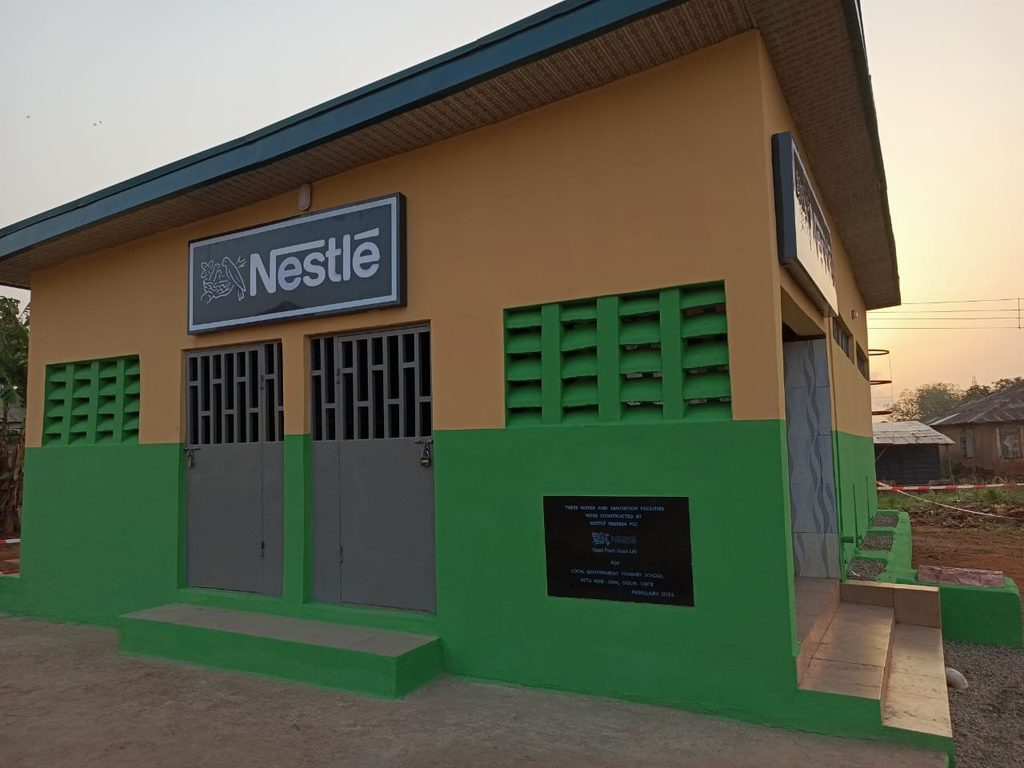
In 2024, the company also commissioned water and sanitation facilities at Wesley School 2 in Sagamu and Local Government Primary School, Ketu Adie Ovie, in Ado-Odo Ota.
Building on these interventions, Nestlé is advancing a wider Water Regeneration Project covering the Agbara catchment in Ogun State and the Abaji catchment in the Federal Capital Territory.
The programme is structured around four interconnected pillars: water access, water quality, water conservation and water governance.
It provides for 24 climate-smart boreholes, comprising eight in Agbara and 16 in Abaji, supported by water treatment plants, routine water quality monitoring, rainwater harvesting systems and practical water safety education.
As part of the programme’s sustainability framework, community Water, Sanitation and Hygiene (WASH) committees will be established and supported with governance training. These committees will help provide local oversight, clarify responsibilities for the safe operation of facilities, organise preventive maintenance, facilitate fault reporting and support regular water quality checks.
The initiative also includes the development of a governance training manual for water regeneration and stewardship, while the National Water Quality Advocacy Campaign and National Water Quality Handbook, developed with the Federal Ministry of Water Resources and Sanitation and OPS-WASH, are intended to extend water safety knowledge into homes, schools and institutions.
The eight climate-smart boreholes and water treatment plants in Agbara are scheduled for formal commissioning on November 4, 2026.
Beyond providing physical infrastructure, the programme’s emphasis on community ownership is important. By equipping residents with the knowledge and structures to manage water facilities, Nestlé is seeking to ensure that the benefits of the investment can be sustained over time.

Zaria: Putting women at the centre of economic development
Recognising the economic importance of women-led enterprises, Nestlé Nigeria introduced its Empowering Rural Women Initiative in 2021 to provide women retailers with business training, mentorship and opportunities to strengthen their businesses.
In August 2026, the company extended the initiative to Zaria, Kaduna State, where 50 women retailers received practical business training and product grants valued at three times their existing stock. The intervention also introduced a three-month mentorship programme to help the beneficiaries apply the knowledge acquired, manage their expanded inventory and build sustainable businesses.
The training covered bookkeeping, merchandising, stock management, financial management and customer service. With the addition of the Zaria beneficiaries, the initiative has reached 482 women entrepreneurs across Nigeria.
For Zainab, one of the beneficiaries in Zaria, the intervention has provided an opportunity to improve not only her business but also the way she manages money and organises her daily activities.
Before the initiative, managing her finances and arranging her goods were among the challenges that affected the smooth running of her business. Keeping track of money, knowing when to restock and arranging products effectively were not always easy.
The training has helped her develop a more organised approach to business management.
Speaking about the initiative, Victoria Uwadoka, Corporate Communications, Public Affairs and Sustainability Lead at Nestlé Nigeria, has emphasised the importance of supporting women who contribute to the company’s retail network and creating opportunities for them to grow alongside the business.
The Zaria intervention reinforces the importance of investing in women as contributors to economic development, rather than viewing them merely as beneficiaries of corporate assistance.
Abaji: Equipping young Nigerians with skills for employment
In Abaji, in the Federal Capital Territory, Nestlé’s contribution to community development has also taken the form of technical and vocational education. The challenge of youth unemployment in Nigeria is closely connected to the gap between formal education and the practical skills demanded by employers. Addressing this gap requires more than encouraging young people to seek jobs; it requires equipping them with competencies that make them employable and productive, and that is what Nestlé Nigeria’s Technical Training Initiative was set up to address. Established in 2011 at its Agbara factory, it has expanded to three locations: Agbara, Abaji and Flowergate in Ogun State. The programme provides practical training in engineering, manufacturing and food technology, leading to City and Guilds of London Technicians’ certification.
In May 2026, the company graduated 20 trainees from its Abaji Technical Training Centre as part of activities marking 15 years of the initiative. The 18-month programme combines classroom instruction with practical experience, preparing participants for careers in technical and industrial fields.
Nestlé reported a cumulative investment of more than ₦6 billion in the initiative. Its training centres had produced 289 graduates by the May 2026 milestone, while its reported employment transition rate for graduates stood at 98 per cent. These figures suggest that the programme is not simply about issuing certificates but establishing pathways into the workplace.
At the graduation ceremony, Nestlé Nigeria’s Managing Director and Chief Executive Officer, Wassim Elhusseini, encouraged the graduates to approach their careers with confidence, discipline and a willingness to continue learning.
He noted that the skills acquired through the programme provided a strong foundation for their professional journeys, adding that success would depend on their ability to keep learning, adapting and applying themselves.
Yusuf Buhari, one of the beneficiaries of Abaji training, said the programme represents an opportunity to move beyond the uncertainty of searching for employment without practical experience.
In his words, “Before the training, I had an interest in engineering but lacked the practical knowledge to compete for technical jobs. The opportunity to work with equipment, learn from experienced professionals and obtain an internationally recognised qualification has given me greater confidence. I now have skills that can help me build a career and support my family.”
The broader community benefits when young people acquire marketable skills. They become potential employees, entrepreneurs, trainers and contributors to local economic activity. Technical education also strengthens Nigeria’s manufacturing sector by
helping to develop the skilled workforce required to sustain industrial growth.
Lagos: Turning schoolchildren into environmental ambassadors
In Lagos State, Nestlé Nigeria has taken community development into the classroom, recognising that environmental responsibility must begin early if sustainable behaviour is to become part of everyday life.
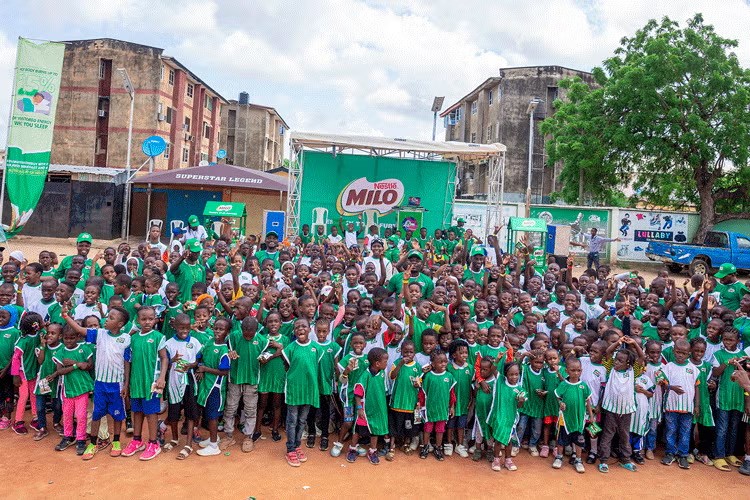
Through the MILO Elevate Recycling Initiative, more than 60,000 children across 100 primary schools in Lagos collected over one million used MILO wrappers in activities marking World Environment Day 2026.
The initiative combined a school recycling competition with practical environmental education. Pupils learnt about waste segregation, responsible disposal and the importance of recycling, while participating in an activity that connected classroom lessons with real environmental challenges.
An interesting dimension of the programme was the involvement of Rotaract District 9112, which led an upcycling project that transformed the recovered wrappers into 1,013 items, including school bags, lunch bags and pencil cases. These items were donated to participating schools and awarded to top-performing pupils.
Speaking at the awards ceremony, Gilbert Tweneboah-Koduah, Category Manager for MILO at Nestlé Nigeria, said:
“Through the Elevate Recycling Initiative, we are encouraging children to understand that small everyday actions can create meaningful environmental impact.”
Stephen Avoseh, Deputy Director of the Lagos State Universal Basic Education Board, also highlighted the importance of taking environmental education into schools, noting that children could share the lessons they learnt with their families and communities.
Speaking about her experience, Tobani Chibuike, a pupil from one of the participating schools, said the experience goes beyond collecting wrappers for a competition.
In her words, “I used to think that an empty wrapper was just rubbish to be thrown away. Now I understand that waste can block drains and contribute to flooding. I have learnt to separate materials that can be recycled and to encourage my friends and family to keep our surroundings clean.”
The programme also demonstrates how schools can serve as effective channels for community development. By introducing children to environmental responsibility, Nestlé is helping to nurture a generation that understands the relationship between individual choices, public health and the sustainability of the environment.
Also, for 26 years, MILO has contributed to youth development through grassroots sports programmes. Through the Elevate Recycling Initiative, the brand is extending its commitment to nurturing future champions beyond the values of sports, by helping children develop environmental awareness and positive sustainability habits.
Sagamu: Creating pathways into technical careers
Sagamu, Ogun State, is another important location in Nestlé’s youth development activities through its Flowergate Technical Training Centre.
In April 2026, 20 young Nigerians graduated from the centre after completing technical training under the company’s Needs YOUth initiative. The programme, which has operated for 15 years, provides young people with practical experience in technical disciplines and manufacturing.
The initiative is particularly relevant to communities where young people may have educational qualifications but limited access to industry-specific experience.
Expressing his gratitude, Frank Babatunde, one of the graduates, said, “The training has changed how I see my future. Instead of depending entirely on the availability of general employment opportunities, I now have technical skills that can help me work in manufacturing and engineering. It has given me a sense of direction and the confidence to pursue a professional career.”
The significance of such investment extends beyond the individual graduate. Skilled young people contribute to industrial productivity, improve household incomes and strengthen the talent pool available to Nigerian businesses.
Environmental sustainability and the wider community impact
Nestlé’s environmental interventions extend beyond school-based education and water conservation to include plastic waste recovery, recycling partnerships and community clean-up activities.
In June 2026, the company launched a multi-stakeholder environmental coalition to scale up environmental action across 12 locations nationwide. The initiative brought together government agencies, environmental regulators, industry associations, recyclers and development partners to strengthen waste collection and recycling systems.
According to the company, its partnerships with organisations including Chanja Datti, Wecyclers and MECOM have helped recover more than 60,000 metric tonnes of plastic for recycling since 2019. This is a cumulative achievement spanning several years, not a figure attributable exclusively to the November 2025–November 2026 reporting period.
The company also disclosed that its Employee Plastics Collection Scheme had recovered more than 12,000 kilogrammes of plastic since 2022.
Speaking at the coalition launch, Victoria Uwadoka said: “Waste management outcomes improve when intervention shifts from awareness alone to shared accountability across the value chain.”
The initiative reflects an understanding that environmental sustainability requires cooperation among manufacturers, government institutions, recyclers, communities and consumers.
Creating shared value for a better future
Across Zaria, Abaji, Sagamu and Lagos, Nestlé Nigeria’s community development activities demonstrate how investments in people, infrastructure and environmental sustainability can contribute to social and economic progress.
For Zainab, the opportunity is to manage a stronger and more organised business. For Yusuf and Frank, technical education has provided a pathway towards professional careers. For Omotola and Tobani, environmental education has created an opportunity to influence the habits of young people and their families. For communities around Agbara and Abaji, the planned water infrastructure represents another step towards improved access to safe drinking water and stronger local water governance.
However, the true measure of community development is not simply the number of boreholes constructed, women trained, graduates produced or wrappers collected. It is the extent to which these interventions translate into lasting improvements in people’s lives.
Continued investment, transparent monitoring, effective partnerships and community participation will therefore remain essential to sustaining the gains.
As Nigeria pursues inclusive economic growth, businesses have an important role to play in supporting the communities that contribute to their operations and long-term success.
Nestlé Nigeria’s interventions illustrate how this responsibility can be translated into practical action, creating opportunities for individuals, strengthening local economies and promoting environmental sustainability.
Ultimately, the most meaningful measure of business success is not only what a company produces or the markets it serves, but also the positive difference it makes in the lives of the people and communities around it.
