

The word, ‘’Empowerment’’ has many definitions. However, one common thread among them is that empowerment means giving strength. Simply put, to empower an individual is to provide all the knowledge and tools he or she needs to excel. The muscle behind that strength is the paraphernalia of performance that the individual needs.
For women, empowerment obviously means providing the apparatus they need to amplify their presence in society. It was former US President Barak Obama who smartly drove home the point when he declared, ‘’empowering women isn’t just the right thing to do–it’s the smart thing to do’’

Women empowerment involves promoting their self-value by providing opportunities for them to excel. To empower a woman is to give her the power to determine her own choices, without fear or constraint.
For women, empowerment can be done under 4 major categories: political, economic, educational, and psychological. The political process guarantees women’s presence and influence in the power framework. From past trends there seems to be an entrenched social discriminatory creed against women, empowering them will help quench such biases.

The economic category will ensure that withheld tangible and intangible resources such as assets, knowledge, wealth, empowerment, and information are made available for women’s access and utilization. Learning to read and write, having knowledge of her rights, and education are all very critical to women’s empowerment. As a woman discovers her capabilities, she is more likely to start believing in herself and perform above average.
One incontestable truth about women’s empowerment is that it is the key solution to several societal headaches. Empowerment of women not only benefits them but extends to families, communities, and the world at large. Progress without women’s inclusion is almost impossible.
However, it’s a haunting reality that even with the clamor for women’s empowerment, ladies globally are still facing huge challenges. In the Acholi tribe of Northern Uganda, as well as some tribes in the South- Eastern Nigeria, women are not allowed to own land and other resources. Such a woman cannot launch a business without consultation and blessings from her husband. In Mexico, women have a more equal opportunities to work but face domestic violence.
It’s a well-known fact that empowering women and girls is the single biggest catalyst for unleashing human development and economic growth – worth an estimated $28 trillion by 2025. Yet, some women are limited to the role of housewives, with little room for personal growth. They are also denied leadership positions.
What about lack of education? Rape and domestic violence rise daily at an alarming rate. It’s impossible to ignore the gender pay gap, with women working like men and getting a lower payment. What about sexual harassment in the workplace?
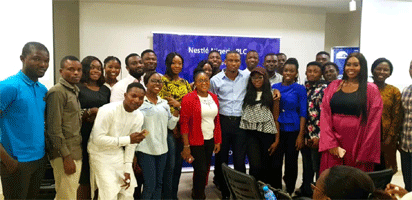
Remarkably, efforts are being made to address the challenges of women’s empowerment in many quarters. An example is the Nestlé Empowering Rural Women in Nigeria Project, pioneered by Nestle PLC. To recognize and elevate the impact of women in society, the high-flying food and beverage company launched the project to aid rural women within its chain of distribution to boost their income.
The beneficiaries comprise female retailers given grants valued at 300% of their monthly sales in form of Nestlé products. In addition, training and mentorship programs were made available for the beneficiaries. The project is one of the Creating Shared Value (CSV) initiatives employed by Nestlé to raise robust communities by improving livelihoods.
In August last year, the project began in North Central Nigeria, with the induction of the first 50 women from Abuja suburbs. Late into that same year, November, the project progressed to the South West and added an additional 50 beneficiaries, selected from Ede, Ilesha and Osogbo axis in Osun State. In February this year, 50 inductees from Obolo-Afo and Nsukka axis of Enugu State benefitted immensely from the project.
As 50 women have been recently inducted into the project in Port Harcourt, Rivers State, 200 female beneficiaries have so far been contacted from the project. The project aims to reach 300 women across the country before the year 2022 expires.
Speaking at the induction in the South-South which was the fourth phase of the Nestlé empowering project, Nestlé Nigeria’s Commercial Manager, Khaled Ramadan said: “We are happy to fulfil our promise of expanding Nestlé empowering rural women in Nigeria project to reach more women in other parts of Nigeria.
“We are pleased with the progress made so far by the 150 currently benefiting from the project. The beneficiaries who currently enjoy the training and mentorship provided by Nestlé and her implementation partners – FDConsults, are reporting faster turnover and increased revenue as well as stronger visibility of their outlets within their locations.
Testimonials to Nestle’s impact in this area are vast. One of the popular one reported in the media is that of a beneficiary from Obolo-Afor in Enugu State, Mrs. Peace Eze, She said, “I am very happy to have been selected to benefit from this program. I am going home with good news. With what we were taught today, I now have the knowledge to support my business to grow. With the help of the goods that Nestlé is also giving to us, I have everything I need to make my business succeed. I thank Nestlé for this important initiative, it will help all the women benefiting from the programne a lot.”
Obviously, It is of utmost importance that women are recognized and supported in every society. By empowering women, decisions are made with them, not for them. For the progress of any economy, its women must be granted access to resources, and be free to determine their own choices.
When a woman is empowered, her contribution to the citizenry increases. She attains her full potential, contributes to the workforce, and boosts her self-confidence. In addition to these, there is a decline in poverty and an increase in economic growth. All these are made possible when she is empowered enough to pursue her personal and professional goals.
In our modern-day world, the greatest barrier to women’s empowerment still remains cultural norms—societal rules that are unfair to women. Those rules are so deeply entrenched that researchers refer to them as ‘unconscious bias’. Women are seen as emotionally or physically incapable to take on some jobs. A woman isn’t to own a car if her husband doesn’t have one. A woman is to behave in a certain way, lest she is seen as loose and uncouth. Women are to conform to traditional standards of beauty. It is always a question of what is and is not ‘okay’.
The truth is, for the advancement of any society, the position of a woman must be uplifted. Such a society must fine-tune to a point where social and cultural norms support rather than hinder women. Such a society must be fair to women, granting them equal rights and access to networks, knowledge, education and skills. In decision-making and employment, they must be thoroughly considered. A society where women are safe from harm. A society that grants economic security to women. Indeed every society must be rated by the way it treats the weaker ones in its midst.
At present, El Salvador is one of 14 countries in the world with women holding at least 50% of ministerial posts. This is a staged strategy by the government to level the playing field for women to be actively involved in policy formulation and decision-making in the country. In Europe there is a level playing field that should be emulated across the world. The Germans once had a female Chancellor in the person of Angela Merkel. 45-year-old Giorgia Meloni was recently sworn in as Italy’s first female prime minister. The UK has seen many female Prime Ministers this century.
Investing in opportunities for women could have tremendous economic and social value. If women farmers had the same access as men to training, information, and resources, they could increase production on their farms by up to 30% or more which would be a definite plus for the food bank. And on a wider scale, a recent study estimated that women’s equal participation in the labor market would increase the global GDP by 26%, or $28 trillion. Moreover, women’s economic empowerment not only promotes greater economic development but greater equity, opportunity, and social progress.
Women empowerment goes beyond ensuring women get their basic rights. It also covers their aspects of choice, freedom of expression, self-sufficiency, and most importantly, equality. When presented with the right support, women are liable to shine the brightest in any room. Be it an astronaut, mechanic, event planner, or head of state, women can perform excellently well if given the chance.
Is it possible for a community to grow when its women are neglected? Can a country move forward when its female citizens are denied growth? For the full growth of any country, women’s empowerment should be taken as one of the most essential sectors. A woman can lead if only given a chance through empowerment because they have that ‘can-do’ spirit. As Margaret Thatcher said, “If you want something said, ask a man; If you want something done, ask a woman.”