


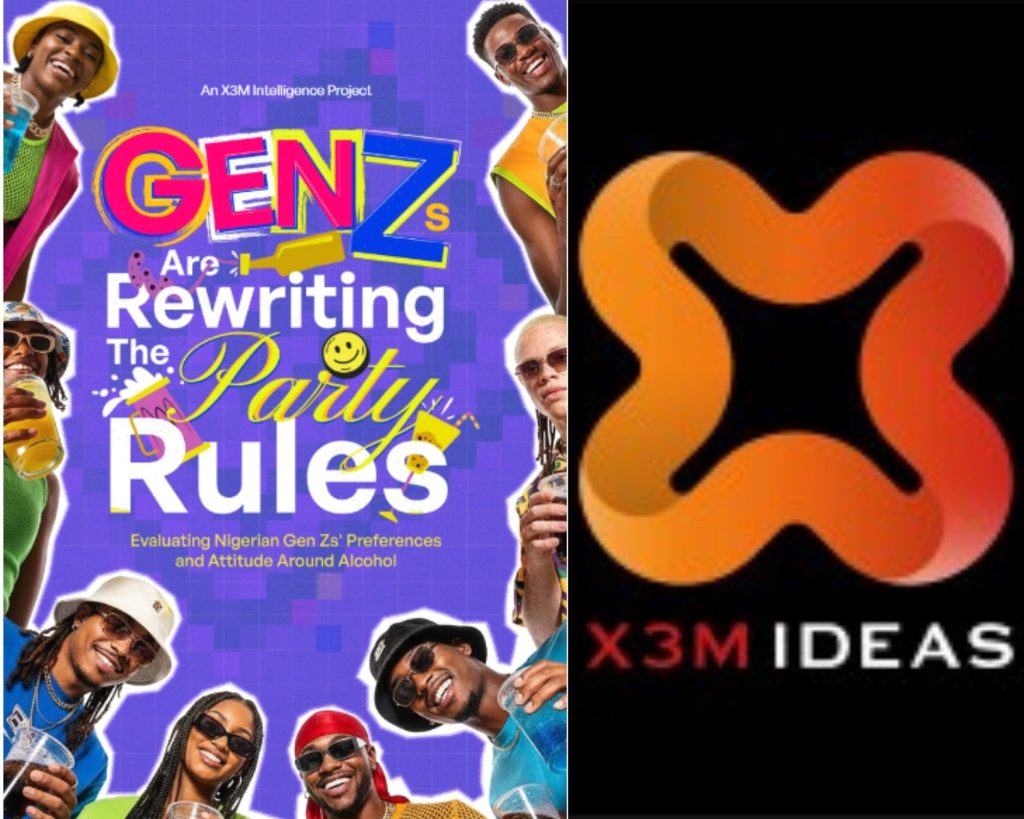
The prevailing assumption that Nigeria’s Generation Z is turning away from alcohol has become one of the most discussed themes in contemporary consumer marketing. Across global reports and industry commentary, younger consumers are frequently portrayed as sober-minded, health-conscious and increasingly detached from traditional drinking culture.

But according to a new consumer intelligence study unveiled by X3M Intelligence, the insights and strategy arm of Nigeria’s reigning agency of the year, X3M Ideas, that narrative, while directionally accurate, fails to capture the full complexity of what is unfolding in the Nigerian market.
The more strategic question, the agency argues, is not why Gen Zs are not drinking, but whether marketers have been asking the wrong question altogether. The study which was presented by the agency’s Strategy Lead, Ayode Omolola to stakeholders in the marketing communications, consumer goods and beverage industries at the Lagos Marriott Hotel Ikeja in Lagos last Friday offers one of the most comprehensive local studies to date on how Nigerian Gen Z consumers relate to alcohol.
The report combines large-scale quantitative research with qualitative observations to deliver a detailed portrait of a generation that is not rejecting alcohol, but redefining the role it plays in their lives.
Based on a nationwide online survey involving 1,015 respondents aged 18 to 28 who had consumed alcohol within the last three years, alongside two focus group discussions involving 15 participants from urban and semi-urban Lagos, the study captures the attitudes and behaviours of 1,015 young Nigerians across multiple life stages, from undergraduates and corps members to young professionals, freelancers and entrepreneurs. The respondent base was evenly balanced by gender, comprising 475 male and 540 female participants.
Central to the research is the deceptively simple question: has alcohol consumption among Nigerian Gen Z increased or decreased? The answer, according to X3M Intelligence, is both clear and commercially important.
Acknowledging that there is indeed a decline in the alcohol consumption habit of GenZs, the study however shows that alcohol remains culturally relevant, socially symbolic and strategically important. Gen Z is still drinking, only more selectively, more occasionally and more intentionally than previous generations.
A Generation of Occasional, Purpose-Driven Drinkers
The study’s headline finding is that Nigerian Gen Z is not a frequent-drinking generation. In fact, 74.3 per cent of respondents said they drink only rarely or occasionally. Specifically, 40.1 per cent reported drinking “once in a blue moon,” while 34.2 per cent consume alcohol just one to three times per month. Only eight per cent said they drink regularly at least once a week, while five per cent said they drink only when they go out. Another 12.7 per cent said they no longer drink at all.
When respondents were asked how their alcohol consumption had changed over the past two years, nearly three in five, representing 56.2 per cent, said their consumption had decreased either significantly or slightly. By contrast, only about 14 per cent said their drinking had increased. Roughly 29.9 per cent reported that their drinking habits had remained the same.
For X3M Intelligence, this does not signal an anti-alcohol movement. Instead, it reflects what the agency describes as a “re-approach” to alcohol, where consumption is shaped by context, mood, identity and values rather than routine or peer pressure.
Why Gen Z Drinks: Connection, Celebration and Taste
If Millennials helped normalise alcohol as part of lifestyle culture, Nigerian Gen Z appears to be reframing it as an occasional, mood-driven social ritual.
The study identifies three primary motivations for drinking.The strongest driver is connection. Some 41.7 per cent of respondents said they drink during bonding moments with friends, family and colleagues. Another 30.8 per cent cited celebrations and milestones, while 29.5 per cent said they drink because they enjoy the taste and the opportunity to experiment with flavours.
These findings suggest that alcohol is valued less for intoxication and more for the experiences it enables. It serves as a social lubricant, a celebratory symbol and a vehicle for culinary exploration.One focus group participant, a 24-year-old software engineer, summed it up succinctly when he explained that alcohol gives him “that little push” that helps him relax and connect with others.
Surprise surprise! Wine Leads the New Drinking Hierarchy
Perhaps the report’s most commercially relevant revelation is the emergence of wine as the undisputed favourite among Nigerian Gen Z consumers. Wine ranked as both the most purchased and the most consumed alcohol category. It accounted for 42.4 per cent of purchases and 47 per cent of overall consumption. Vodka followed at 36 per cent, while whiskey came in at 32.5 per cent. Table wine and flavoured beer each attracted roughly one-quarter of respondents. Indeed, this is a shift from earlier generations, where beer and stronger spirits were more dominant.
According to the report, wine’s popularity stems from its smoothness, sweetness, versatility and perceived sophistication. It can be consumed alone or shared, during intimate gatherings or celebrations, making it especially attractive to a generation seeking balance, control and aesthetic appeal.
Cocktails Now the Fastest-Growing Expression of Drinking Culture
While wine dominates category rankings, cocktails emerged as one of the most culturally resonant findings in the study. Despite not being included as a formal survey option, cocktails were repeatedly mentioned by respondents in both quantitative and qualitative responses. Favourite choices included Long Island Iced Tea, Cosmopolitan, Screaming Orgasm, Strawberry Daiquiri, Chapman Remix, Palmwine Spritz, Zobo Sangria and Mojito.
For Gen Z, cocktails are experiences that are colourful, customisable, camera-ready and highly shareable. They combine taste, theatre and social currency in a way that aligns perfectly with the generation’s desire for experimentation and visual storytelling. This explains why X3M Intelligence believes the Nigerian market is primed for a new wave of ready-to-drink alcoholic beverages that replicate the cocktail experience with greater convenience.
The Retail Landscape
The study also sheds light on how Gen Z accesses alcohol. Supermarkets emerged as the leading purchase channel, cited by 46.3 per cent of respondents. Yet one of the more revealing findings is that 39.3 per cent of respondents said they often consume alcohol supplied by friends or family members rather than purchasing it themselves.
Bars, lounges and clubs were mentioned by 32.4 per cent of respondents, confirming that experience-led environments remain important despite cost pressures.
The report breaks down drinking behaviour across life stages and finds that undergraduates exhibit the greatest fluctuations in alcohol consumption. About 17.1 per cent of undergraduate respondents reported significant decreases in drinking, reflecting their sensitivity to disposable income, academic calendars and inflation.
Among employed respondents, only nine per cent reported significant decreases, suggesting relatively stable habits supported by regular income.
Postgraduate and NYSC participants recorded a 5.2 per cent significant decline, while entrepreneurs, freelancers and those in transitional phases also reported reductions.
Loyalty Is Fluid, Switching Is Strategic
Consumer loyalty among Gen Z appears far less entrenched than in previous generations. According to the report, 47.7 per cent of respondents still drink the same types of alcohol, but 19.4 per cent have switched to different categories. Another 17.5 per cent no longer drink at all, while 15.4 per cent admitted they do not pay close attention to what they consume.
The leading reasons for switching include better taste, the desire for change, health concerns, curiosity and the search for smoother drinking experiences.
The report’s switching analysis reveals that beer often serves as an entry point into alcohol but is increasingly abandoned as tastes evolve. Vodka remains popular but highly interchangeable. Wine is experiencing what the report describes as a “glow-up,” while whiskey has become an aspirational choice associated with maturity and status.
The Rise of Alternatives
Notably, the study shows that Gen Z’s experimentation extends beyond alcoholic beverages. Fruit juices, smoothies and milkshakes attracted 412 mentions as preferred substitutes, while mocktails received 358 mentions and malt drinks 345 mentions. Energy drinks also featured prominently.
Beyond beverages, respondents identified weed with 180 mentions, edibles with 89 mentions, vaping with 68 mentions and shisha with 64 mentions as alternative ways to achieve social stimulation and relaxation.
The implication is that alcohol is no longer the sole gateway to altered states or social belonging. It is one option among many.
One of the report’s most interesting sections beyond alcohol, is the profile of Gen Zs as a broader cultural force. X3M Intelligence describes them as skeptical by default, entrepreneurial by instinct, digitally native yet surprisingly inconsistent with technology, culturally proud and deeply invested in identity.
They are monetising everything from content creation to dropshipping, embracing “Naija-ness” with confidence, and joining niche communities where individuality and belonging coexist. Perhaps most importantly, they care more about authenticity than legacy. Brands that feel forced or out of touch can lose relevance quickly, regardless of how iconic they once were.
Under the leadership of Steve Babaeko, X3M Intelligence has produced a report that goes well beyond category analysis. It offers a strategic roadmap for brands seeking relevance in an era where consumers are increasingly deliberate about every aspect of their choices.
The real insight, therefore, is not that Gen Z has stopped drinking. It is that a generation defined by identity, wellness, taste and intentionality is rewriting the rules of consumption. For brands that understand this shift, the opportunity is enormous. For those that do not, the market may prove increasingly difficult to decode.