
AI In Advertising: Anyone Can Drive, But Not All Can Race Like Hamilton, Babaeko Tells Global Audience At Cannes

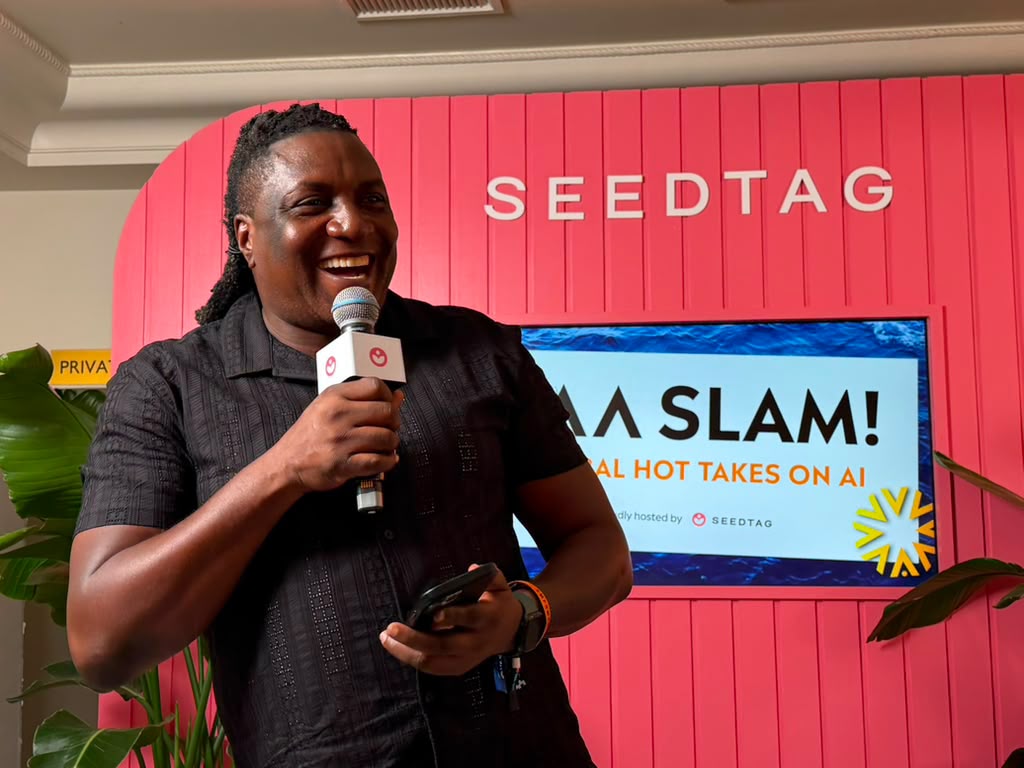
Steve Babaeko, Group CEO and Chief Creative Officer of X3M Ideas and Vice President and Area Director for Africa on the Global Board of the International Advertising Association (IAA), has urged advertising and marketing agencies to stop treating access to artificial intelligence tools as a competitive advantage, arguing that the real industry conversation should be about judgment, craft and taste rather than just the usage of AI.
Babaeko made the remarks at the first-ever IAA Slam, held on the sidelines of the Cannes Lions International Festival of Creativity in France, where he was among a lineup of global AI thought leaders convened to share perspectives on the technology’s impact on the marketing and creative industries. The Slam, which had an open-mic, collaborative format, formed part of a busy week of IAA programming in Cannes that also included the United Nations of IAA Dinner and an Open House for Good session.
Delivering what he described as his “hot take on AI,” Babaeko built his argument around an extended comparison between driving a car and racing one, using Formula 1 world champion Lewis Hamilton as his central reference point. “Everyone can learn to drive a car,” he said. “Give me three weeks and a quiet car park, I will have you parallel parking and doing the school run. But everyone who can drive a car. How many of them can drive like Lewis Hamilton?” That distinction, he told the gathering, represents “the AI conversation our industry is not having properly.”
The X3M Ideas chief acknowledged that the rapid spread of generative AI tools has unsettled many agencies, but argued that the anxiety is misplaced. “Right now every brief writer, every junior strategist, every client with a laptop has the same AI tools we do,” he said. “The cost of producing something has collapsed. A script, a deck, a campaign idea. Anyone can generate it in seconds.” He added that this development “has a lot of agencies panicking,” but insisted “it should not,” noting that “access to a car has never been the same thing as mastery of a car.” According to him, “the fact that everyone can now get behind the wheel does not make everyone a racing driver. It just makes the gap between average and exceptional more visible than ever.”
Babaeko went further to break down what, in his view, separates a champion driver from an ordinary one, and by extension, what separates a skilled creative professional from someone simply operating an AI tool. “It is not that he presses the pedals harder,” he said of Hamilton. “It is judgment under speed. Knowing exactly when to brake into a corner everyone else is afraid to take fast. Reading conditions other drivers cannot read.” He summarised the point with a line that drew visible reaction from the room: “Hamilton does not out-drive the car. He gets more out of the car than the car was built to give.” That, he said, “is exactly what separates a great creative from a great prompt.”
Turning directly to the technology itself, Babaeko described AI in purely instrumental terms. “The AI is the car,” he said. “Fast, powerful, it will go wherever you point it. But pointing it well, knowing which corner to take aggressively and which one to slow down for, knowing what a culture will actually feel rather than what a model predicts it should feel, that is craft.” He maintained that this craft “still belongs to us, if we choose to keep earning it,” placing the burden of relevance back on creative professionals rather than on the tools they use.
From there, Babaeko issued what amounted to a three-point challenge to agency leadership attending the festival. First, he called on agencies to stop marketing their use of AI as a differentiator. “Stop selling access,” he said. “If your pitch deck still says ‘we use AI,’ that is a driving school advertising that they own a car. Nobody is impressed. Everyone owns the car now.” Second, he urged a redirection of training budgets away from tools alone and toward the people using them. “Invest in the driver, not just the garage,” he said. “Tools change every quarter. Judgment, taste, cultural instinct, that compounds over years. Spend your training budget there, not just on licenses.” Third, he challenged the industry to be candid about the limits of artificial intelligence, particularly in culturally specific contexts. “Get honest about what AI cannot read,” he said. “It cannot read a room in Lagos traffic. It cannot read an Afrobeats chorus landing at exactly the right second. It cannot read history, irony, or the weight of a proverb. We can. That is not nostalgia, that is our actual commercial advantage.”


Babaeko closed his address with a line that has since been widely shared among delegates and on social media: “AI did not lower the value of creative work. It exposed who actually had craft in the first place.” He ended with the framing that gave his talk its title, telling the room, “Everyone can drive the car now. The only question worth asking is: who is driving it like Hamilton?”
Babaeko’s appearance at the IAA Slam comes weeks after his election to the IAA Global Board as Vice President and Area Director for Africa, a position in which he has been charged with driving the association’s growth across the continent, amplifying African voices in global marketing conversations and strengthening collaboration among practitioners, brands and creative communities. He is a former two-term President of the Association of Advertising Agencies of Nigeria (AAAN), a Visiting Fellow at Henley Business School in the United Kingdom, and was named one of Adweek’s Top 100 Creatives in the world in 2019. He has also served on juries for the New York Advertising Festival, the Loeries, the African Cristal Awards, D&AD Awards, the Pitcher Awards Festival and AD Stars.
Under his leadership, X3M Ideas has grown from a Nigerian start-up into one of Africa’s fastest-growing independent agency networks, with offices in South Africa, Zambia, Kenya, Congo Brazzaville, Dubai and London. The agency remains the only Nigerian and West African agency to have won a Cannes Lions Award, having broken what was described as a seventy-year jinx for the country at the festival. Babaeko’s remarks at the IAA Slam add to a growing body of commentary from African creative leaders positioning the continent’s cultural specificity and contextual fluency as a distinct advantage in an industry increasingly shaped by generalised AI tools.
What an insight! Drive differently
Very thought provoking on AI in the creative industry.