

…Says Effective Storytelling Critical To Understanding Government Policies, Programmes
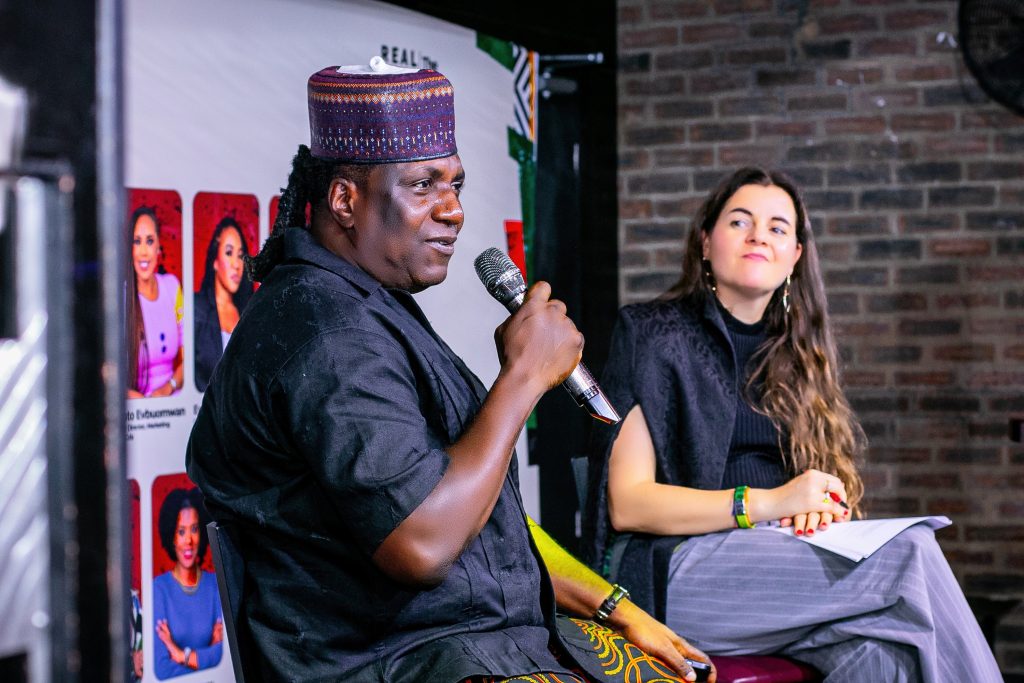
As Nigeria approaches yet another election cycle, Group CEO and Chief Creative Officer of X3M Ideas, Steve Babaeko, has urged the federal government to make strategic use of the country’s advertising and creative talent, arguing that effective storytelling is critical to helping citizens understand government policies and programmes.
Babaeko, who is also Vice President and Area Director, Africa, of the International Advertising Association (IAA), made the call during a fireside conversation with Katharina Link, CEO of Pulse and Business Insider Africa, at the inaugural Nigerian edition of the Real Talk/The Debate Series Lagos organised by Women in Marketing Africa (WiMAfrica), in collaboration with Women in Advertising (WIA) and Kantar.
The conversation, held at La Bamba, Ikeja, Lagos, was themed “From Creative Ambition to Impact: Is Nigeria Realising its Creative Potential?” and covered the country’s creative capacity, advertising, brand ambition, global competitiveness and the relationship between government and the creative industry.

Responding to Link’s question on what he would like to see from the next government to make creative excellence more commercially viable and sustainable, Babaeko offered a three-pronged prescription that include government should communicate its achievements more effectively, protect and incentivise the advertising industry, and give Nigerian agencies greater priority in government advertising and strategic communications.
Babaeko argued that regardless of political affiliation or views about the performance of the current administration, there are policies and initiatives that government believes it has implemented successfully. The problem, in his view, is that these achievements have not been communicated in a manner that reaches ordinary Nigerians in language and formats they understand.
“Unfortunately, I don’t think they’ve been able to articulate the things they’ve done well in such a manner as for it to percolate down to the bottom of the pyramid for everybody to understand it,” he said. For him, the solution is not a shortage of talent. Nigeria, he stressed, has an abundance of storytellers capable of translating complex government policies into compelling narratives.
“If I was the government, all I’m going to do is look across the country and pick the top 20 storytellers and build a war room for them and throw them in there,” he said. The assignment of such a team, according to Babaeko, would be to tell the stories of government activities and translate them into local languages and narratives so that citizens across the country can understand them.
Babaeko’s proposition is that communication should become part of the process through which policies are understood, interpreted and ultimately judged by citizens. This is particularly important in an election season, when competing political narratives can easily overshadow policy communication.
In Babaeko’s view, government should not leave the task of explaining its policies to chance, social media commentary or political rhetoric. It should deploy professional storytellers who understand how to turn policy into narratives that resonate with different audiences.
The second part of his prescription concerns the industry itself. Babaeko believes Nigeria’s advertising industry remains undervalued despite the role it plays in supporting businesses, creating employment and helping brands communicate with consumers.
He quoted an old IAA proposition which, in essence, links the health of advertising to the health of the businesses that depend on it. When advertising works, he argued, the businesses that depend on effective communication are better positioned to survive and retain jobs; when advertising fails, the consequences can extend beyond agencies to the wider economy.
His recommendation is therefore for stronger regulatory enforcement and incentives that can help the industry become more sustainable.“A is the regulator to be able to regulate better, and then whatever tax breaks, whatever incentive you can give the industry, it will be nice to give it to them,” he said.
The call for stronger regulation is notable because Nigeria already has a statutory framework for regulating advertising practice. ARCON, established under the Advertising Regulatory Council of Nigeria Act 2022, is responsible for regulating and controlling advertising, advertisements and marketing communications, including the registration of practitioners and the establishment of professional standards.
ARCON’s licensing framework also requires advertising organisations operating in Nigeria to obtain appropriate licences, with specific provisions governing national and foreign agencies. For Babaeko, however, regulation should not simply be about policing advertising. It should also help create an environment in which legitimate Nigerian practitioners can compete, invest in talent and build globally competitive businesses.
That leads to his third recommendation: government procurement. Babaeko wants legislation or policy that gives qualified Nigerian agencies the first opportunity to handle government advertising and communications briefs. “If you’re going to call for maybe some kind of bid, the right of first refusal should go to local agencies first,” he said.
He questioned the practice of bringing foreign political strategists and communication consultants into Nigeria during election seasons when local professionals possess a deeper understanding of the country’s political, cultural and linguistic complexities.
He argues that outsiders cannot understand Nigeria in precisely the same way as professionals who have lived, worked and built their careers within the country. “So, if you really want to build this country, the same way we are saying, oh, we are no longer going to be exporting shea butter unless it is processed, it is the same way we should also register that we’re not going to be importing advertising people unless we use the local ones.”
Babaeko’s position is that if government is serious about building a local creative economy, it should treat the sector as an industry capable of generating employment, intellectual property and international competitiveness, rather than simply as a supplier of publicity materials.
His comments also connect with his broader advocacy for African creative capability. As Vice President and Area Director, Africa, of the IAA, Babaeko has increasingly positioned African creativity as a force that should be represented more strongly in global marketing conversations.