
Beyond Empowerment: How Nestlé Nigeria Is Helping Women Build Better Lives For Their Families & Communities

For many Nigerian women, the day begins long before the rest of the household wakes up. There are meals to prepare, children to get ready for school, businesses to open, and countless other responsibilities competing for attention. Between caring for their families and trying to earn a living, many women carry the weight of keeping their homes running, often with limited resources and little room for financial mistakes. Yet, behind these daily struggles are women with dreams, ambitions and an extraordinary determination to give their families a better life. When these women are given the right opportunities, knowledge and support, the impact can be felt far beyond their immediate circumstances. That understanding has driven Nestlé Nigeria’s commitment to women’s empowerment for years.
For Nestlé, empowering women is not just about providing support or celebrating their achievements. It is about recognising their potential and helping them turn it into something meaningful and sustainable. Through initiatives that support women entrepreneurs, improve nutrition knowledge and create opportunities for community participation, the company has continued to invest in women as important contributors to family well-being and national development.
A little support, a big difference

To an outsider, a small neighbourhood shop may not look like much. To the woman behind the counter, it is school fees, food on the table and the hope of depending less on others.
For many rural female retailers, the problem is not a lack of determination. It is limited stock, little training in managing money and no capital to expand. A woman can serve customers all day and still wonder why so little is left after restocking.
These are some of the challenges Nestlé Nigeria’s Empowering Rural Women Initiative seeks to address. Launched in 2021, the Empowering Rural Women Initiative addresses these gaps with practical business training, product grants and mentorship.
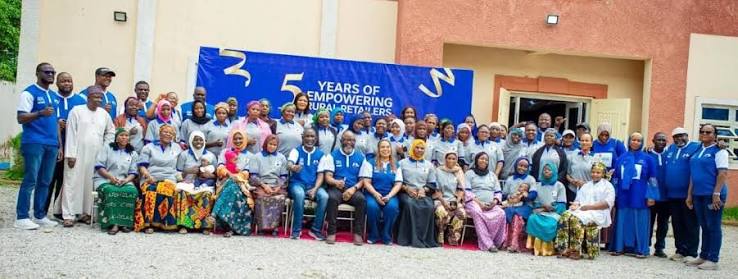
In August 2026, Nestlé marked the initiative’s fifth anniversary and 10th edition in Zaria, Kaduna State, supporting another 50 female retailers. They received training in bookkeeping, merchandising, stock management, financial management and customer service. They also received product grants worth three times their existing stock and began a three-month mentorship programme.
With the Zaria cohort, the initiative has reached 482 women across Nigeria. Nestlé’s monitoring data from earlier editions shows that more than 80 per cent of participants have sustained and expanded their businesses, with many reporting higher turnover, larger inventories and sharper financial skills.
Amina Yusuf, one of the Zaria initiative’s beneficiaries
Every morning, Amina opens her provisions shop in Zaria. She knows most of her customers by name, and the shop is how she contributes to her family’s survival.
Speaking about how, before the training, she said she had no real idea where her money went. “I sold all day and was tired every night, but I could not tell you if I was making a profit. Money from the shop and money for the house were in the same pocket,” she explained.
Learning to record her sales and track her stock changed that. “Now I write everything down. When I see my numbers, I know what to buy and what to leave. I am not guessing anymore,” She revealed.
The extra stock matters too. A fuller shelf means she can serve customers who once left empty-handed. A better-run business means a more dependable income, and that shows up at home in school fees, meals and household needs.
The value of someone to guide you
The testimony of Zainab Ibrahim, another beneficiary from Zaria, shows why the initiative includes mentorship. Receiving stock is one thing; knowing how to manage it is another.
Talking about her experience with the initiative, Zainab said, “The grant was a blessing, but the mentor is the one who sat with me and showed me how to use it. When I had a problem, I had somebody to ask.”
That is the purpose of the three-month mentorship. With guidance from mentors and local distribution partners, participants apply what they have learnt, work through challenges and make better decisions. Nestlé is not simply handing over products to women but helping them build the capacity to run their businesses long after the support ends.
When women gather, families benefit
Empowerment is more than financial independence. It also means having the knowledge and confidence to make decisions that improve family life.
In many Nigerian homes, women decide what the family eats and how limited resources are used. They are often the ones working out how to prepare nutritious meals on a tight budget. Nestlé recognises this role through MAGGI’s engagement with women at the traditional August Meeting in South-Eastern Nigeria.
For generations, August Meeting has been a cornerstone of social and cultural life for women in the region. Women return to their communities, reconnect with relatives and friends, discuss issues affecting their families and celebrate the bonds that unite them.

In 2026, MAGGI expanded its August Meeting engagement to reach 19,670 women across five South-Eastern states, more than doubling participation from the previous year. The programme partnered with 30 women’s associations and held five market activations. There were cooking demonstrations, culinary competitions, music and gifts, alongside practical nutrition education on balanced diets, dietary diversity, iron and other micronutrients, and making healthy choices within a budget. Women also learnt about the role fortified foods, including MAGGI products fortified with iron, can play as part of a varied diet.
Reaction Participants
Chinyere Okafor one of the participants and a member of a women’s association in Enugu State, Chinyere knows the strain of stretching a budget like many mothers. There are school expenses and food to buy, yet she still wants her children to eat well.
Speaking about her experience at the August meeting, she said, “I always thought good food meant expensive food. At the meeting, I learnt that a balanced plate is about variety, and that iron matters for my children. I can do that with what I can afford.”
She takes the ideas home, talks them over with her family and shares them with neighbours. “When one woman learns something at the meeting, the whole street hears it before the week ends,” she would add. What begins as a conversation at a women’s gathering can shape meals in many households.
Also in Ebonyi State, Ngozi Nwankwo, another participant, shows what these associations offer. “In our association, nobody carries her problem alone,” she might say. “We talk, we learn from each other, and we realise that what troubles one of us troubles many.”
At the 2026 celebrations, that spirit was clear. Christianna Nwibo, an executive of the Catholic Women Organisation in Nwofe, Ebonyi State, spoke warmly of her MAGGI experience, praising the food, the gifts and the activities.
Funmi Osineye, Category Manager, Culinary (MAGGI), Nestlé Nigeria, described the August Meeting as a powerful expression of women’s role in strengthening families, preserving traditions and driving community progress. The 2026 edition carried extra meaning as MAGGI marked 60 years in Nigeria, celebrating the women who have been part of its story across generations.
Agbara: the same belief, a different community
The commitment to women retailers extends beyond Zaria. In July 2025, Nestlé supported 49 female retailers in Agbara, Ogun State, with business training, product grants and a three-month mentorship programme.
Bisi Adewale, a small-business owner in Agbara, stands for the women this support is designed to reach. She keeps customers satisfied, watches her stock and ensures the shop stays profitable, all while managing family responsibilities.
“Before, I did everything by memory and by feeling,” she said. “Now I keep records, I know my stock, and I make decisions with confidence. Even when the day is hard, I am not afraid of my own business.”
Together, Agbara and Zaria show how seriously Nestlé takes the economic importance of women who run small businesses.
What “shared value” really means
These activities connect to Nestlé’s Creating Shared Value philosophy, the idea that business growth and community development reinforce each other. Women account for approximately 60 per cent of Nestlé Nigeria’s retail distribution network. They are the familiar faces behind neighbourhood shops, the people customers trust and the entrepreneurs who keep everyday commerce moving.
At the initiative’s fifth anniversary, Boladale Odunlami, Commercial Manager, Nestlé Nigeria, stressed the importance of investing in the skills and businesses of women who contribute to the company’s growth. Strengthening their businesses, he explained, improves their earning potential while building a more resilient retail network.
Victoria Uwadoka, Corporate Communications, Public Affairs and Sustainability Lead, Nestlé Nigeria, added that the true measure of the initiative lies in what the women go on to build after receiving support.
That captures sustainable empowerment. It is not about how many women attend training or how many products are distributed. It is about whether women use the opportunities to strengthen their livelihoods and create better possibilities for their families. That more than 80 per cent of earlier participants have sustained and expanded their businesses is an encouraging sign.
When one woman moves forward
Across Nigeria, millions of women quietly work to secure their families’ futures. Some run shops; others farm, process food, trade, or lead community associations. Their contributions are sometimes taken for granted, but their impact is hard to overlook.
Through the Empowering Rural Women Initiative, women retailers are gaining practical tools to strengthen their businesses. Through MAGGI’s August Meeting engagement, women are gaining nutrition knowledge and stronger community ties. The approaches differ, but the purpose is shared: helping women improve their lives and the lives of those around them.
Ultimately, the true story of empowerment lives in everyday possibilities. It is the woman who opens her shop each morning, the mother who wants her children to have a better start and the community leader who believes women working together can solve common problems.
By continuing to invest in women, Nestlé Nigeria is supporting more than individual ambitions. It is contributing to stronger households, more resilient communities and a future in which women have greater opportunities to realise their potential.
