
Hacking Survival: How @Officialladyfaith Is Using DIY Energy Solutions To Tackle Nigeria’s Cost Of Living Crisis

It is not uncommon to hear the roar of petrol and diesel generators echoing across the industrial and commercial areas of Lagos and other states of Nigeria. But with the seemingly unending feud affecting fuel prices around the world, coupled with unreliable power, this last resort is affecting many businesses and putting a dent in many people’s pockets.
Business owners and low-income individuals are struggling due to the high utility bills, this however, has encouraged a rise in tech innovation from bottom up. Many individuals are coming up with solutions within their own homes and kitchens.
Across the oil rich region of Niger Delta, many ordinary people are noticing how their old ways of doing things are no longer giving them a safety net. With the constant hike in cost of utilities, they’re learning to fall back on quick fixes within their homes. This has influenced low and middle income families to think differently about their energy costs and become Do-It-Yourself (DIY) engineers.

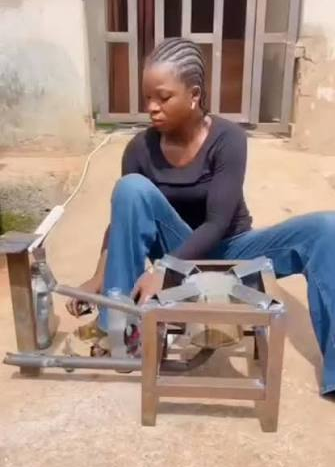
One such individual is @Officialladyfaith, a local housewife and community resource builder who has turned her home into a DIY energy and utility centre. She has developed various energy saving and general alternative solutions to avoid paying unending, rising bills.
DIY Energy Saving Solutions
@Officialladyfaith’s main innovations are: LPG saving energy solution
She built a bespoke and efficient gas stove for cooking. Using local valves, strong fittings and bespoke burner heads, she has reduced gas usage by 35-40% compared to standard burners.
By using smaller valves and wrapping the burner with recycled reflective alloys, she has reduced gas wastage. This means her food cooks quicker and uses less gas.
Off-grid energy solution
To reduce reliance on petrol powered generators, @Officialladyfaith has built an energy system using recycled deep cycle batteries, step up transformers and bespoke wiring. This enables her to run high energy appliances like blenders, fans and lights.
Having knowledge of the energy consumption of her devices, @Officialladyfaith has built an inverter using two capacitors connected to a bank of recycled 12v car and marine deep cycle batteries. This allows her to overcome the high surge issues that come with starting devices like electric motors found in heavy duty blenders. As most cheap inverters cannot cope with this issue.
“When you calculate what it costs to run a 3.5kVA generator just to blend tomatoes or run a fan for a few hours, the math simply doesn’t work for an average family or small shop owner.” I needed to identify what resources I had access to. I had to understand some basic electrical theory however I have built a system that will save me money, she explains whilst showing off her batteries powering a 600 watt blender. I looked around and identified what materials I had. I then used my knowledge of basic electrical theory to create something that will give me energy without costing me a fortune.”
Energy Crisis and MSME Loss
@Officialladyfaith’s creativity demonstrates how impactful this issue is. Micro, Small and Medium Enterprises make up over 84% of employment in the country and contribute 48% of the nations GDP (SMEDAN & NBS).
However, energy costs are significantly high for small businesses, with costs amounting to 30-50% of overhead expenditure, thereby putting micro businesses at risk whenever fuel prices start rising.
Small businesses located in key trading centres like Lagos, Aba, Kano and Port Harcourt are paying more for energy solutions than they are for raw materials or rent. This is causing a drain on resources which could have been invested back into their businesses. When fuel prices fluctuate, it causes an instant direct effect on the informal sector. The resultant chain effect is an increase in prices of consumer goods and services.
“What we are seeing in the informal sector is a rational, market-driven survival response. When the formal sector isn’t providing or is too expensive, people use their own ingenuity to overcome the issue. Individuals like @Officialladyfaith are implementing DIY solutions to increase their chances of succeeding as a home or micro business. They have reduced the barriers to entry for energy independence by using DIY battery solutions”, says Dr Chinedu Eke, Enterprise Economist based in Port Harcourt.
The use of small petrol generators, also known as “I pass my neighbor”, are impacting the environment in the long term. The fumes and noise from these generators are causing poor working conditions in busy market stalls. Using battery energy banks, even if being built using DIY methods, means much less noise pollution and less overall carbon production. This is an unintentional green switch.
DIY Energy Solutions with Non-Commercialised Intent
What makes @Officialladyfaith’s work so impressive is that she is not making money from these ideas. She is using her home as a public prototype, thereby invariably teaching local food vendors and housewives how to recreate her solutions using easily available parts.
Her home, projected on youtube and other social media has become a DIY workshop for locals. People bring old car batteries, faulty inverters and old wiring to watch how she puts them to use. @Officialladyfaith shows the public, through her youtube channel how to solder, understand polarity and insulate.
Her social media community education includes:
Cost Saving
By using her battery energy system, the public can save up to 60% on the costs of running their devices. This means they will have no fuel costs to pay every day. This money can then be used for food, education and healthcare.
Safety and Ease of Use
By using a low voltage DC to AC system and sealed fittings, this reduces the risk of fire. As most people live in high density accommodation, using a fuel source can result in accidental fires. Using battery energy instead reduces the risk of fire in the community.
Local Trading
Everything is purchased locally from scrap yards, electrical suppliers and hardware stores. This increases micro trading. As there is demand for second hand batteries and old wiring, this creates a local circular economy. Local mechanics and scrap dealers will benefit.
Although her energy solutions are DIY, this demonstrates that businesses are not only surviving due to government policies but also the ability to adapt from the bottom up.
DIY Energy Solution and Circular Economy
Looking further into @Officialladyfaith’s energy solution, we can see how important the thriving scrap and electronics industry is in Nigeria. Thousands of batteries are recovered each month from industrial sites, telecom towers and old vehicles.
Within a formal industrial economy, these would be classed as electronic waste however, in @Officialladyfaith’s “homeshop” they are seen as underused resources. By checking the capacity and replacing dead batteries/cells with electrolyte fluid, she can get these batteries working again.
CIRCULAR ENERGY SOLUTION
Commercial Waste – Industrial scrap and old batteries
Reuse & Repair – Battery capacity check, replacing dead cells
Replacing electrolyte fluid & rewiring
Community Benefit – Low cost off grid energy for local businesses
This circular economy means the total cost of building an off grid energy bank is greatly reduced. For example, a solar generator or lithium energy station providing 1000W of energy can cost between ₦500,000-₦1,200,000. This is far beyond the budget of an average employee in Nigeria who earns ₦50,000 per month. However, @Officialladyfaith’s lead acid solution costs under ₦60,000 to build. This means energy independence is achievable for low income families.
Industrial Policy
Whilst the country is struggling to catch up with energy policies, we need to take notice of these solutions. Often top down policies take a long time to implement and can be very costly with complicated infrastructure.
By identifying the power of grassroot initiatives such as @Officialladyfaith’s, government bodies and private companies can help this movement. This can be done through setting up micro grants, safety training and standardised safety protocols for second hand batteries.
Instead of looking at these DIY engineers as inferior and unsafe, we should see them as vital to our energy independence. By training micro innovators with standardised safety protocols, we can avoid any electrical risks.
Corporate Insight
@Officialladyfaith’s DIY energy solutions provide valuable insight to corporate leaders, policy makers and industrialists. Her work shows us that products must be designed to make the most out of limited resources. They must be easy to repair and have low running costs.
For consumer goods manufacturers, food processors and appliance designers, this shows us that products must be designed for developing countries. Products requiring constant high voltage electricity will lose market share to energy efficient devices that can use multiple energy sources.
Corporate Social Responsibility and Creating Shared Value strategies should look at investing in local innovation centres. By funding technical vocational training for grassroots tinkerers and promoting local circular economy, we can provide sustainable development.
The informal sector is the best asset Nigeria has during this time of change. Innovators like @Officialladyfaith are bridging the gap between understanding and adapting, demonstrating that adapting to economic crises isn’t only decided in boardrooms but also in kitchens and local workshops.
