


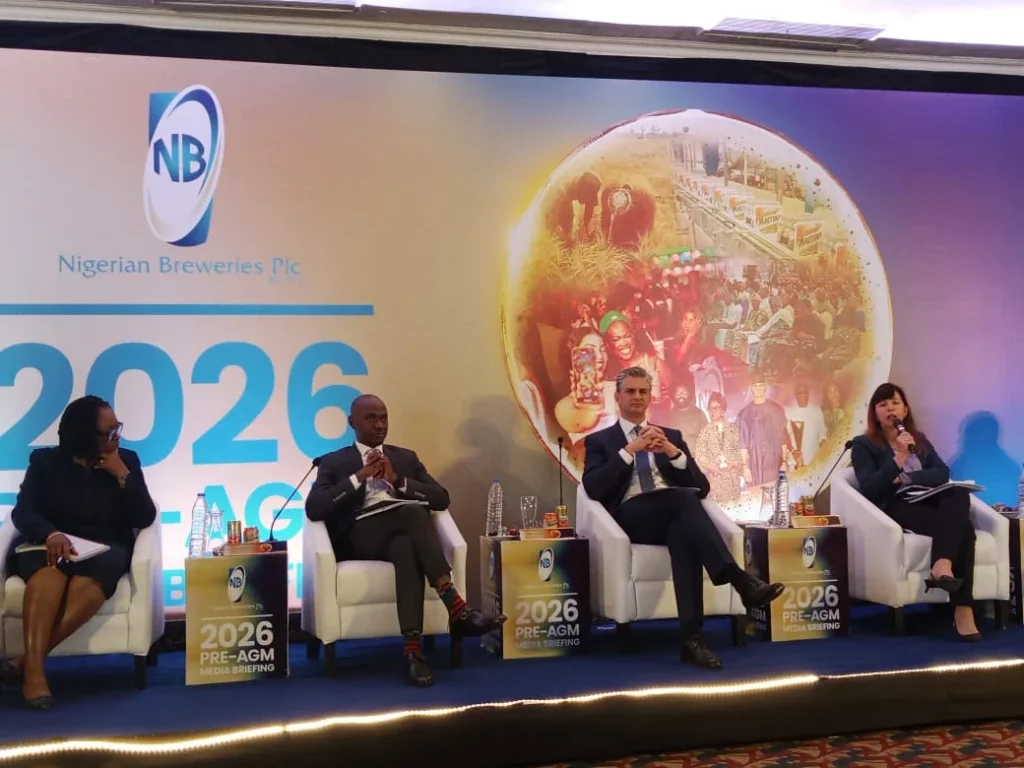
Nigerian Breweries Plc has said that scenario planning, reduced FX exposure, stronger liquidity, disciplined cost management, and supply chain localisation are part of its multi-layered strategies that will anchor its growth and resilience in what it describes as a “very volatile” 2026 operating environment.

Top executives of the company, including Managing Director Thibaut Boidin; Uzodinma Odenigbo, Corporate Affairs Director; Maria Karaseva, Finance Director; Grace Omo-Lawai, Human Resource Director and Uaboi Agbebaku, Company Secretary/Legal Director, revealed this recently at its pre – 80th Annual General Meeting (AGM) media roundtable in Lagos. They outlined how this framework is designed to absorb shocks from foreign exchange volatility, inflationary pressures, and policy uncertainty.
According to Thibaut Boidin, Managing Director at Nigeria Breweries, the brewer is moving decisively from crisis recovery into a more deliberate phase of financial fortification, building what management calls a “financial shield” to avoid a repeat of the heavy losses recorded in recent years.
This strategic reset follows a strong financial turnaround in 2025. After two years of losses triggered largely by currency devaluation and macroeconomic shocks, the company returned to profitability. Revenue rose to about N1.47 trillion from N1.08 trillion in 2024, while profit after tax rebounded to roughly N99 billion from a loss of N144.9 billion. Profit before tax climbed to about N161 billion, reversing a loss of over N180 billion, and operating profit surged by nearly 194 per cent.
Managing Director, Thibaut Boidin, described 2025 as a defining year. “You can see that on all the key metrics, we outperformed what we expected,” he said, adding that the company delivered “close to N100 billion” in net profit and successfully transitioned “from a negative cash position to a positive one.”
Beyond the numbers, Boidin emphasised that the experience reshaped how the company manages risk. “We learned a lot in the last few years how to navigate a crisis, how to work in a better way, how to focus on the key components of winning and growing,” he said, noting that those lessons now underpin the company’s shock-absorption framework for 2026.
At the heart of this framework is a more structured approach to planning. “What we’re doing differently is we build our plans for this year based on scenarios,” Boidin explained. “We mapped all kinds of scenarios to make sure that we know how to respond to any case.”
He added that this forward-looking approach is already proving valuable. “We were not expecting the Middle East crisis, but we anticipated it because we did scenario planning,” he said.
To ensure agility, the company has introduced continuous monitoring. “We have a weekly meeting on these macroeconomic triggers, and every week we measure what the impact will be,” Boidin added, marking a clear shift from the reactive posture seen during the 2023–2024 FX crisis.
A key pillar of the strategy is the near elimination of foreign exchange exposure. After suffering significant losses linked to naira devaluation and FX-denominated obligations, the company has moved to reduce that risk sharply.
Finance Director, Maria Karaseva, confirmed the shift. “As of today, we don’t have forex liabilities in the form of borrowing or investment needs anymore,” she said. Total borrowings fell from over N200 billion in 2024 to about N59 billion in 2025. “Forex-denominated debts went down to zero, which significantly improved our financial position,” she added.
At the operational level, the company is also reducing import dependence through localisation. Management says the share of local suppliers has increased significantly, supported by initiatives such as its barley development programme. Still, Karaseva noted that policy support remains critical: “We are looking at policies that will help unlock access to financing for our farmers.”
Liquidity has also emerged as a major buffer. After years of deficits, the company ended 2025 with a positive cash position. “We are now cash positive, and we have resources to navigate difficult environments,” Karaseva said, highlighting improved working capital management and operational efficiency.
Cost discipline remains central, but management insists it will not undermine core priorities. “We will continue strong cost management, but without compromising what is important, quality, safety, and salaries,” Boidin said, signalling a more balanced approach compared to previous periods.
The brewer is also recalibrating its pricing strategy. “In the past, we had to pay a price to stay afloat. Now we are planning to price substantially less,” Karaseva explained, citing weak consumer purchasing power as a key concern heading into 2026.
Despite the improved outlook, risks remain. Management identified inflation, currency volatility, and broader macroeconomic instability as the most significant threats, alongside political and policy uncertainties, as Nigeria approaches another electoral cycle.
With its balance sheet stabilised, the company is now shifting toward expansion. “We were focused on recovery for the last three years. We are now focusing on growth,” Boidin said, pointing to opportunities across both premium and mainstream product segments.
However, shareholders will not receive dividends for 2025 despite the return to profit. “As long as retained earnings are negative, the law does not allow you to pay dividends,” Karaseva said.