


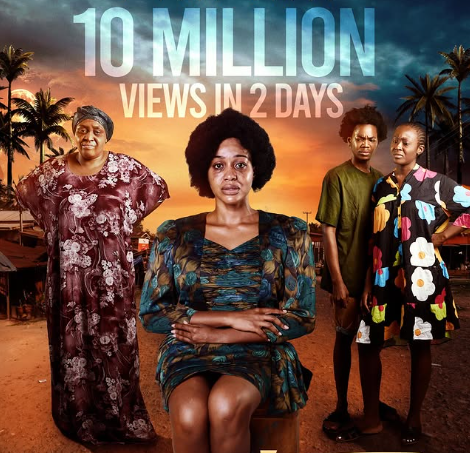
Within 22 hours of its release on May 2, 2026, Uche Montana’s Monica 2 had clocked an astonishing six million views on YouTube. By the close of its first day, the film had surpassed 7.6 million official views on the platform. Day two saw it cross the 10 million marks, with over 80,000 comments registering audience engagement. By day three, figures publicly displayed on the platform had pushed past 13 million views, with sustained daily momentum showing no sign of slowing. The original Monica, which premiered on March 7, 2026, had itself crossed 13 million views within two weeks of its debut, averaging close to one million views daily in its early run, and has since recorded approximately 19.6 million views in its first month, making it one of the top-performing Nollywood titles on YouTube in recent times.

Nollywood’s Economic Weight
To fully appreciate what Monica 1 and 2 represent, one must understand Nollywood’s impact on Nigeria’s economy. According to the U.S. International Trade Administration’s Nigeria Media and Entertainment Country Commercial Guide (2025), Nigeria’s film and music sector contributed approximately ₦1.97 trillion (USD $1.4 billion) to the country’s GDP as of 2023, a 27.5% increase over just three years.

Nollywood is globally recognised as the second-largest film industry in the world by volume, producing roughly 2,500 films annually, according to the same source. The sector employs over one million Nigerians directly and indirectly, a figure that the Nigerian Entertainment Conference’s 2023 report projects could climb to 2.7 million as digital distribution platforms scale. Nigeria’s entertainment and media industry as a whole is forecast to reach $13.89 billion by 2027, per industry projections cited by multiple economic analysts, driven by a youthful population, increasing mobile internet penetration, and the growing global appetite for African-led storytelling.
It is worth noting that Nollywood’s economic importnce was not even formally counted in Nigeria’s GDP until a landmark 2014 rebasing exercise after which the Nigerian economy jumped from an initial estimate of $285.5 billion to $510 billion, as documented in a 2016 report by the International Monetary Fund (IMF). Nollywood went from economic invisibility to accounting for 1.42% of GDP almost overnight. By 2021, according to a PwC Nigeria report cited by the U.S. Trade Administration, that contribution had grown to 2.3%, or approximately $660 million (₦239 billion). The trajectory is clear, and the Monica franchise is a living data point within it.
The digital-first model that Monica employs is particularly significant from a business standpoint. By distributing directly via YouTube rather than through traditional cinema or television gatekeepers, Montana bypasses overhead costs while accessing global audiences instantaneously. This model allows for real-time performance analytics, audience feedback loops, and direct monetization, all of which represent a leaner, more agile revenue architecture for independent Nollywood creators.
When Brands Follow the Audience
The commercial logic of high-viewership YouTube Nollywood is perhaps best illustrated by what happened with Omoni Oboli’s ‘Love in Every Word’, which premiered in March 2025 and rapidly became a benchmark for digital distribution in the industry. The film pulled over two million views within its first 24 hours on YouTube, climbing to 4.3 million within 72 hours. By the time its sequel was announced, Love in Every Word had surpassed 30 million views, leading Zikoko to report that an estimated one in every eight Nigerians had watched it.
The numbers did exactly what large numbers tend to do: they attracted brands. When Omoni Oboli confirmed production of the sequel, Love in Every Word: The Wedding, she arrived with a commercially significant announcement, a confirmed sponsorship roster that included UBA Group, Coca-Cola Nigeria, MTN, Close-Up Nigeria, Knorr Nigeria, Vaseline Nigeria, GIG Logistics, GAC Motor Nigeria, Mamador Nigeria, Peak Milk, and Lipton Nigeria, according to the Nollywood Reporter.
This was not product placement in the traditional Nollywood sense. This was cross-sector brand investment spanning banking, telecoms, beverages, food, personal care, logistics, and automotive, a signal that corporations now view high-performing YouTube Nollywood as a legitimate media buy, comparable to premium broadcast advertising.
As Techpoint Africa reported in November 2025, the brand presence in Love in Every Word 2 “Could mark the start of a shift in how Nollywood sustains itself financially.” That shift matters for the Monica franchise too. With Monica 2 surpassing 10 million views in 48 hours on a comparable trajectory, the commercial infrastructure that Love in Every Word built where audience scale attracts brand capital, which in turn funds higher-quality sequels, is a model that Montana and other digital-first Nollywood filmmakers are increasingly positioned to replicate.

The Monica Signal: How Brands Can Read the Room
Here is where the strategic opportunity sharpens for agencies and brand custodians. Love in Every Word attracted brands after the fact after the millions of views arrived and the cultural conversation was already deafening. That is the reactive model, and while it works, it is not the most efficient use of brand capital. The smarter play is learning to read the signals before a film breaks the internet, so that a brand is already inside the content when the audience arrives.
There is a reliable framework for doing this, and Monica illustrates it precisely.
Watch the producer, not just the film. The first indicator of a likely viral Nollywood film is the track record of the producer-filmmaker. Uche Montana is not a newcomer. Her YouTube channel had already demonstrated consistent audience engagement before Monica launched. Omoni Oboli had similarly demonstrated repeat performance before Love in Every Word made brand history. When a filmmaker has built a loyal subscriber base, released multiple films with strong engagement metrics, and has shown an ability to generate comment-section conversations, the next film from that creator is not a speculation, it is a probability. Agencies should be mapping Nollywood’s top digital-first filmmakers the same way they map media properties: by audience size, engagement rate, and demographic reach.
Audience demand for sequels is the clearest buying signal in entertainment. When viewers beg for a Part 2, they are not just expressing admiration, they are demonstrating an emotional investment in a story that they have not finished processing. That unfinished emotional conversation is the most valuable advertising environment in media. Audiences watching a sequel are not passive consumers; they are active, invested, returning viewers who already trust the world the filmmaker has built. A brand placed inside that world inherits that trust. Monica 1 ended in a way that left hundreds of thousands of viewers openly demanding a continuation. Comment sections on YouTube, X, Instagram and WhatsApp groups became organic focus groups, with viewers speculating about plot directions, arguing about character choices, and sharing the film unsolicited. That is not just audience engagement that is unpaid brand amplification waiting to be channelled. By the time Monica 2 was confirmed, any brand that had been tracking the conversation already knew it was walking into one of the most attentive audiences in Nigerian digital media.
The Brands Monica Should Have Had in the Room
Monica 2 presented a major missed opportunity for brands seeking authentic audience engagement across Nigeria, Ghana, the UK, the US, Canada, and the wider African diaspora. Centered on Monica, a working-class young woman navigating financial strain, family pressure, and everyday adult life, the film unfolds in relatable domestic settings filled with real consumer behavior. Brands across categories such as food seasoning, salt, pepper cooking oil, fintech, personal care, food delivery, ride-hailing, and banking could have integrated naturally into these emotionally resonant moments.
From kitchen scenes and market runs to household budgeting and fast-paced Lagos interactions, these placements would have connected directly with women aged 20–45 and young urban professionals while reinforcing themes of responsibility, survival, and independence. More importantly, they would have delivered stronger emotional engagement at a fraction of traditional advertising costs. With over 80,000 comment-section interactions, Monica 2 demonstrated the kind of audience attention most television campaigns rarely achieve.
The Business Case for Being Early
Monica 1 and 2 are not simply viral moments. They are a strategic framework dressed in storytelling. Over 1.2 million views in four hours of release, six million within 22 hours, over 10 million by day two, and exceeding 11 million by day three, these figures rival the opening-weekend trajectories of well-funded cinematic productions, achieved at a fraction of the cost and through a platform freely accessible to anyone with a data connection in Lagos, London, Toronto, or Houston.
Industry experts said that brands that collaborated on Love in Every Word: The Wedding, made a smart bet and those that would have collaborated with a movie like Monica 2, would have made a smarter one, because they were earlier to a franchise that had already demonstrated audience loyalty through a Part 1. The brands that will make the smartest bet of all are the ones that learn to identify the next Uche Montana, the next Omoni Oboli, before the views arrive, by tracking producer track records, monitoring audience sentiment in comment sections, and recognising that a film where viewers are begging for a sequel is not just a cultural moment. It is an open media inventory, populated by tens of millions of emotionally engaged consumers, waiting to be claimed.
The Nigerian entertainment industry is producing this kind of digital gold with increasing frequency. The only question for brands is whether they will be inside the film or watching it from the comment section.
