

Somewhere in the world, in the time it takes to read this sentence, cardiovascular disease will have claimed another life. It is not a rare or exotic killer. It is the most ordinary one. According to the World Health Organization, an estimated 19.8 million people died from cardiovascular diseases in 2022 alone, accounting for roughly one in every three deaths recorded globally. Heart attacks and strokes were responsible for 85 percent of those deaths, and the burden is not evenly spread as more than three-quarters of the world’s cardiovascular deaths occur in low- and middle-income countries, where diagnosis is patchy, and treatment is expensive. Prevention campaigns compete for attention with more visible emergencies.

It is against this backdrop that Power Oil, Nigeria’s long-trusted cooking oil brand under Tolaram Group, has spent the last ten years building what has quietly become one of the country’s most sustained private-sector responses to a public health crisis most consumer brands would rather not touch at all.
Africa’s cardiovascular story is quietly becoming one of the continent’s most serious health narratives. Global Burden of Disease modelling puts total cardiovascular deaths worldwide at over 19 million a year, with mortality rates in parts of Central and West Africa now among the fastest-rising anywhere, driven by ageing populations, urbanisation, and the slow abandonment of traditional diets in favour of processed, high-salt, high-fat convenience food. Where cardiovascular disease was once framed as a condition of wealthy, ageing nations, the epidemiological transition has arrived firmly on Nigerian soil, and it is precisely this transition that Power Oil has built its decade-long WalkHeartOn platform to confront.
The numbers at home make the case even more alarming. Hypertension, the single largest modifiable risk factor for heart attack and stroke, is now estimated to affect between one in four and two in five adults, depending on the population studied and the diagnostic threshold applied. National reviews of Nigeria’s non-communicable disease burden attribute close to three in ten of all deaths in Nigeria to cardiovascular and related conditions. Perhaps more troubling is the awareness gap sitting beneath them as studies place hypertension awareness among affected Nigerians at well under a third, treatment rates below one in five, and blood pressure control, the point at which the condition is actually being managed, in the single digits. In practical terms, this means the overwhelming majority of Nigerians walking around with dangerously high blood pressure do not know it, are not being treated for it, or are being treated inadequately. It is, in the language epidemiologists reach for, a silent epidemic, one that rarely announces itself until it presents as a stroke, a heart attack, or a sudden, unexplained death in a family that had no idea anything was wrong.
This is the terrain into which any conversation about heart health in Nigeria must be dropped, as a fast-growing population, an overstretched primary healthcare system, low screening culture, and a food environment where the quality of something as basic as cooking oil, whether it is genuinely refined and cholesterol-free or an unhygienically sourced refill of unknown provenance, has a direct bearing on cardiovascular outcomes at scale. It is precisely this terrain that Power Oil chose to enter a decade ago as an entire architecture of intervention that has run, largely unbroken, from 2016 to the present day, culminating in the tenth edition of WalkHeartOn in August 2026.
Power Oil: The Brand That Decided Health Was Not a Season
Most consumer brands treat health advocacy as a calendar event like a World Heart Day post, a wellness-themed activation, a season of goodwill messaging that recedes once the news cycle moves on, etc. Power Oil took a different route. Over ten uninterrupted years, the brand built what its marketing team now describes internally as a four-stage maturity model, each phase layering on the credibility of the one before it. The decision to commit to a decade-long structure, rather than a rotating cast of campaign ideas, is itself worth pausing on. The FMCG market is a famously fast-moving, trend-driven space, where brand platforms are consistently refreshing their pursuit of relevance. Power Oil’s leadership instead bet on the opposite instinct, that in a category as commoditised as cooking oil, where genuine product differentiation is difficult to sustain, the deepest competitive advantage available was years of consistent, verifiable public health credibility that a rival entering the category late could not simply buy or replicate.
In an interview, Roland Akpe, Marketing Manager for Tolaram’s Oils and Fats Portfolio, had framed the brand’s journey as one built less on advertising spend and more on a decade of showing up. He had added, “Over the last ten years, Power Oil has grown beyond functionality into a health authority by executing millions of free checks, supporting critical heart surgeries, and building WalkHearton into one of the country’s largest health-led consumer movements, now attracting over 10,370 registrants and 5,250 active participants this year.”
Since the earliest years of the programme, Power Oil has publicly framed its promise around a single master idea of certifying families’ health by inspiring mindful, everyday choices. Everything that follows in the brand’s decade-long narrative, the health camps, the surgeries, the marathon community, and now a primetime cooking show, is presented as a variation on that one theme.
Phase I: The Bedrock of Trust (2016 – 2023)
The brand’s heart-health story does not begin on a billboard. It begins on the ground, in markets and neighbourhoods, with mobile health camps carrying diagnostic scales and blood pressure monitors directly to consumers who would otherwise have no easy access to either. For close to a decade without pause, Power Oil ran an active public health partnership aimed squarely at one of the more overlooked contributors to Nigeria’s cardiovascular burden, which is the widespread sale of unhygienically-sourced refill cooking oil of unknown origin and composition, a category that, according to experts, undermines the very dietary choices many Nigerian households believe they are making responsibly.
Long before any campaign line was coined, Power Oil was already in the business of free screenings, at scale, in the places where Nigeria’s hypertension and cardiovascular risk factors are least likely to be caught early. The reach of this outreach is estimated at a staggering over 15 million Nigerians engaged and educated through grassroots activity, with more than 3.5 million free, preventative heart health screenings administered since the programme’s inception. This is one of the more sustained private-sector-led health screening efforts undertaken by any consumer brand in Nigeria.
The choice to lead with the refill oil problem was, in itself, a piece of shrewd category strategy as much as public health advocacy. Informal, unbranded, and often reused cooking oil remains a persistent feature of open markets, sold cheaply out of unmarked kegs with no verifiable refining process, no cholesterol data, and no accountability if it turns out to be adulterated. For a brand whose entire value proposition rests on the cholesterol-free credentials of properly refined vegetable oil, positioning itself as the antidote to that informal market did two things at once: it protected consumers from a genuine, measurable cardiovascular risk, and it gave Power Oil a defensible reason to be the brand leading the conversation about heart health in the first place, rather than a brand simply borrowing the topic’s emotional weight for a campaign season.
Phase II: From Awareness to Intervention (2024 – 2025)
Having spent years building trust, the brand’s second phase converted that trust into direct action. “Together We Can” moved the conversation from lifestyle education into life-saving cardiac intervention, funding heart surgeries in partnership with the Kanu Heart Foundation, the charitable organisation founded by former Super Eagles captain Nwankwo Kanu, himself a survivor of a diagnosed heart condition discovered during his playing career. Power Oil’s contribution, three fully funded, life-saving heart surgeries carried out in direct partnership with the Foundation, sits at the more emotionally relatable end of the brand’s decade-long portfolio.
The same period saw the brand consolidate its positioning under two synchronised banners, Certified Healthy and Be Certified Fit, and lean deliberately into Nigeria’s growing running culture ahead of the Access Bank Lagos City Marathon. What began as a sponsorship activity scaled into a genuine community of Power Oil Fitness Tribe network that the brand now puts at over 2,500 members and growing across major cities, and 478 runners competing in full brand colours at the 2026 marathon. Akpe’s own description of the sponsorship strategy, deploying brand presence across platforms like the marathon to turn everyday awareness into engagement triggers that inspire real-life healthy choices, reflects a broader shift in the brand’s thinking from telling consumers to be healthy, to building the infrastructure, screenings, running clubs, and surgeries that make healthy choices achievable.


Phase III: From the Kitchen to Primetime
If the first two phases were about infrastructure and intervention, the third is about culture. In 2026, Power Oil headlined the sponsorship of MasterChef Nigeria’s maiden season, a move the brand describes not as an isolated lifestyle spend, but as the logical climax of a story that began, quite literally, in the kitchen.
The rationale, according to the brand’s marketing team, rests on treating food, culture, entertainment, and participation as connected levers of consumer engagement rather than separate marketing lines. Headlining a national culinary competition puts Power Oil at the centre of home meal preparation and recipe creation, while also opening what the brand calls the next frontier of marketing: passionate creators. The sponsorship’s executional core, the Power Oil Certified MasterChef Challenge, a user-generated content and geotargeted sales conversion drive, was designed to move consumers from passive viewers into active participants, cooking their own dishes, uploading them for public voting, and, in the process, connecting with the brand through the craft of cooking rather than through a conventional advertisement.
The scale of that participation offers an early read on the strategy’s traction. Over a four-week, football-themed user-generated content activation timed to overlap with the World Cup calendar, more than 70 content creators took part, drawing a cumulative 63,002 votes. For a maiden-season sponsorship, brand executives frame this less as a vanity metric and more as evidence of a working loop as digital participation converting into modern trade footfall and, ultimately, sales. “Unlike many sponsorships that stop at visibility and placement, Power Oil leveraged the platform to create a nationwide participation ecosystem through the Power Oil Certified MasterChef Challenge, encouraging consumers to cook, create content, vote, and engage with the brand directly.”
The brand is careful to frame MasterChef Nigeria not as a departure from its health platform but as a reinforcement of it. Its Certified Healthy Confidence positioning, the team argues, aligns naturally with a show built around elite culinary technique and ingredient choice, giving the brand a credible stage on which to demonstrate that healthier cooking need not come at the expense of the taste and richness Nigerian households expect from their meals. Contestants preparing traditional dishes using healthier techniques, rather than abstract nutrition messaging, became the vehicle for that argument. As the brand’s team put it in response to inquiries, healthier cooking should never come at the expense of the authentic taste Nigerians know and love, and the two are treated as compatible rather than competing goals.
There is also a generational calculation at play. MasterChef Nigeria gave the brand access to a younger, more digitally native audience than its legacy health camps and marathon sponsorships typically reach, extending a heart-health platform built over a decade into an entirely new demographic without diluting its original public-health foundation.
The Numbers Behind the Narrative
Brand storytelling of this scale invites the obvious question of what, precisely, a decade of this activity adds up to? The answer is overwhelming!
● 15 million-plus Nigerians reached and educated through grassroots neighbourhood outreach
● 3.5 million-plus free, preventative heart health screenings administered since inception
● 85 percent category Share of Voice locked down during World Heart Month
● 10,280 registrants and 5,200-plus active physical attendees tracked at WalkHeartOn 9
● 2,500-strong and growing membership in the Power Oil Fitness Tribe network
● 478 runners competing in full brand colours at the Access Bank Lagos City Marathon
● 3 life-saving heart surgeries fully funded in direct partnership with the Kanu Heart Foundation
Set against the scale of Nigeria’s cardiovascular burden, where national studies show tens of millions of adults live with undiagnosed or poorly controlled hypertension, these numbers are a meaningful but modest dent rather than a solved problem. What they show more convincingly is consistency. They show a private brand sustaining free screening infrastructure and community programming over ten consecutive years, in a market where most cause-marketing campaigns rarely survive beyond a single product cycle.
Reading the Trophy Cabinet as an Audit[RA1]
Power Oil’s sweep of recognitions at the prestigious Brandcom Awards and the pan-African Pitcher Awards is, on the brand’s own framing, best read as an independent audit of a decade of accumulated work. The Brandcom Awards is an institutional verification of the brand’s category supremacy and its execution of long-term behavioural change, whereas the Pitcher Awards is continental validation, placing initiatives like the Kanu Heart Foundation surgical partnership, the Lagos skyline activation that turned the city itself into a public health canvas, and the record-setting WalkHeartOn 2025 edition alongside the best marketing effectiveness work being produced anywhere on the continent. It is a framing brand often reached for after the fact. What lends it some weight here is the underlying pattern of the accolades tracking years of externally observable activity, screenings that happened, surgeries that were paid for, runners who showed up in branded kits, rather than a single campaign concept produced for a judging panel.
Some the awards won are captured below:
BrandCom Awards 2025
– Most Outstanding Cooking Oil Brand in Consumer Engagement
– Most Outstanding Brand Execution of the Year for Our Lagos Sky Takeover in Commemoration of World Heart Day and Walkhearton
– Most Outstanding Cooking Oil Brand of the Year
Pitcher’s
– Silver Award, Care Category, Wellness & Lifestyle Sub-category for WalkHearton 2025
– Silver Award, Channel Category, Use of Insights and Strategy Sub-category for WalkHearton 2025
– Silver Award, Channel Category, Use of Insights and Strategy Sub-category, Together We Can
– Bronze Award, Digital Category, Social Media Campaigns Sub-category for WalkHeartOn
– Bronze Award, Digital Category, Social Media Campaigns Sub-category for Be Certified Fit
– Bronze Award, Entertainment Category, Live Events Sub-category for WalkHeartOn 2025
– Bronze Award, Care Category, Wellness & Lifestyle Sub-category for Together We Can
– Bronze Award, Channel Category, Use of Insights and Strategy Sub-category for Together We Can
– Shortlist, Digital Award, Integrated Digital Campaigns Sub-category for Be Certified Fit

Phase IV: WalkHeartOn 10 and the Case for A Decade of Moving Together
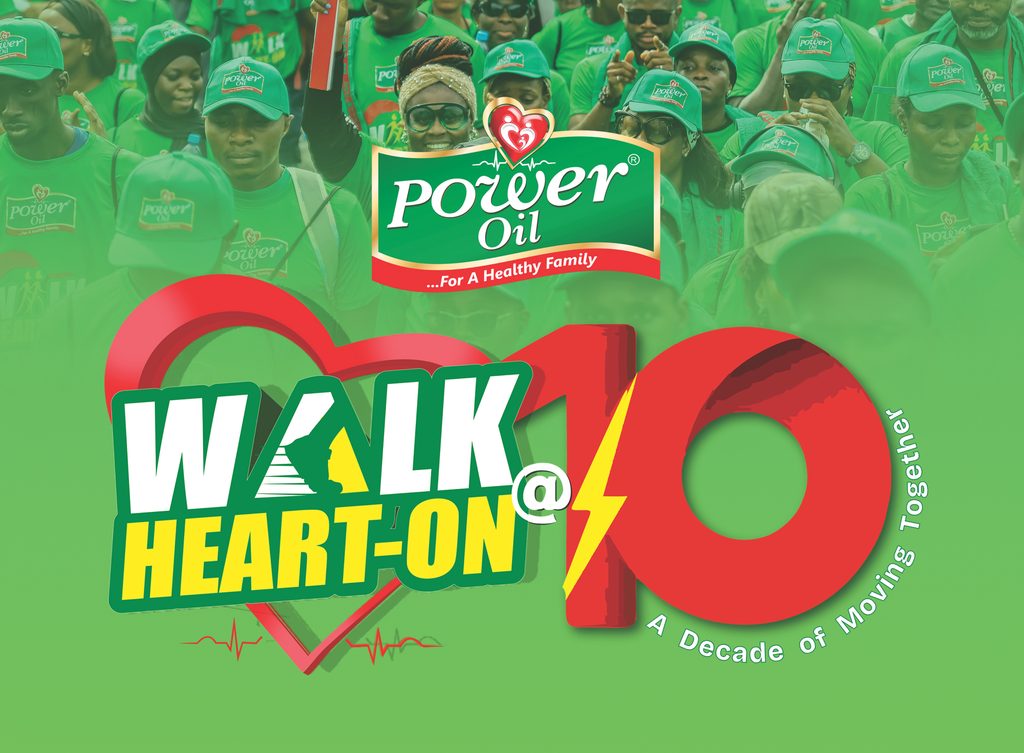
Every strand of the preceding decade converges this year, when WalkHeartOn marks its tenth edition under the theme A Decade of Moving Together. This year’s WalkHeartOn, in commemoration of World Heart Day will be held on 1st October, 2026. It is designed as the circle closing: the health camp history, the funded surgeries, the fitness tribe and marathon runners, and the culinary talent surfaced through MasterChef Nigeria, brought together into what the brand is calling a human mosaic, a single civic gathering meant to stand in for ten years of scattered, cumulative effort.
The ninth edition, held around World Heart Day, offers a preview of the scale organisers are building toward. That edition drew over 10,000 registrants and more than 5,000 active attendees, alongside a drone-powered banner activation that redrew the Lagos skyline and generated nationwide talkability, and a televised fitness and dance session with celebrity choreographer Kaffy that turned advocacy messaging into entertainment. Akpe, describing that edition, frames it as proof of a broader principle, that when marketing genuinely serves both people and purpose at once, it stops being communication and becomes culture. “With the Certified Healthy seal and campaign line Be Certified Fit, Power Oil is re-emphasising its health equity. It is proof that when marketing serves both people and purpose, it becomes more than communication; it becomes culture,” he had said.
For the tenth edition, the ambition appears to be more about showing continuity. A decade is a long time in Nigerian brand marketing, long enough for campaign lines, agency relationships and even category leadership to change hands several times over. That Power Oil’s heart-health platform has run, largely unbroken, across all of it, through changing ownership dynamics in the broader FMCG sector, shifting media landscapes, and an economy that has tested consumer loyalty across every category, is arguably the more interesting story than any single year’s attendance figure.
What A Decade Buys
Return, for a moment, to where this story began, on a global disease burden claiming close to 20 million lives a year, disproportionately in countries like Nigeria, where awareness, screening, and treatment infrastructure remain thin. Against that backdrop, no single brand campaign, however well-funded or well-attended, is going to resolve Nigeria’s hypertension crisis. What Power Oil’s ten-year architecture does offer is a working template for what sustained, structurally embedded private-sector health advocacy can look like when it is not treated as an annual marketing moment. It has been consistent with grassroots screening, funded clinical intervention where it is needed most, community infrastructure that keeps people moving, and increasingly, cultural platforms that make healthier choices feel aspirational rather than obligatory.
As WalkHeartOn prepares for its tenth outing in October 1, 2026[RA2] , the more durable measure of Power Oil’s decade-long bet may not be the size of the crowd that turns out on the day, but the quieter, harder-to-market fact that the brand kept showing up, year after year, long after the news cycle had moved on to the next campaign. In a category as commoditised as cooking oil, and a health crisis as under-addressed as Nigeria’s cardiovascular burden, that consistency is, on its own, a kind of case study.
There is a broader lesson here for the wider FMCG and marketing communications industry, one that extends well beyond a single brand’s trophy count. Cause marketing in Nigeria is frequently criticised, sometimes fairly, for being opportunistic: a logo placed next to a worthy issue for the duration of a single activation, with little structural follow-through once the cameras leave. Power Oil’s decade-long build suggests an alternative model is commercially viable, that health advocacy sustained over ten years, backed by consistent budget and measurable outcomes rather than a single flagship event, can simultaneously build brand equity, category leadership, and genuine public health impact, without those three goals working against one another. Whether the model can be replicated by other brands in other categories, where the underlying public health need is less immediately tied to the product itself, remains an open question. But for a cooking oil brand whose core promise was always about what goes into the pot, spending a decade building the case for what should not, in the form of unregulated refill oil and unmanaged hypertension, has proven to be more than a marketing conceit. It has become, on the evidence assembled here, the brand’s clearest point of difference in a market where almost everything else about cooking oil is interchangeable