
Fortifying The Everyday Bowl: How Nestle’s Industrial Bio-Fortification And Literacy Combats Hidden Hunger In Nigeria

The bubbling of water coming to its boiling point, clatter of enamel bowls and smoky scent of roasted maize fill the air of a busy kitchen in Agege area of Lagos State. Mama Blessing, a mother of four, prepares her family’s breakfast. However this is not simply a maternal task, but also a financial one.
“I find it difficult to buy fresh meats, eggs and vegetables due to the high cost of these food items,” Mama Blessing said while adjusting her gas flame to cook her simmering bowl of porridge. “I am always worried that my children will not get enough nutrients.”
Many caregivers in low and middle income urban communities in Nigeria have the same issue: secondary hunger. Hidden hunger can be described as a lack of essential nutrients in the body which is caused by deficient feeding. Due to macroeconomic issues, families turn to cheap, easily available, high-carb foods like cassava grits and unfortified grain to feed their children. As a result, their children are deprived of vital nutrients such as iron, zinc, iodine and Vitamin A.

This is reflected in the daily anxiety that Mama Blessing feels. In West Africa, 68% of children under the age of five suffer from anaemia and 37% suffer from stunting (permanent physical and mental retardation). This is due to chronic deficiency of essential micronutrients.
Hidden Hunger Epidemiology
Primary Cause: Chronic deficiency of essential micronutrients
Physical Effects: 37% of children suffer from stunting.
Blood Health: 68% of children suffer from anaemia.
Public Response: Industrial Fortification + Biofortification.
The long term effects this has on society can be quite severe. Stunting limits brain development, weakens immunity and reduces learning ability. Children suffering from stunting struggle to remember information and will have reduced earning potential throughout their adult life. On a macro scale, secondary hunger reduces human capital and costs billions of dollars to sub Saharan nations.
Due to macroeconomic issues like currency fluctuations and increased food prices it is not financially viable for many vulnerable households to diversify their diet. Therefore clinical nutritionists and public health strategists are focusing on industrial food fortification.
Fortification on a Large Scale
To tackle the issue of micronutrient deficiencies, it is important to target people where they already consume their food. Industrial fortification provides a solution by adding essential micronutrients (iron, iodine, zinc and Vitamin A) to cheap, widely distributed foods.
Food technology plays a key role in the process of industrial fortification. It is carefully calculated to ensure food compatibility, heat resistance, long shelf-life and bioavailability. Iron must be added to ensure fortification does not affect the taste, colour or shelf-life of the food and also to ensure the essential micronutrients added are completely absorbed.
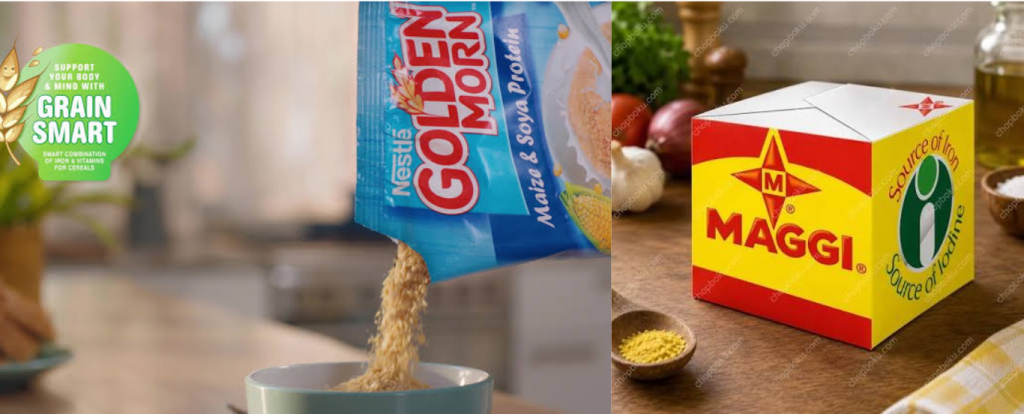
In Nigeria, Nestlé has used food science to improve their products. They have fortified Maggi Seasonings with iodine and iron and Golden Morn cereals with iron and Vitamin A. This ensures that over 80% of household daily iron requirements are met by adding them to foods that are consumed everyday by a wide range of socio-economic groups.
Nestle Nigeria’s Fortification and Bioavailability
Maggi Seasonings – Bioavailable Iron and Iodine.
Golden Morn Cereals – Vitamin A and High Absorption Iron.
Daily Requirement – More than 80% of daily requirement.
This method targets the most vulnerable groups who may never be able to afford pharmaceutical alternatives. By simply adding iron and iodine to cheap and widely used items, like seasoning cubes and native breakfast cereals, general health can be effortlessly improved. Consumers do not need to change any of their cooking methods and will automatically be improving their health by eating their usual food.
“Micronutrient fortification is one of the most cost-effective public health interventions available to developing economies,” says Dr Kemi Adeyemi, Clinical Nutritionist, Lagos. “When daily condiments and accessible breakfast grains carry bioavailable iron and iodine, it bridges the physiological gap between what low-income families can afford and what growing children biologically require to prevent irreversible stunting and anaemia.”
This is what gives Mama Blessing peace of mind. “Knowing that the basic seasonings and grains we buy from Nestle Nigeria carry essential vitamins gives me confidence,” she says, “It means my children aren’t just eating to survive; they are getting the nutrients needed to stay healthy.”
Improving Health Literacy
Whilst providing nutrient rich foods is half the battle, it is also important to educate communities. Nestlé for Healthier Kids (N4HK) is a grassroots programme that uses corporate sustainable strategies to improve public health. This is done by integrating health education in schools.
Health behaviour change theory shows that simply providing products will not reduce malnutrition if people are not given clear guidance. For example, people may struggle to absorb iron if they eat iron fortified cereals with high calcium or tannin containing drinks. However, pairing iron rich foods with vitamin C rich foods will improve micronutrient absorption. This needs to be constantly communicated to the public.
The N4HK programme works with local universal basic education boards to provide education to over 18,000 school children and hundreds of educators in Nigeria. They teach children and parents how to create balanced meals using easily accessible ingredients. They focus on teaching the importance of micronutrients during physical development and performance.
They use a hands-on approach to educate children. They plant school gardens so children can grow native leafy greens, legumes and vegetables. This means that children become health advocates within their homes. They will hereby influence what their families buy and encourage better eating habits.
“We train teachers and parents to view nutrition through the lens of combination and accessibility. Simple changes like pairing fortified local cereals with native leafy greens or legumes have made a real difference. Our children are much more focused and attentive in school and are less tired” confessed Mrs Funke Adebayo, Health Coordinator, Government Primary School, Ogun State.
Creating Sustainable Agriculture
To ensure that cheap foods can be provided in the long run, it is important to ensure there is a strong domestic agriculture industry. Industrial food producers need to work with local farmers to ensure there is a constant supply of high quality raw materials.
Small scale farmers in developing countries often suffer from low yields, poor storage and high losses. A big issue when sourcing grains in West Africa is the presence of aflatoxins. These are natural toxins produced by fungi which affect maize and groundnuts. These toxins cause serious health problems and make crops unsuitable to be processed. This can be overcome with long term technical solutions.
In this regard, Nestlé Nigeria have used their Creating Shared Value (CSV) strategy to source over 80% of their raw materials from local farmers. They work with tens of thousands of small scale farmers in Nigeria to source grains like maize, soy and sorghum. They provide training to farmers to improve their post-harvest techniques and aflatoxin control.
Nestle Nigeria Local Agronomy in CSV
Small Scale Farmers – Training in Aflatoxin Control and Soil Health.
Local Materials – More than 80% of Raw Grains sourced locally (maize, soy, sorghum).
Economic Impact – Stable prices and Guaranteed Markets.
By providing soil testing kits, biological pesticides and controlled moisture stores, local farmers greatly reduce crop loss. This helps improve the quality of their crops to meet strict food safety requirements and creates a sustainable economy in the region. Small scale farmers gain stable income, food processors benefit from a strong domestic supply of high quality grains and consumers benefit from fresh fortified foods produced in their country.
“Partnering directly with industrial food processors guarantees a steady, reliable market for our harvests.” Ibrahim Musa, Grain Farmer in Kaduna State stated. “We also benefit from training which improves the quality of our grains and increases our yield. This means we earn more money from our farms as we know the food our children in Nigeria are eating was grown in Nigeria.”
Policy and the Future of Bio-fortification
To improve these developments across West Africa, policies need to be continually updated to improve bio-fortification and Industrial Fortification standards. Food fortification laws are mandatory and enforced by organisations such as the National Agency for Food and Drug Administration and Control (NAFDAC) and the Standards Organisation of Nigeria (SON). However, public policy should also encourage private investments in domestic agriculture research.
Bio-fortification is another innovation that can improve public health. This involves cross breeding staple foods to give them higher micronutrient content. Examples include pro-vitamin A yellow cassava and iron rich pearl millet. If food processors use bio-fortified crops then the nutritional value of food will increase.
Collaboration between different ministries (health, agriculture, education) and private sectors will also improve national nutrition strategies. Viewing food security as an ecosystem will improve the resilience of the nation’s nutrition strategies.
A Sustainable Public Health Strategy
To overcome secondary hunger in Nigeria, there needs to be a change in food science, agriculture and public education. By adding essential micronutrients to everyday foods and creating sustainable local resources, public-private partnerships show that health can be improved in an economical and accessible way.
The success of these systems can be applied to tackle malnutrition in developing countries. When food processors work towards societal needs their Corporate Social Responsibility becomes creating shared value. This creates a sustainable economy where business growth equals public health resilience.
As Mama Blessing places steaming bowls of fortified Golden Morn cereal on her table, it becomes obvious how Nestle Nigeria is making positive impact daily on the nation’s nutrition and economy, because every fortified meal eaten is an investment in the health, productivity and future of Nigeria’s next generation.
