
Top Trends 2026: 11 Insight-Driven Trends To Define Nigeria’s Marketing Industry In 2026

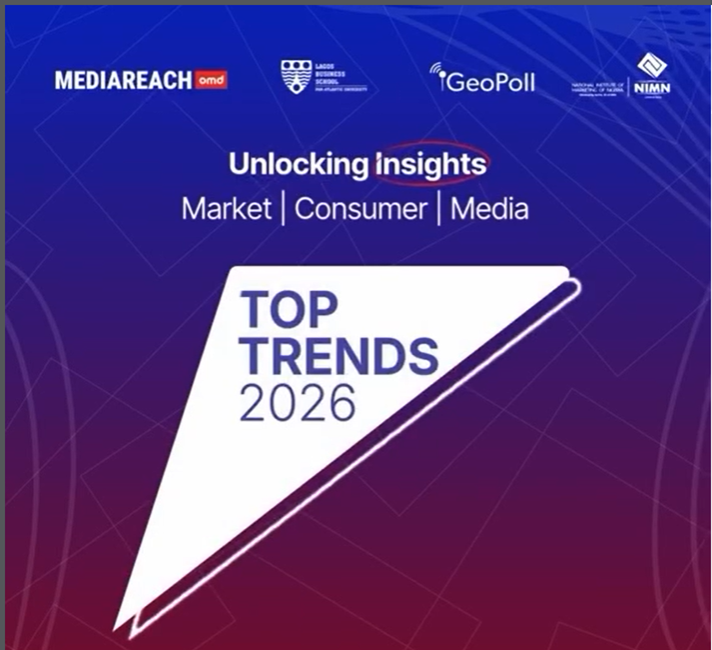
The marketing and communications landscape in Nigeria is set for a seismic shift, according to insights unveiled today at the fifth edition of Top Trends, held at the prestigious Marriott Hotel in Ikeja, Lagos. Presented by Prof. Uchenna Uzo of the Lagos Business School (LBS), Pan-Atlantic University and Emmanuel Adediran of mediaReach OMD, this year’s edition themed “Insight-Driven Decisions to Disrupt the Marketing Industry in 2026” brought together industry leaders, marketers, and brand strategists to explore the forces reshaping consumer engagement and brand strategy.
The platform, founded by mediaReach OMD in partnership with Lagos Business School, Pan-Atlantic University, GeoPoll, and the National Institute of Marketing of Nigeria (NIMN), has established itself as Nigeria’s premier marketing thought leadership forum. Each edition surpasses the last, and this year’s gathering reinforced Top Trends’ position as a disruptive, future-shaping platform where industry leaders don’t just discuss change—they define it.
THE 11 TRENDS THAT WILL DEFINE 2026
1. Salespeople Will Drive Loyalty Through Memorable Experiences
The role of salespeople is evolving beyond transactional interactions. In 2026, brands will increasingly recognize that customer loyalty is built through memorable, personalized experiences rather than mere product features or competitive pricing. Sales teams will be trained as experience architects, creating emotional connections that transcend the point of sale.
2. Pricing Strategies Will Be Overhauled as Customers Adjust Their Price Preferences
Economic pressures and inflation have fundamentally altered Nigerian consumers’ price sensitivity and purchasing behaviour. Brands can no longer rely on traditional pricing models. Instead, dynamic pricing, value-bundling, and flexible payment options will become standard practice. Customers are becoming more sophisticated in their price evaluations, comparing not just absolute costs but value-for-money across multiple touchpoints. Successful brands will adopt data-driven pricing strategies that reflect real-time market conditions and consumer sentiment.
3. Customer Attention to Details Will Rise and Will Influence Spending Priorities
Nigerian consumers are becoming increasingly discerning, paying closer attention to product quality, ingredient transparency, sustainability practices, and brand authenticity. This heightened scrutiny means brands can no longer rely on flashy marketing alone. Every detail, from packaging to customer service to corporate social responsibility, will be examined and will directly influence purchasing decisions. Brands that demonstrate genuine commitment to quality and transparency will win market share.
4. Value Will Be Defined by How Brands Adapt to Customer Needs
The definition of “value” is shifting from static product attributes to dynamic brand responsiveness. In 2026, value will be measured by how quickly and effectively brands can adapt to evolving customer needs, preferences, and contexts. This trend demands organizational agility, customer listening systems, and the willingness to iterate products and services based on real-time feedback. Brands that can demonstrate they’re listening and adapting will build deeper customer relationships.
5. Brands Will Pivot from Traditional SEO to Generative Engine Optimization (GEO)
As AI-powered search tools and generative engines like ChatGPT, Google’s Gemini, and others reshape how consumers find information, brands must evolve beyond traditional search engine optimization. Generative Engine Optimization (GEO) focuses on ensuring brand content is discoverable and favorably represented when AI systems generate responses to user queries. This requires structured data, authoritative content, and strategies to influence how AI models perceive and present brand information—a fundamental shift in digital marketing strategy.
6. TikTok Will Become Nigeria’s Primary Cultural Engine
TikTok’s influence in Nigeria has reached a tipping point where it’s no longer just a social platform but the primary driver of cultural conversations, trends, and consumer behavior, particularly among younger demographics. From music discovery to political discourse, from fashion trends to brand virality, TikTok will set the cultural agenda. Brands that fail to develop authentic TikTok strategies risk becoming culturally irrelevant to Nigeria’s most economically important emerging consumer segment.

7. With the Election Cycle On, Expect Heightened Attention but Lower Trust—Raising the Stakes for Brands
Nigeria’s electoral cycles traditionally generate heightened media consumption and public attention, but also widespread misinformation and declining trust in institutions and media. For brands, this creates both opportunity and risk. While audiences are more engaged, they’re also more skeptical and sensitive to perceived manipulation. Brands must navigate this landscape carefully, maintaining authenticity and avoiding politicization while capitalizing on increased attention. Transparency and fact-based communication will be essential.
8. Digital Provenance Will Take Center Stage as the Battle for Truth and Brand Distinctiveness Intensifies
With AI-generated content on the rise, deepfakes, and widespread misinformation, proving authenticity and origin becomes critical. Consumers and regulators alike will demand verification of content sources, product origins, and brand claims. Technologies like blockchain-based verification, content authentication systems, and transparent supply chain documentation will move from nice-to-have to essential. Brands that can definitively prove their authenticity and the truthfulness of their claims will gain significant competitive advantage.
9. Traditional Media Owners Will Re-evaluate Content Creation by Adopting “Creator-First” Distribution Strategies
Television stations, radio networks, and print publications are recognizing that the future of content distribution lies in empowering individual creators rather than maintaining exclusive control over content production. Traditional media owners will increasingly partner with digital creators, adopt influencer-style content formats, and distribute content across platforms where audiences actually congregate. This “creator-first” approach represents a fundamental shift in how traditional media views its role in the content ecosystem.
10. Resurgence of OOH as a Lead Traditional Channel, Driven by Innovation, Impact-Led Storytelling, and Localized Urban Targeting
Out-of-home (OOH) advertising is experiencing a renaissance in Nigeria, driven by digital billboard technology, data-driven placement strategies, and creative innovation that transforms static ads into cultural moments. As digital ad fatigue increases and privacy regulations limit online targeting, OOH offers brands unmissable presence in high-traffic urban centers. The most successful campaigns will combine technological innovation with deeply localized storytelling that resonates with specific urban communities, particularly in Lagos, Abuja, and Port Harcourt.
11. Shoppertainment Is Merging Entertainment and Commerce, Making Every Scroll a Potential Sale in Nigeria
The boundaries between entertainment and shopping are dissolving. Livestream shopping, in-app purchasing on social platforms, and gamified commerce experiences are transforming passive content consumption into active shopping opportunities. Nigerian consumers, particularly on platforms like Instagram, TikTok, and emerging local platforms, are increasingly making purchase decisions within entertainment contexts. Brands must reimagine their content strategies to seamlessly integrate commerce into entertaining experiences, recognizing that every piece of content is now a potential point of sale.