
Not Many Nigerian Brands Are Taking Enough Risk To Stand Out, Babaeko Says At Maiden WiMAfrica Lagos Real Talk Debate

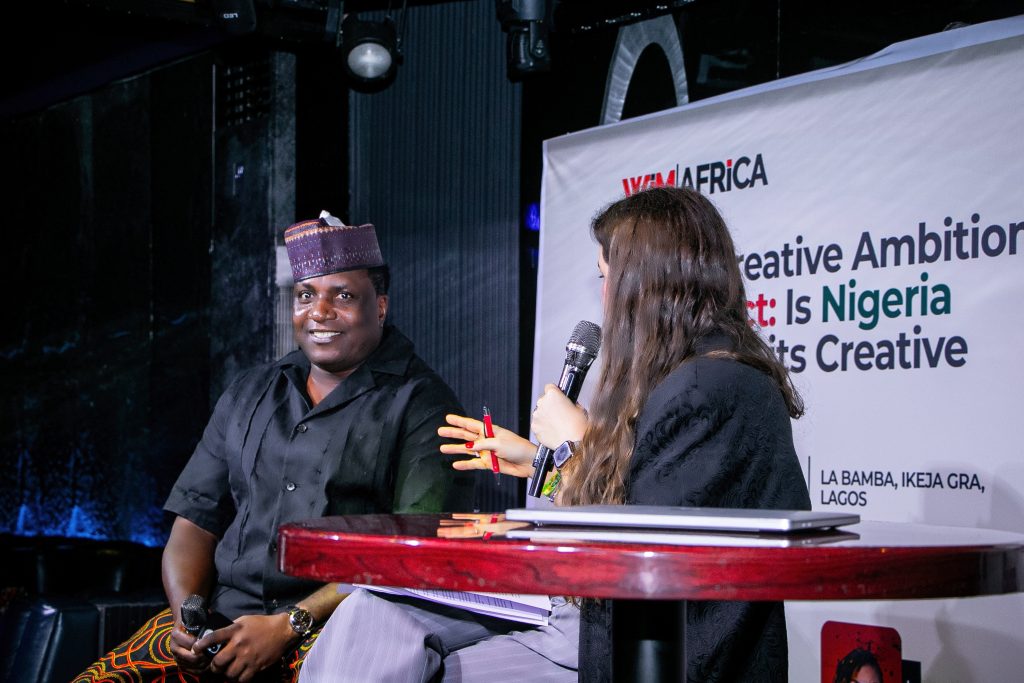
For Steve Babaeko, the question of whether Nigeria has the creative talent to compete with the best in the world has already been answered. The country has the talent. What remains in doubt is whether the ecosystem, particularly brands and their marketing decision-makers, is sufficiently willing to take the risks required to turn that talent into globally competitive work.
That was one of the strongest messages to emerge from Babaeko’s conversation with Katharina Link, CEO of Pulse and Business Insider Africa, at the inaugural Nigerian edition of the Real Talk/The Debate Series Lagos, organised by Women in Marketing Africa (WiMAfrica) in collaboration with Women in Advertising (WIA) and Kantar at La Bamba, Ikeja, Lagos.
Speaking on the theme, “From Creative Ambition to Impact: Is Nigeria Realising its Creative Potential?”, the Group CEO and Chief Creative Officer of X3M Ideas Group and Vice President, Africa/President Nigeria of the International Advertising Association (IAA) returned repeatedly to the central issue that creativity does not thrive on talent alone, but needs courage, particularly on the part of clients.
His position is informed by a journey that culminated in 2023 when X3M Ideas became the first Nigerian and West African agency to win a Cannes Lions medal. The agency won a Bronze Lion in the Health and Wellness category for ‘Soot Life Expectancy’, a campaign developed around the soot pollution crisis in Port Harcourt. The victory broke a barrier that had stood for seven decades of the global festival’s existence.
Between Creativity & Volume Target
For Babaeko, however, the real importance of Cannes is not simply the medal but what the achievement has done to the conversation between agencies and their clients. Before the win, he recalled, mentioning Cannes to clients could easily produce a response like “Yeah, yeah, yeah. Let’s just meet this volume target first.”
It is no secret that there has always been a traditional tension between creativity and commercial performance, where brand handlers, marketing directors/CMOs have targets to meet, budgets to defend and business objectives to deliver. Agencies, meanwhile, are often pushing for ideas that may appear unfamiliar, untested, even contested. risky or difficult to justify internally.
But after Cannes, Babaeko said, the conversation changed. “A lot of my clients came to me and said, ‘Yeah, you won this one, but when are you going to win mine?’” The question, he suggested, was evidence of a shift in attitude. Clients who previously saw international creative recognition as something distant from the immediate realities of sales and market share were suddenly asking how their own brands could produce work worthy of the same global stage.
“Our clients now demand more work from us, they demand better work from us, and they push us to even do better than ourselves,” he said.
That development, however, has also created a new pressure. Once a client has seen what is possible, the expectation rises. The agency is no longer being asked merely to produce competent advertising; it is being challenged to produce work that can stand apart. This is where Babaeko believes the industry needs a fundamental change in the relationship between agencies and brands.
“…There has to be an agency-client synergy to produce award-winning works”
Link put the dilemma directly to him. Agencies frequently argue that the work they believe could win on global platforms is not necessarily the work a marketing manager is prepared to approve. Brands, on the other hand, argue that creative ambition must ultimately serve commercial objectives.
Babaeko’s answered that if he had deep enough pockets, he would take one or two clients to Cannes every year. “Usually, when the clients start to tell you how it is not aligned with my goals, it’s because they’ve not been to the festival,” he said.
Over the years, he has actually paid for clients to attend Cannes as an education in what global brands are doing with creativity. Once there, he said, he walks them through the festival and shows them what their peers are attempting. “See what your mates are doing,” is essentially the message.
For him, exposure changes the conversation because it gives clients a benchmark beyond the immediate competitive landscape in Nigeria. A marketing executive may be reluctant to approve an unconventional idea when judged only against the previous campaign, the competitor down the street or the quarterly sales target. Seeing the best work from around the world changes that frame of reference.
More importantly, he believes the industry must stop pretending that agencies alone create award-winning work. “When an agency wins, yes, you can clap for the agency, but I promise you the foundation of that win is in the hands of a client that was bold enough to take a major risk,” he said. “Ordinary works are not going to win a Cannes, no matter what you say or do.”
He pointed to the growing influence of international brands operating in Nigeria, noting that companies such as Heineken are able to participate in global creative conversations while operating in the Nigerian market. He was encouraged, too, by initiatives such as ‘Road to Cannes’, which bring marketers and agencies together around the pursuit of better creative work. For him, the very existence of such initiatives shows that the conversation is beginning to move in the right direction.
But he wants more.
The Nigerian creative industry, in his assessment, has no shortage of people capable of delivering world-class ideas. He singled out agencies including Insight Publicis, Noah’s Ark among others, arguing that there are enough creative teams capable of competing internationally. Babaeko admitted that during X3M Ideas’ own campaign to win at Cannes, he regarded Noah’s Ark as a particularly serious competitor. He told his team that the agency appeared to be pursuing the same objective and wanted the same prize.
The rivalry became a motivational tool. Every year, Babaeko personally put prize money on the table for his team. What began at $1,000 and increased over time reached $5,000 in the year X3M Ideas finally won in 2023. That internal pressure was about creating an organisational culture in which excellence was treated as a competitive necessity rather than an occasional ambition.
But Babaeko’s broader point is that Nigeria should not be satisfied with one Cannes medal. “We’ll see the next Silver, we’ll see the next Gold, we’ll see the next Grand Prix from Nigeria,” he said confidently during the conversation. His optimism is grounded in what he sees as a growing appetite among Nigerian creatives to compete globally. The Cannes victory, he believes, has simply opened a door that others can now walk through. The bigger challenge, however, remains converting creative potential into consistent commercial impact.
The Martel Tower example
Asked how brands could become more daring, Babaeko pointed to examples of Nigerian businesses that had made big bets despite difficult economic conditions. He cited the engineering and ambition behind the Martel Tower project as an example of what happens when an organisation decides to pursue something that appears difficult rather than retreat to what is comfortable.
His analogy extended beyond advertising. He referenced Aliko Dangote’s decision to commit enormous capital to building the Dangote Refinery, arguing that the willingness to act despite uncertainty is a defining characteristic of people and organisations that create something consequential.
For Babaeko, creativity requires the same mindset. “There is an ability in your gut where you know this is the right thing to do,” he said. “All of these circumstances and all of the elements around you are telling you something different, but you must step up and just throw your gauntlet in the ring.”
It is an attitude that mirrors the story of X3M Ideas itself. Babaeko established the agency in 2012 after leaving 141 Worldwide. He recalled that he was frightened by the decision, despite what outsiders may have perceived as confidence. He had a family to support and did not know whether the new business would survive.
His first major act of irrationality, as he described it, was to spend almost all of the money he had saved, about N8 million at the time, renovating the agency’s first office to make it look like a serious creative organisation. In hindsight, he admitted, the money might have been better preserved for payroll. Yet the decision also helped him project confidence to prospective clients at a time when X3M Ideas was still an unknown agency.
That contradiction between caution and ambition runs through much of Babaeko’s thinking about creativity. The industry cannot tell brands to be brave while agencies themselves remain afraid. Equally, brands cannot demand global-standard creativity while approving only the safest ideas.
Indeed, Babaeko does not believe Nigeria lacks the creative intelligence to produce another historic winner. Quite the opposite. He sees a young, energetic creative population, agencies with strong talent and a growing number of brands willing to experiment.
What Nigeria needs, therefore, is more clients willing to put their money and reputation behind ambitious ideas. The agency-client relationship, in his view, must evolve from one in which the client briefs and the agency executes into a partnership where both sides understand that meaningful impact sometimes requires stepping outside the predictable.