

Lagos State runs the most sophisticated government communications machinery in Nigeria. That much is not in dispute. The Ministry of Information and Strategy has existed since 1971 and was restructured in 2015 to reflect a more deliberate approach to positioning. Around it sits a full apparatus. The Chief Press Secretary’s office, with a retinue of robust press corps. Lagos Television and Radio Lagos as owned media. Official digital handles with real followings. And above it all, a set of narrative pillars that have held for decades. Centre of Excellence. Africa’s fifth-largest economy. The THEMES+ agenda that gives every project a storyline and every commissioning a context.

By the standards of Nigerian public sector communications, it is an impressive system. It announces well. It commissions with ceremony. It earns coverage. And that is precisely the problem. It is a broadcast-era system serving a post-broadcast population.
The Lagosian Has Changed in Every Ramification

The Lagos of the ministry’s playbook no longer exists. In its place is a city of more than twenty million people, most of them under thirty-five, digital-native and smartphone-first. They do not wait for the network news at nine or the newspaper the next morning. They consume information through X, TikTok, Instagram, WhatsApp groups, skit makers and community forums, in real time, with commentary attached.
But the change runs deeper than media habits. The Lagosian carries a completely new persona.
Today’s Lagosian is a tech innovator building products in Yaba and Lekki that compete on the global stage. She is a young student with a worldview shaped by the internet, who compares her city to Nairobi, Dubai and London because she watches all three, daily. He is an Afrobeats star, or one of the millions of dreamers in his orbit, exporting Lagos culture to the world and expecting the city to look like the brand he is selling. They are diaspora returnees and visitors who land with global reference points. They are investors running due diligence with their own eyes. They are remote workers earning in dollars, serving global teams from Surulere, and asking why the power and the roads do not match their ambition.
This new Lagosian behaves differently in three ways that matter for reputation.
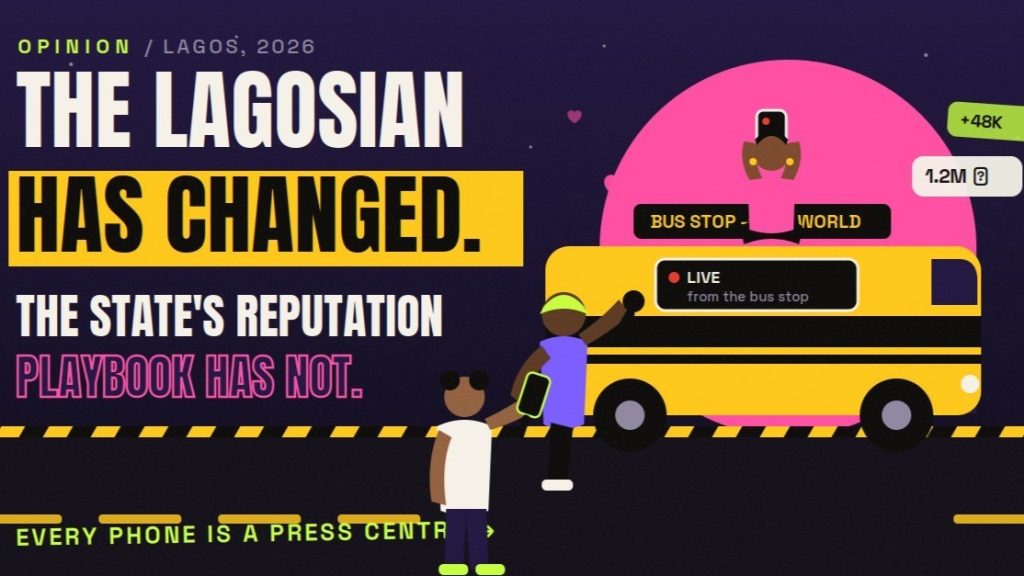
They verify before they believe. Every government claim is checked against lived experience and archived receipts. They trust peers over podiums. A resident’s video outranks a commissioner’s statement every single time. And they experience government daily, then publish that experience. Every Lagosian is now a correspondent. Every phone is a press centre.
The implication is uncomfortable but unavoidable. PR no longer reaches this generation through channels. It reaches them through experiences. Which means the real reputation management system of Lagos State is not in Alausa. It is at the touchpoints, from bus stops to street walks.
The Touchpoints Where Reputation Is Leaking
Reputation is built at the frequency of contact, not at the scale of the project, not at the polish of the campaign, but at the points where citizens physically meet their city, day after day. Judged by that standard, Lagos has a set of touchpoints that now constitute live reputation risks. Each one contradicts the brand more loudly than any campaign can affirm it.
Start with the infrastructure touchpoints.
Public transportation remains the loudest counter-narrative in the city. The danfo experience is undignified by any measure, with rickety vehicles, chaotic loading, no formal boarding infrastructure, and conductors hanging from doors. For a state marketing itself as a mega-city, the daily commute tells a different story to millions of people twice a day, and they believe the commute.
Shared space infrastructure falls far short of the world-class standard the brand promises. The parks, walkways, markets, motor parks and public squares where city life actually happens do not look like the Lagos of the investment brochures, and the new Lagosian notices the difference because she has seen the alternative.
Road markings and signage seem minor until you understand what they communicate. An unmarked road signals disorder before a single driver misbehaves. Wayfinding is part of a city’s body language. Lagos often presents itself with its shirt untucked.
Night infrastructure completes the picture. Poorly lit streets and public spaces do more than inconvenience. Darkness communicates insecurity, and insecurity is a reputation, not just a condition. A city that goes dark at night is making a statement about itself, whether it intends to or not.
Then the service touchpoints, where the contradictions sharpen.
Healthcare, as experienced in primary health centres and general hospitals rather than as commissioned at ribbon cuttings. Traffic management, the single most frequent contact point between Lagosians and their government, experienced twice daily by nearly everyone. Waste management, which is visible, photographable and endlessly shareable. A refuse heap is a billboard against the brand, and it never stops running.
Law enforcement deserves particular honesty. The current posture is militant and aggressive where it should be tech-driven and quietly efficient. And it is not one agency. It is a full apparatus of state enforcement, LASTMA, KAI, sundry task forces and local government revenue collectors, each meeting the citizen with force where a system should meet him with service. Every hostile checkpoint encounter, every vehicle chase, every roadside shakedown over a levy is a reputational transaction, and the state loses it. The young remote worker stopped and harassed over his laptop does not experience a security agency. He experiences the brand, and he posts about it before the officer has finished writing anything down.
Then there is the menace the state rarely names. Street urchins who harass the everyday Lagosian at bus stops, junctions and markets, extorting traders, intimidating commuters and shaking down motorists in broad daylight. Their favourite targets now include the city’s prized content creators, the very people filming Lagos for the world. A creator shooting on a Lagos street is as likely to be accosted for “settlement” as to finish the shoot. Every one of those encounters ends up online, and each one tells a global audience that the city cannot guarantee order on its own streets. A state cannot claim to be Africa’s creative capital while its creators need protection money to point a camera.
Public hygiene sits in the mundane details. Drainage, public toilets, market sanitation. These small things determine whether Centre of Excellence reads as aspiration or irony. And access to public services rounds it out. The friction of documentation, permits and land services. Every long queue and every “come back tomorrow” is the brand in action, experienced one frustrated citizen at a time.
This Is Not a PR Review. It Is a Reputation Review
Here is the turn, and it is where the playbook truly fails. These touchpoints are not service delivery problems sitting adjacent to the state’s reputation. They are the reputation management system itself, because this generation forms perception at the touchpoint, not at the press briefing.
This produces a hard rule that Lagos must internalise. Bad experience plus good PR is worse than bad experience alone. When the campaign and the commute contradict each other, the campaign does not soften the commute. The commute exposes the campaign. The gap reads as insincerity, and insincerity is the one offence this generation does not forgive.
What a Reviewed System Looks Like
The review Lagos needs involves four moves. First, audit and rank every touchpoint by frequency of contact rather than size of project. The drain matters more than the flyover because it is experienced more often. Second, build listening infrastructure before messaging infrastructure, and treat citizen complaints as telemetry rather than attacks. Every complaint is free intelligence about where reputation is leaking. Third, redesign law enforcement, street-level order and frontline services around dignity and technology, because every officer, every LASTMA official and every counter clerk is a brand ambassador whether the state likes it or not. Fourth, engage the creators, communities and digital voices who now shape perception as the new press corps, with access, protection and honesty rather than hashtags and campaigns.
None of this diminishes the communications function. It repositions it. In the new model, communications stop manufacturing perception and start giving shape and meaning to verified reality. A humbler role, but the only one that survives contact with the new Lagosian.
The truth is now simple, and Lagos can either lead with it or be led by it. Infrastructure is the message. Service delivery is the media plan. Communications is just the caption.

Very concise analysis about the bridge that separates what the everyday lagosian sees and what those in alausa see. It explains the mistrust that deepens between the masses and the state. Very intelligent news article.