
Elon Musk Unveils Next-Generation Roadster With Flying-Car Technology, Targets 2028 Production

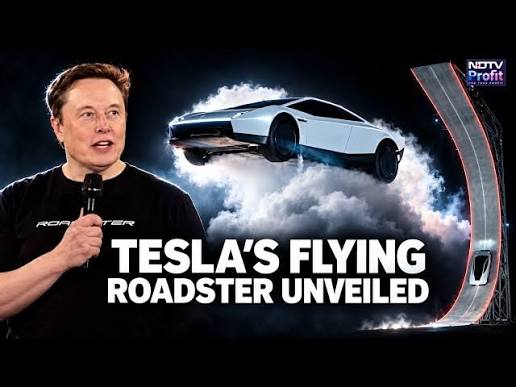
Elon Musk, Tesla’s Chief Executive Officer, has unveiled a next-generation version of the company’s Roadster electric sports car, featuring experimental technology designed to lift the vehicle into the air, nearly a decade after the company first promised the model.

Musk unveiled the two-seater electric sports car last Thursday at a SpaceX test facility in Texas, United States, showcasing what he described as a combination of advanced automotive engineering and rocket technology.
The new Roadster, which has faced years of delays, is expected to enter production in 2028. However, Musk did not disclose its price or when customers could begin receiving deliveries.

During the demonstration, the vehicle performed a series of dramatic manoeuvres, including climbing a steep ramp, hanging upside down and flipping in the air before landing with the aid of propulsion jets.
The car was also shown leaping over a row of parked Tesla vehicles, while Musk claimed it could accelerate from zero to 60 miles per hour in less than one second.
No driver was inside the vehicle during the demonstration, a precaution Musk said was taken to prevent injuries in the event of a technical failure.
“Success is not guaranteed,” Musk told the audience, adding that the demonstration was being conducted from a safe distance because of the experimental nature of the technology.
According to Musk, the Roadster uses 10 nozzles and what he described as ultra-high-pressure air tanks to generate thrust. The system is designed to support the vehicle’s aerial manoeuvres and deliver rapid acceleration on the road.
He attributed the technology to collaboration between Tesla, the electric vehicle manufacturer, and SpaceX, his aerospace company.
Musk also told an enthusiastic audience that the public demonstration was intended to show that the vehicle was real rather than a computer-generated presentation.
“We need an audience to prove that it’s not AI or SI,” he said, urging those present to share their experience of the event.
Despite the spectacle, questions remain about the vehicle’s practical capabilities, particularly whether it can achieve sustained flight rather than perform short aerial jumps.
The demonstration did not establish that the Roadster could fly over long distances, and further technical details would be needed to determine how the propulsion system would function under normal operating conditions.
Tesla’s production target has also drawn attention because the Roadster has been subject to repeated delays since Musk first announced plans for the model nearly a decade ago.
Although the latest unveiling has renewed interest in the electric sports car, the company will need to demonstrate that the technology can be developed into a commercially viable vehicle before the promised production date.
For now, the next-generation Roadster represents an ambitious attempt to push the boundaries of electric vehicle performance, although its flying-car capabilities and eventual market availability remain uncertain.