

Fédération Internationale de Football Association (FIFA) spent millions building walls around this World Cup to keep unpaid brands invisible. Three of them climbed right over, and turned the wall itself into the ad.

Levi’s, Heinz, and Beats paid FIFA nothing for a presence at this tournament. By the tournament’s midpoint, all three were generating more conversation than several brands that wrote official sponsorship cheques worth tens of millions. The route there wasn’t a clever campaign. It was getting caught, covered up, and blocked, on camera, in public, repeatedly.
The Cover Up That Became the Campaign
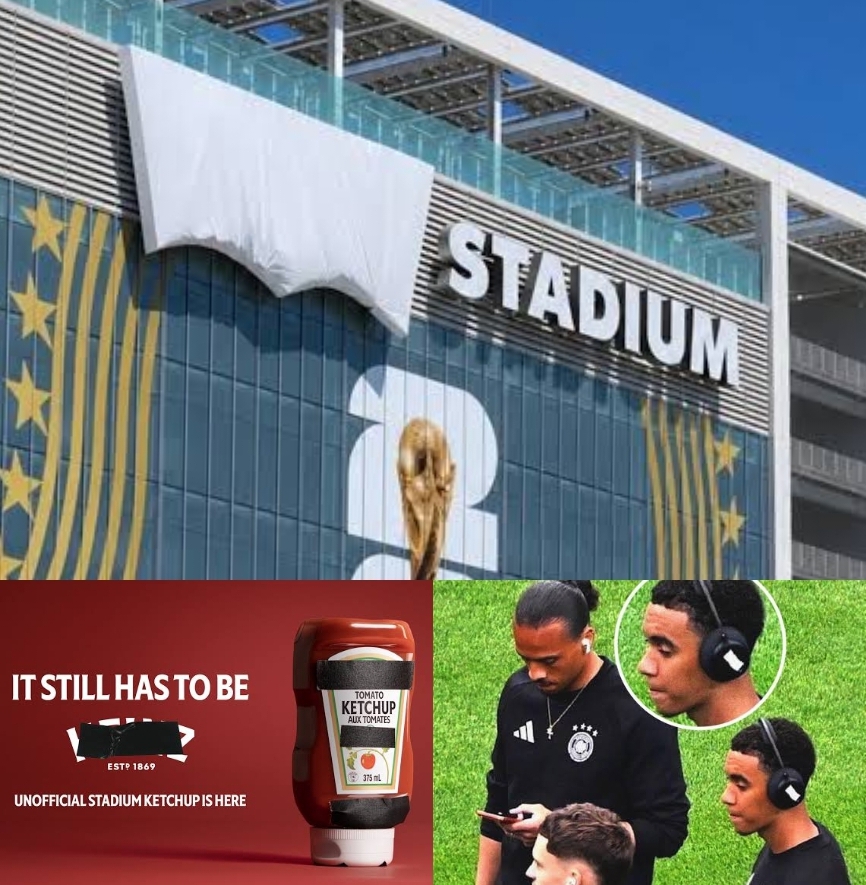
Outside Levi’s Stadium in San Francisco, FIFA’s enforcement team did what it always does when a non-sponsor’s branding shows up on protected turf: it covered the Levi’s logo with a plain white tarpaulin. In the press box, Heinz bottles got the same treatment, logos taped over. Even players weren’t spared: Germany’s Jamal Musiala was photographed pre-match with tape slapped across the Beats logo on his headphones.
The stakes behind that particular tarp are considerable. Levi’s holds a 10-year naming-rights deal for the Santa Clara venue worth roughly $170 million, about $17 million a year, a deal it renewed in 2024, only for FIFA to void the stadium’s name and logo entirely for the duration of the tournament. According to a report by industry outlet NSS sports, the covering left Levi’s unmistakable batwing-shaped silhouette visible underneath, with the outline staying legible throughout, at least in part because of wind conditions on the day. The same outlet reported that a similarly labour-intensive covering process played out at Gillette Stadium in Foxborough, home of professional football in the Boston area, a detail not corroborated elsewhere, but one that points to how far FIFA’s brand-protection sweep extended across host venues.
Levi’s didn’t fight it. It didn’t stage a stunt. It simply let the tarp stay up and pointed its audience straight at it. The brand changed its Instagram profile picture to the covered logo and posted a video riffing on the viral “Nobody’s Gonna Know” trend, welcoming fans to the stadium’s newly blanked-out name. One social post pulled hundreds of thousands of interactions. A single TikTok clip of the covered logo racked up nine million views. Levi’s has since rolled the tarp imagery out to its own stores across London, Paris, Milan, Berlin, Hong Kong, Brazil and Mexico. The censorship became the campaign.
Heinz went further, turning its taped-up ketchup bottle into an actual limited-edition product release. Beats posted Musiala’s photo with a caption teasing an unreleased headphone model, turning FIFA’s tape job into a de facto product launch.
Named After A Singer, Weaponised By Marketers
There’s a name for what’s happening here: the Streisand Effect, borrowed from Barbra Streisand’s infamous attempt to scrub photos of her home off the internet, which only multiplied how many people saw them. Suppress something hard enough, and you guarantee it gets noticed.
FIFA isn’t doing this out of pettiness, it’s protecting a business model. Official sponsors pay tens of millions of pounds precisely for the promise that no one else gets that exposure for free. To defend it, FIFA controls stadium naming rights, dress codes, tournament language, even the official typeface. It’s a tightly managed perimeter.
The scale of what that perimeter protects is substantial: sponsorship is projected to generate roughly $2.8 billion in revenue for the 2026 World Cup, making it one of the tournament’s largest commercial pillars. FIFA’s rulebook for the tournament draws a careful line between ordinary commercial activity and deliberate ambush marketing, businesses operating normally within affected areas, under what FIFA calls its “business as usual” principle, are treated differently from brands actively trying to hitch a ride on the tournament’s visibility.
But attention doesn’t respect perimeters. This tactic of gate-crashing the spotlight without paying the entry fee is known in marketing circles as ambush marketing, and FIFA has been fighting it since 1994.
A History of Blocks That Backfired
This isn’t new. It’s a pattern that keeps repeating with almost comic predictability:
In 2006, Dutch fans were told to remove their trousers before entering a stadium because they carried the logo of Bavaria beer, not official sponsor Budweiser. Word spread that one fan watched the match in his underwear, and the story went global, publicity Bavaria never had to pay for.
By 2010, South African airline Kulula was forced to pull an ad calling itself the “unofficial carrier” of the tournament. The forced withdrawal generated more buzz than the ad itself ever would have.
In 2014, with Sony as the official sponsor, Beats by Dre was shut out of every stadium and media event. Sony handed out free headphones to athletes, but stars wore Beats on the team bus, in training, through the tunnel, everywhere outside FIFA’s reach. Beats leaned into it with a five-minute ad. Sony paid for exclusivity; Beats got the ears.
Each time, the enforcement, not the sponsor, not even the blocked brand became the headline.
An Industry Verdict on the 2026 Repeat
Marketing professionals watching this year’s tournament have weighed in with similar readings of the situation. In a blog post published by the agency Harrison Carloss, its Client Services Director, Rebecca Cox, was quoted describing the irony of brands told to cover their logos ending up dominating the conversation instead of the official sponsors who paid for the privilege.
Cox’s own prediction, however, leaned the other way long-term: she argued that brands who paid to sponsor the tournament will still come out ahead over time, partly through the scale of data access bundled into an official partnership.
The same post cited an estimate that FIFA’s marketing database holds hundreds of millions of customer records globally, a figure that, like the quote itself, comes from this single agency source and hasn’t been independently verified elsewhere. It’s a useful industry perspective, but readers should treat it as informed opinion and an unverified estimate rather than confirmed fact.
Two Different Games
It would be tempting to conclude ambush marketing simply beats sponsorship. That reads the situation wrong.
Official sponsors aren’t just buying visibility. They’re buying rights, hospitality, activations, and formal association with one of the biggest events on the planet, access that can’t be improvised or hijacked. What Levi’s, Heinz and Beats won is something else entirely: a moment in the conversation, not a stake in the event.
One camp is trying to own the tournament. The other is trying to crash the party. They’re not really competing for the same prize.
Ambush marketing can win the tournament. Sponsorship is built to win the memory that outlasts it. Right now, the tarp has clearly captured the room. Whether it still means anything once the trophy is lifted and the tape comes off the ketchup bottles, that’s the question nobody can answer yet.