

…A Look At How Brands Are Changing The ATL Engagement Game

“Guinness Nigeria is proving that sustainability and brand visibility can live in perfect harmony. Repurposing or mimicking product forms in public spaces, like a BRT, is a brilliant strategy. They’ve turned a simple utility into a 24/7 billboard you can actually hold onto, and you cannot help but see. This is ‘Top of Mind’ Pro Max!”
These were the words of Grace Rauf, a Corporate Communications and Branding Executive at Halogen Securities, after she came across the Malta Guinness BRT handrail campaign on her LinkedIn feed. Her reaction was not unique. Thousands of Lagosians who commute daily on the Bus Rapid Transport network have seen, touched, or even shared images of grab handles designed and branded to resemble Malta Guinness cans.

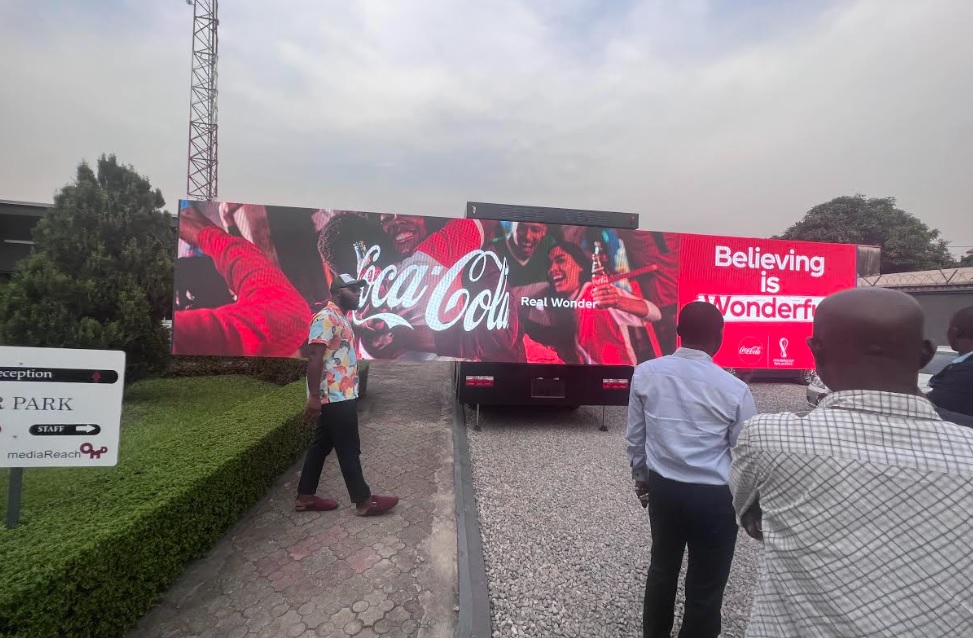
This campaign changed an unavoidable daily ritual into a seamless brand interaction. No pop-up. No pre-roll. No skip button. And this is on an advertising medium that many in the industry quietly wrote off, but which the data now shows has not merely survived the digital revolution. It has thrived because of it, and this is consistent with available findings.
When the findings of the sixth annual Top Trends 2026 report were presented at the Marriott Hotel, Ikeja, in January, the figure that drew the sharpest intake of breath was that the Out-of-Home (OOH) advertising recorded a 41% compound annual growth rate (CAGR) in Nigeria between 2021 and 2025, making it the fastest-growing above-the-line channel in the country across the entire measurement period.
The research, produced by mediaReach OMD in partnership with Lagos Business School, Pan-Atlantic University, GeoPoll, and the National Institute of Marketing of Nigeria (NIMN), drew on MediaTrack AdEx Data covering 2021–2025 (Q1–Q3) and the All Media Products Survey (AMPS) from 2018 to 2024. Together, the datasets revealed that while press declined from 35% to 18% reach between 2018 and 2023, while cable television slipped from 42% to 38%, and while every other traditional channel showed volatility or contraction, OOH remained anchored, holding reach in the 69–78% band across the entire measured period and standing at 74% in 2023.
“While everyone predicted the death of traditional media in the digital age, OOH has not just survived, it’s thriving,” Emmanuel Adediran of mediaReach OMD, who presented the trend, had explained. “The 41% CAGR we’re seeing tells us that brands are voting with their budgets, and they’re choosing OOH.”
The Nigerian trajectory aligns with a global movement. According to data from Grand View Research, the global digital OOH advertising market was valued at USD 20.74 billion in 2024 and is projected to reach USD 39.12 billion by 2030, growing at a CAGR of 10.7%. WARC Media reports that global DOOH spend grew 15% in 2024 alone, with further growth of 14.9% forecast in the following year. These numbers place it among the fastest-growing advertising formats on the planet. In Nigeria specifically, Mordor Intelligence projects that the OOH market will grow from USD 135.23 million in 2024 to over USD 309 million by 2030, with digital OOH formats forecast to expand at 21.4% CAGR across the same period.
A World Running From Ads
Perhaps to understand OOH’s resurgence, you must first reckon with the crisis it is partly solving. The digital advertising ecosystem, for all its reach and targeting precision, has generated a consumer backlash of historic proportions.
According to a 2023 report by HubSpot Research, 91% of consumers now feel that digital ads are more intrusive than they were just two to three years ago. The same study found that 87% of people use ad blockers when browsing online, and 73% actively pay for premium subscriptions on platforms like YouTube and Spotify specifically to eliminate ads. A GlobalWebIndex study placed global ad-blocking software use at 47% of all internet users, a figure that rises to 56% among users aged 16 to 24, precisely the demographic that brands most urgently need to reach. Research from Kantar Millward Brown found that banner blindness affects up to 86% of consumers, who have trained their eyes to skip over digital advertising formats entirely.
Billions of naira and dollars of digital advertising spend are disappearing into a void. Meanwhile, a billboard cannot be blocked. A branded bus handle cannot be scrolled past. A 3D installation at a major intersection cannot be muted.
This is the structural advantage OOH holds, and it is the foundation upon which the medium’s growth is being built. As the mediaReach OMD report notes, “OOH’s stable high performance amid this disruption shows its unique value proposition.”
Innovation Driving The CAGR
The 41% growth rate was not earned by doing what OOH has always done. The Top Trends 2026 findings identify three key innovation categories that have fundamentally changed for the better what the medium is capable of.
The first is data-responsive digital displays, that is, billboards that now incorporate real-time information, including traffic conditions, live sports scores, weather and temperature data, and time-of-day messaging. Also, location-based messaging adapts to specific neighbourhoods and landmarks. According to industry data, nearly 48% of outdoor ads globally now incorporate digital or interactive elements, while approximately 45% of advanced DOOH deployments in major cities switch creative dynamically based on footfall, time of day, and contextual triggers.
The second is the kind of OOH that does not merely occupy space but commands it. Three-dimensional installations, building dominations, and innovative use of unconventional surfaces have become content engines in their own right, generating social media conversation and organic amplification that multiplies the physical footprint of a campaign far beyond its geographic location. Research consistently shows that 80% of consumers are likely to take action after seeing a funny, creative, or visually engaging OOH execution.
The third is sustainability-led OOH, which the mediaReach OMD report highlights as both a commercial and reputational differentiator. This includes recycled banner and flex materials repurposed into useful products, solar-powered digital displays, LED lighting, and material recycling that eliminates approximately 10kg of CO₂ per square metre per year.
“Today, OOH is about impact, memorability, and creating cultural touchpoints, not just visibility,” the mediaReach OMD report states.

Brands That Dared to Think Bigger
The campaigns that best illustrate OOH’s new potential share a common quality. That is, they do not ask for attention; they earn it by inserting a brand into an experience that was already happening.
The Malta Guinness handrail campaign in Lagos is perhaps one of the most locally resonant recent examples of this principle in action. The brand turned every commute for every passenger who gripped a handle on Lagos’s busiest transit network into an extended brand interaction. It did this by wrapping BRT grab handles in the iconic shape and design of the Malta Guinness can. No impression was forced. No viewer was interrupted. The brand simply occupied a moment that was already unavoidable, and made that moment its own.
“This is smart branding,” Michael Oluwagbenga Imoru, Data Analyst and Head of Operations at Plus Marketing, had noted. “When a brand fits naturally into people’s routines, recall becomes effortless. Simple idea, strong execution.” Oluwatimilehin Sunday Oreniyi, a Digital Marketing Associate at Blaksill Limited, captured the strategic dimension precisely: “Marketing isn’t always about going viral; it’s about the intentionality behind the strategy. This approach is pure TOMA…constant, contextual visibility in a space people already engage with.”
Emmanuel Egaga, Group Head of Digital Marketing at Mediacraft Associates, framed it in terms that should resonate with every brand manager, “Guinness Nigeria didn’t just buy visibility; they embedded the brand into a real-life experience where intent can naturally form. That’s how OOH works best. When it supports behaviour, context, and recall, not just impressions. Simple idea, disciplined execution.”
Equally instructive was Sonia Tomatoes’ activation in Lagos with a full-scale, oversized 3D replica of its sachet tomato paste erected as a live street installation. The sheer scale of turning a household product into a street-level monument generated foot traffic, photography, and organic social sharing that no paid digital campaign could have replicated at equivalent cost.
In South Africa, TransUnion launched what Alliance Media described as Africa’s first peelable billboard in Johannesburg. It is an installation that invited passersby to physically peel away layers of the structure, each revealing a message about removing barriers to credit. Every participant also received access to a financial e-learning course, fusing OOH innovation with genuine social value in a way that earned ‘earned media’ attention far beyond the physical site.
In Kenya, a campaign at the Uhuru Highway roundabout near Nyayo Stadium introduced “Bill the Board”, a billboard given its own personality, displaying location-specific humour and commentary to commuters stuck in traffic.
In the United Kingdom, Prime Video rewrote the rulebook entirely in November 2021 when it deployed a live-action anamorphic 3D illusion at London’s Piccadilly Circus to promote its fantasy series, The Wheel of Time’’. Developed by creative agency Amplify, the installation featured lead actress Rosamund Pike appearing to emerge from the screen in a battle between light and dark. It will become the first time an entertainment company has used an anamorphic billboard to promote a series. The campaign ran simultaneously at Times Square in New York and Tokyo’s Cross Shinjuku Vision, each with bespoke animation, and reached millions more through social media than through physical presence alone.
Implications
For any brands and professionals reading the numbers from Top Trends 2026, several strategic implications emerge with clarity. First, OOH is not a supplementary channel. A 41% CAGR, sustained over five years, in the world’s most competitive emerging market, is not the performance of a support medium. It is the performance of a primary one. Brands that continue to treat OOH as a holdover from a pre-digital media plan are allocating budgets against the evidence.
Second, innovation is not optional. The growth is driven not by more of the same but by better of the new, which are smarter data integration, more spectacular creative, and deeper alignment with the physical spaces consumers already inhabit. Static formats have their place, but the brands extracting disproportionate value from OOH are those investing in its evolved capabilities.
Third, the sustainability dimension is commercially important. As the Top Trends 2026 report shows, Nigerian consumers are among the world’s most scrutinising purchasers, with 95% factoring ethics and sustainability into their buying decisions. OOH campaigns that embed sustainability, maybe through recycled materials, solar power, or purpose-driven activations, are simultaneously building brand equity and addressing a genuine consumer priority.
Fourth, the social media multiplier makes OOH’s true ROI larger than its physical footprint suggests.
Indeed, OOH has earned its revival through reinvention, which is data-driven, experience-led, sustainability-conscious, and powerfully immune to the defensive behaviours that have rendered much of digital advertising ineffective.
“The next era of growth will belong only to those who leverage authentic, local insights to genuinely disrupt legacy systems,” Stephen Onaivi, Managing Director of mediaReach OMD, had said in setting the agenda for the Top Trends 2026 event. The renaissance is already here. It is on every corner, every bus handle, and every installation that makes a city pause. The only question left is which brands will be bold enough to own it.
