


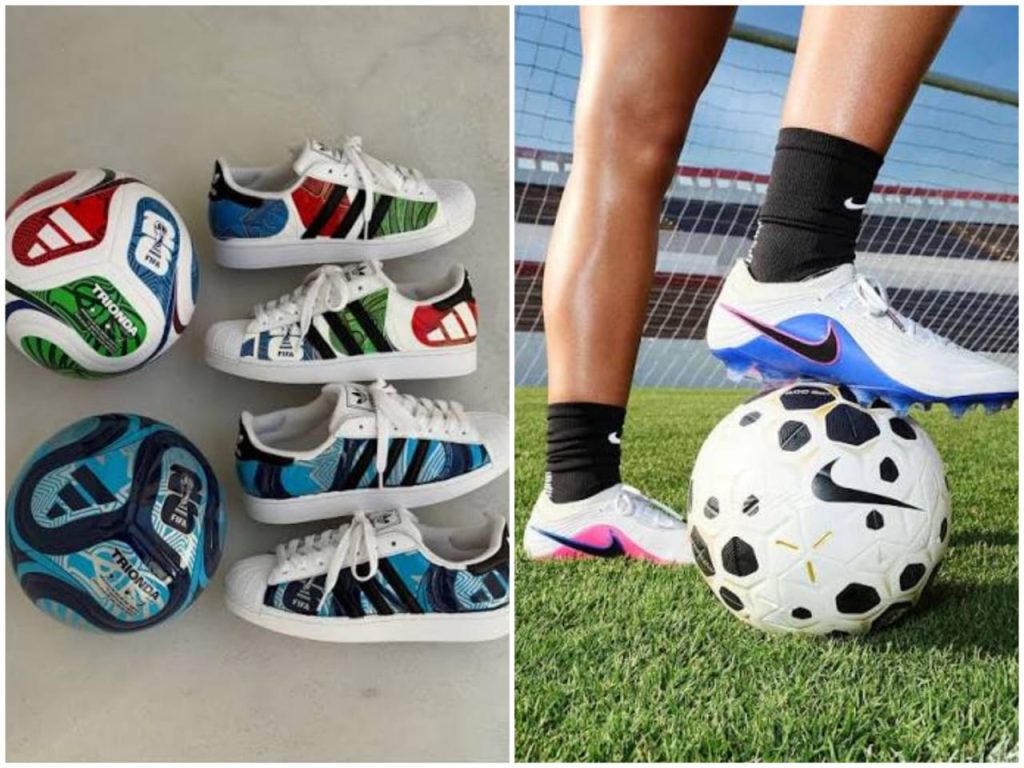
As the FIFA World Cup heads towards its conclusion, another contest is unfolding beyond the regular 90 minutes of play. While players compete for football’s biggest prize, global sportswear giants Adidas and Nike are locked in a fierce battle for consumer attention, brand relevance and commercial advantage.
The rivalry, which has long defined sport marketing, has taken on fresh significance at the 2026 FIFA World Cup, with both companies investing heavily in sponsorships, athlete endorsements, advertising campaigns and fan engagement to strengthen their positions in the world’s biggest sporting event.

Adidas enters the final with a significant competitive advantage on the field. Both finalists, Spain and Argentina, wear Adidas kits, while two of football’s biggest stars, Lionel Messi and Lamine Yamal, are among the company’s flagship athletes.
Beyond team sponsorships, Adidas is also FIFA’s official partner, supplying the tournament’s official match ball, referees’ uniforms and equipment, extending its long-standing association with the competition until at least 2030.

The company also introduced a specially designed match ball for the World Cup final, marking the first time it has created a separate final match ball rather than simply recolouring the tournament ball used during the earlier stages.
Its “Backyard Legends” campaign, developed by creative agency LOLA USA, focuses on football culture, street football and nostalgia, featuring stars including Messi, Yamal, Jude Bellingham, Zinedine Zidane and an AI-generated David Beckham.
Speaking on the campaign, Florian Alt, Vice President of Marketing Communications, Brand and Performance at Adidas, said the company sought to connect with football fans through authentic experiences.
“Our campaign, Backyard Legends, featured a scene familiar to anyone who has played football – a local pitch, an unbeatable crew and some stories that become legends.
“And with that campaign we meet consumers where they are – whether they are watching on TV, following their favourite athletes on social media, or engaging with the culture created by the sport,” he said.
Nike, however, has taken a different route.
Without FIFA sponsorship rights, the company has focused on storytelling and digital engagement through its six-minute campaign titled Rip the Script, created by Wieden+Kennedy.
The film features football stars including Kylian Mbappé, Erling Haaland and Cristiano Ronaldo alongside celebrities from entertainment and sport, creating a fictional football universe designed for online audiences.
The strategy has delivered strong digital results. According to BBC Sport and DesignRush, the campaign has attracted more than 76 million YouTube views, significantly outperforming Adidas’ campaign, which has recorded just over seven million views.
Camilo Andrade, Vice President and General Manager of Nike Global Football, said the objective extended beyond producing a traditional advertisement.
“What has changed is the speed and shape of culture. In the digital age, stories travel faster, fragment faster, and get reinterpreted faster.
“With Rip the Script, we’ve built something broader: a football universe that lives both digitally and in real life.
“Success was never going to be measured only by how many people watched a film, but rather how we open the world up to give fans, players and creators something they could interpret, remix and take further themselves,” Andrade said.
Industry analysts say the contrasting strategies reflect two different approaches to sports marketing.
While Adidas has leveraged ownership of official tournament assets and sponsorship rights to maximise visibility throughout the competition, Nike has focused on creating cultural moments capable of generating conversations across digital platforms.
James Kirkham, a sports brand strategist quoted by BBC Sport, said football has become deeply intertwined with popular culture.
“Football is the ultimate common denominator. It sits right there with music. It’s the ultimate connective tissue,” he said.
He added that modern campaigns are increasingly designed around short-form digital content rather than traditional television advertising.
Commercially, Adidas appears to be benefiting from its official tournament presence.
According to DesignRush, Adidas recorded a 70 per cent year-on-year increase in apparel spending during May as demand for World Cup jerseys surged, while visits to its United States stores increased by 47 per cent during the opening week of the tournament.
The World Cup has also reignited competition in the player endorsement market.

The race for the tournament’s Golden Boot has become an extension of the rivalry between sportswear manufacturers, with Lionel Messi representing Adidas, Kylian Mbappé and Erling Haaland backed by Nike, and Harry Kane competing in Skechers boots.
According to Forbes, individual player performances during the tournament are expected to influence future endorsement negotiations, particularly for Mbappé, whose Nike contract reportedly expires shortly after the World Cup.
The publication notes that a Golden Boot victory can significantly increase an athlete’s commercial value, boosting endorsement earnings while strengthening the visibility of the sponsoring brand.
The expansion of the tournament from 32 to 48 teams has also contributed to higher scoring figures, creating greater opportunities for individual players to enhance their marketability.
As football increasingly becomes both a sporting and commercial spectacle, experts argue that success at tournaments is no longer measured solely by trophies but also by brand visibility, merchandise sales, digital engagement and long-term consumer loyalty.
With Adidas dominating official tournament assets and Nike commanding online conversations, the 2026 FIFA World Cup has demonstrated that modern sports marketing extends far beyond the ninety minutes on the pitch. While one brand may lift the commercial trophy through stronger sales and official visibility, the other has shown that cultural relevance and digital storytelling remain powerful tools for winning audiences in an increasingly connected world.
